. 2023 Jul 20;13(1):11701.
doi: 10.1038/s41598-023-38404-2.

The effect of load on spatial statistical learning

Affiliations

The effect of load on spatial statistical learning

Nadav Amsalem et al. Sci Rep. .

Abstract

Statistical learning (SL), the extraction of regularities embedded in the environment, is often viewed as a fundamental and effortless process. However, whether spatial SL requires resources, or it can operate in parallel to other demands, is still not clear. To examine this issue, we tested spatial SL using the standard lab experiment under concurrent demands: high- and low-cognitive load (Experiment 1) and, spatial memory load (Experiment 2) during the familiarization phase. We found that any type of high-load demands during the familiarization abolished learning. Experiment 3 compared SL under spatial low-load and no-load. We found robust learning in the no-load condition that was dramatically reduced in the low-load condition. Finally, we compared a no-load condition with a very low-load, infrequent dot-probe condition that posed minimal demands while still requiring attention to the display (Experiment 4). The results showed, once again, that any concurrent task during the familiarization phase largely impaired spatial SL. Taken together, we conclude that spatial SL requires resources, a finding that challenges the view that the extraction of spatial regularities is automatic and implicit and suggests that this fundamental learning process is not as effortless as was typically assumed. We further discuss the practical and methodological implications of these findings.


Conflict of interest statement

The authors declare no competing interests.

Figures
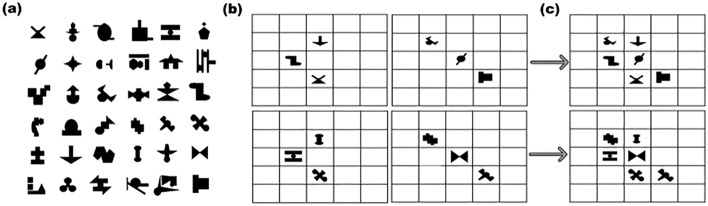
Figure 1
Figure 1
Illustration of Stimuli: (a) The spatial SL shapes used in all experiments (b) Illustration of base triplets (c) Illustration of the spatial SL display used in all experiments.
Figure 2
Figure 2
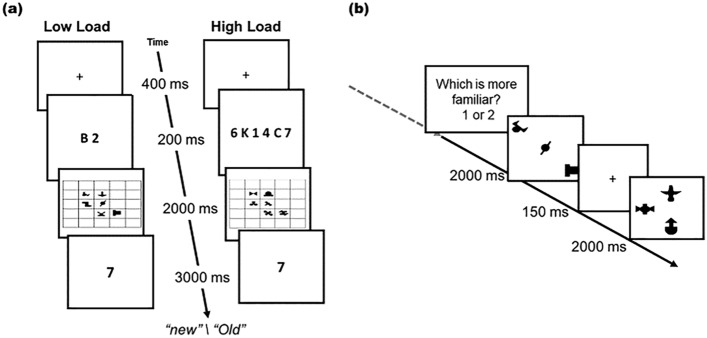
Schematic Illustration of Experiment 1: (a) Illustration of Experiment 1’s trial sequences during the learning phase in the low (left sequence)—and high-load (right sequence) conditions. (b) Schematic illustration of the spatial SL familiarity task. Note: the triplets appeared on a 5 by 5 grid.
Figure 3
Figure 3
Schematic Illustration of Experiment 2. Illustration of Experiment 2’s trial sequences during the learning phase in the low (left sequence) and, in the high-load conditions (right sequence).
Figure 4
Figure 4
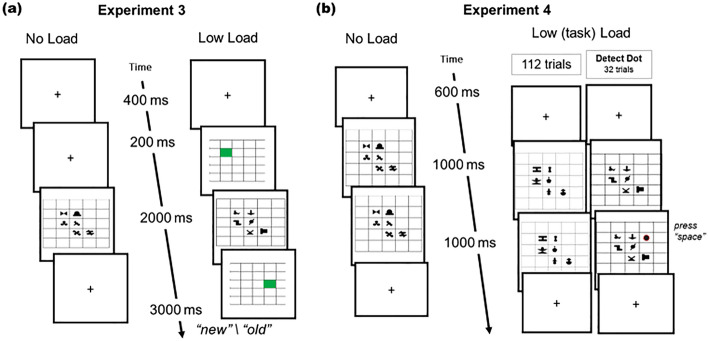
Schematic Illustration of Experiments 3 and 4 (a) Schematic illustration of Experiment 3 design: low-load trials (right) and no-load trials (left) (b) Schematic illustration of Experiment 4 design: task load trials with infrequent dot trials interleaved (“Detect dot”, right), and the no-load trials (left). Note: The dot color was black circled here in red for visualization.
Figure 5
Figure 5
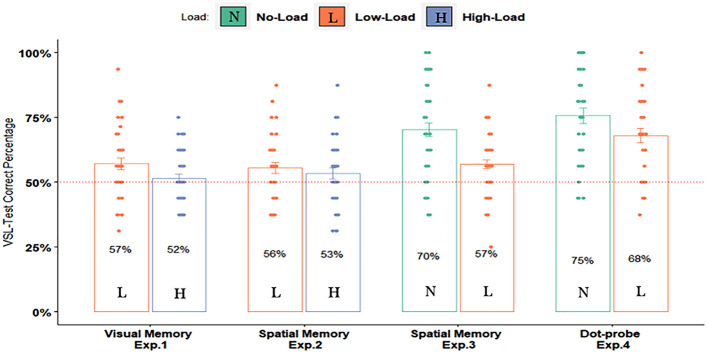
Summary of the results from Experiments 1–4. Percentage of correct responses in the spatial SL task as a function of the load condition and type of task. Error bars represent ± 1 standard error of the mean. The horizontal dotted line represents the chance level performance of 50% correct responses. Mean accuracy (Percent correct) is indicated in each bar. The colored dots represent individual scores. Note: L = Low-load condition, H = High-load condition, N = No-load condition.

References

    1. Frost R, Armstrong BC, Siegelman N, Christiansen MH. Domain generality vs. modality specificity: The paradox of statistical learning. Trends Cogn. Sci. 2015;19:117–125. doi: 10.1016/j.tics.2014.12.010. - DOI - PMC - PubMed
    1. Frost R, Armstrong BC, Christiansen MH. Statistical learning research: A critical review and possible new directions. Psychol. Bull. 2019;145:1128–1153. doi: 10.1037/bul0000210. - DOI - PubMed
    1. Uleman JS, Bargh JA. Unintended Thought. Guilford Press; 1989.
    1. Greene NR, Naveh-Benjamin M. The effects of divided attention at encoding on specific and gist-based associative episodic memory. Mem. Cogn. 2022;50:59–76. doi: 10.3758/s13421-021-01196-9. - DOI - PMC - PubMed
    1. Kane MJ, Engle RW. Working-memory capacity, proactive interference, and divided attention: Limits on long-term memory retrieval. J. Exp. Psychol. Learn. Mem. Cogn. 2000;26:336–358. doi: 10.1037/0278-7393.26.2.336. - DOI - PubMed