Review
. 2023 Jul 20;13(1):11735.
doi: 10.1038/s41598-023-36778-x.

A new Gondwanan mayfly family from the Lower Cretaceous Crato Formation, Brazil (Ephemeroptera: Siphlonuroidea: Astraeopteridae fam. nov.)

Affiliations
Review

A new Gondwanan mayfly family from the Lower Cretaceous Crato Formation, Brazil (Ephemeroptera: Siphlonuroidea: Astraeopteridae fam. nov.)

Arianny P Storari et al. Sci Rep. .

Erratum in

Abstract

The adult holotype of the fossil mayfly Astraeoptera cretacica Brandão et al. 2021 from the Cretaceous Crato Formation, Brazil, is reviewed and attributed to a new family Astraeopteridae fam. nov. Based on alate specimens, we also describe further new representatives of Astraeopteridae fam. nov., namely Astraeoptera vitrea sp. nov. and Astraeoptera oligovenata sp. nov., as well as the new genus and species Eosophobia acuta gen. et sp. nov. A subsequent character analysis of the new material suggests systematic affinities of Astraeopteridae fam. nov. with those extant families of Siphlonuroidea distributed in the Southern Hemisphere. These newly described fossil Siphlonuroidea from the Cretaceous of Brazil thus add to the biogeography and systematics of mayflies.


Conflict of interest statement

The authors declare no competing interests.

Figures
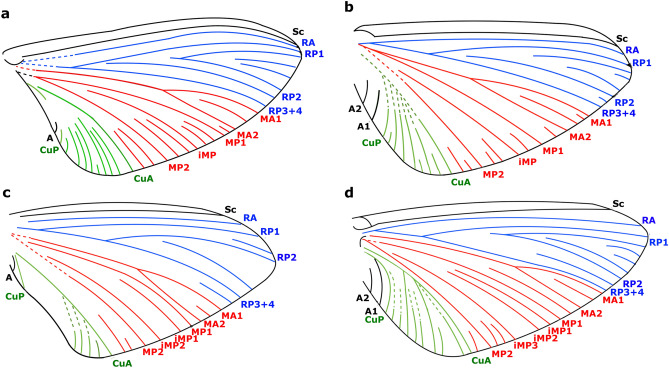
Figure 1
Figure 1
Forewing schemes with longitudinal veins of different Astraeopteridae fam. nov., cross veins are omitted. (a) Astraeoptera cretacica Brandão et al. 2021, LPRP/USP 0504. (b) Astraeoptera vitrea sp. nov., MPSC I 7437. (c) Astraeoptera oligovenata sp. nov., MPSC I 7438. (d) Eosophobia acuta gen. et sp. nov., MPSC I 7439.
Figure 2
Figure 2
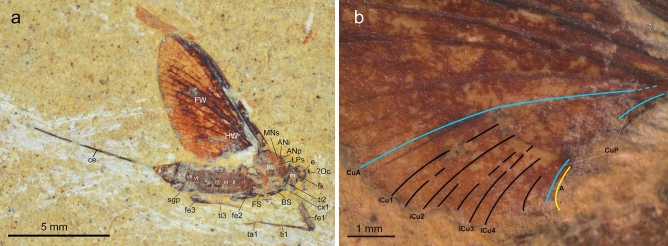
Astraeoptera cretacica Brandão et al. 2021, holotype, LPRP/USP 0504. Photographs adapted from Brandão et al. 2021. (a) General lateral view with reinterpretation of general body structures. Abbreviations: Head: e eye, fk facial keel, Oc frontal ocellus; Thorax: ANi anteronotal transverse impression, ANp anteronotal protuberance, BS basisternum, FS furcastemum, FW forewing, HW hind wing, LPs lateroparapsidal suture, MNs mesonotal suture, MS medioscutum, PT prothorax; Legs: cx1 forecoxa, fe1 forefemur, fe2 middle femur, fe3 hind femur, ta1 foretarsus; ta3 hindtarsus, ti1 foretibia, ti2 middle tibia, ti3 hind tibia; Abdomen: I X abdominal segments, ce cercus, sgp subgenital plate. Scale bar 5 mm. (b). Interpretation of cubital field of forewing. Scale bar 1 mm.
Figure 3
Figure 3
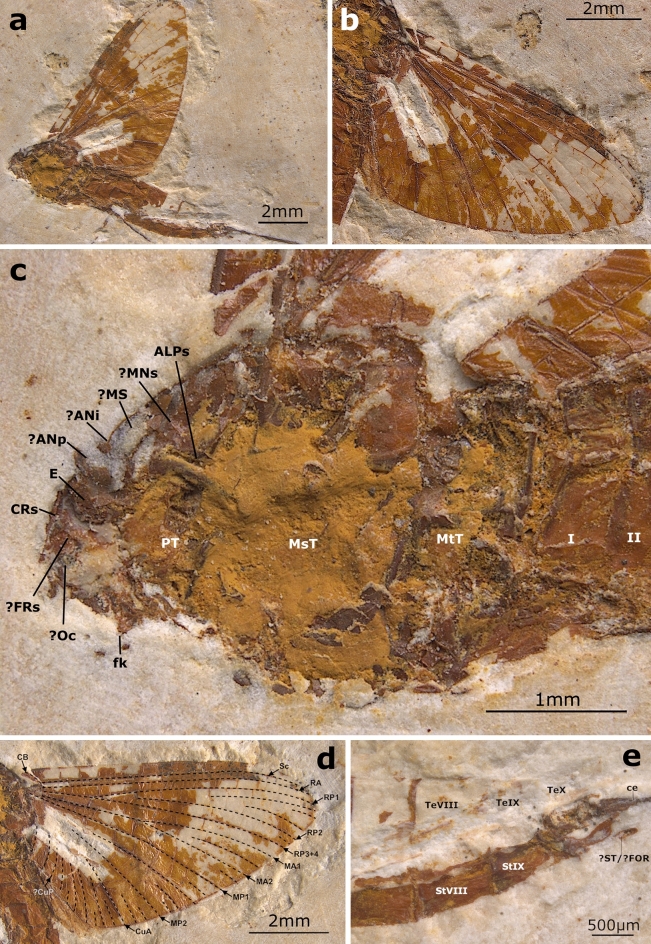
Astraeoptera vitrea sp. nov., holotype, adult male, MPSC I 7437. (a) General lateral view. Scale bar 2 mm. (b) Right forewing in dorsal view. Scale bar 2 mm. (c) Head, thorax and anterior abdomen in lateral view. Head: E eye, CRs coronal suture, fk facial keel; FRs frontal suture, Oc frontal ocellus; Thorax: ANi anteronotal transverse impression, ALPs antelateroparapsidal suture, ANp anteronotal protuberance, MNs mesonotal suture, MS medioscutum, MsT mesothorax, MtT metathorax, PT prothorax; Abdomen: I and II abdominal segments. Scale bar 1 mm. (d) Right forewing with an interpretative overlay of venation, CB costal brace. Scale bar 2 mm. (e) Posterior end of abdomen. StVIII and StIX abdominal sterna, TeVIII–TeX abdominal terga, ce base of cercus, ?ST/?FOR styliger/forceps. Scale bar 500 µm.
Figure 4
Figure 4
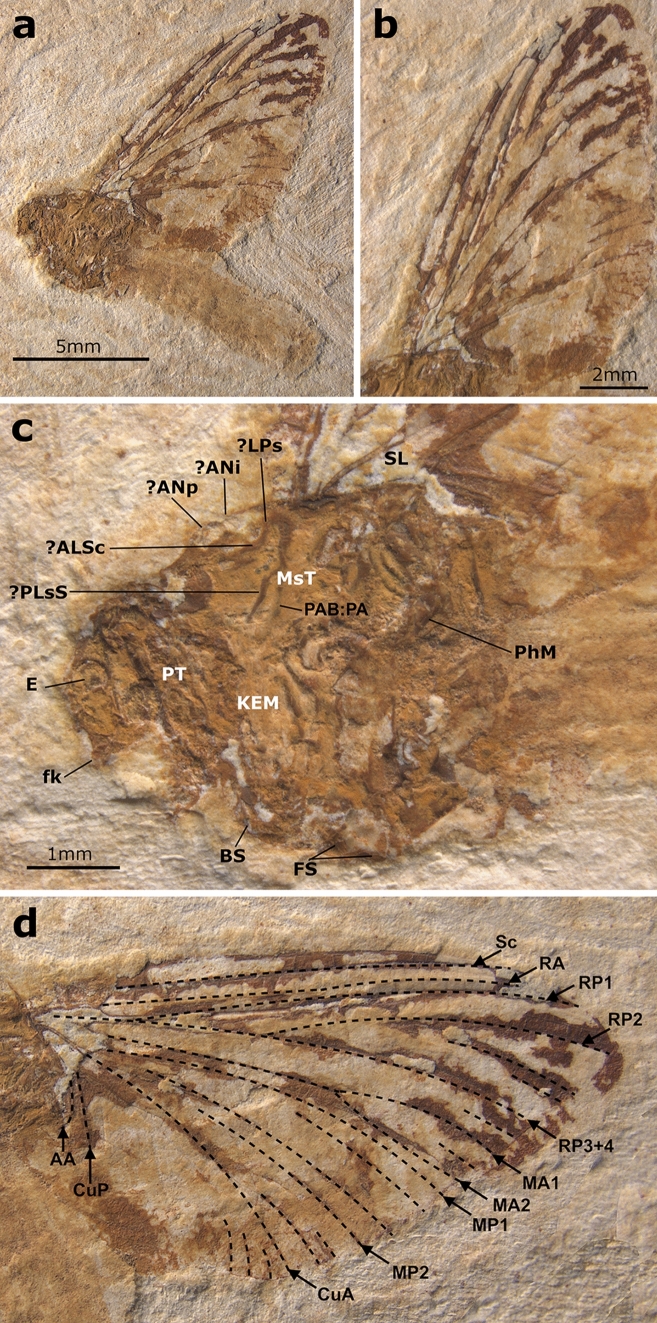
Astraeoptera oligovenata sp. nov., holotype, adult [?] female, MPSC I 7438. (a) General lateral view. Scale bar 5 mm. (b) Right forewing in dorsal view. Scale bar 2 mm. (c) Head and thorax in lateral view. Head: E eye, fk facial keel; Thorax: ?ALSc anterolateral scutal costa, ?ANi anteronotal transverse impression, ?ANp anteronotal protuberance, BS basisternum, FS furcastemum, KEM katepimeron, ?LPs lateroparapsidal suture, MsT mesothorax, PhM middle phragma, ?PLsS superior pleural suture, PAB:PA posterior arc of prealar bridge, PT prothorax, SL scutellum. Scale bar 1 mm. (d) Right forewing with an interpretative overlay of venation. Scale bar 2 mm.
Figure 5
Figure 5
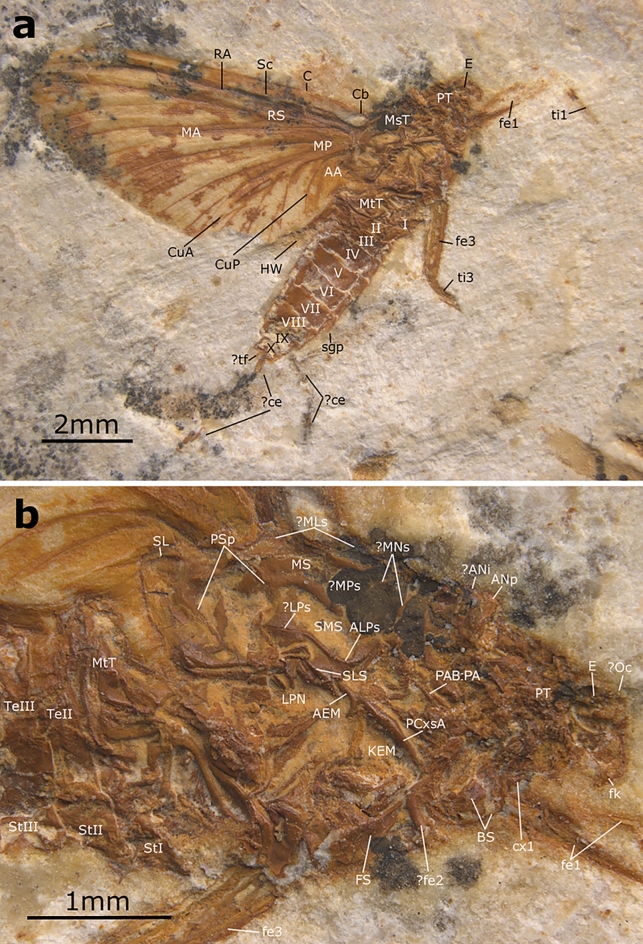
Eosophobia acuta sp. nov., holotype, adult female, MPSC I 7439. (a) General view in lateral attitude with reinterpretation of general body structures. Abbreviations: Head: E eye; Thorax: MsT mesothorax, MtT metathorax, PT prothorax; Legs: fe1 forefemur, fe3 hind femur, ti1 foretibia, ti3 hind tibia; Wings: AA anal anterior, C costa, Cb costal brace, CuA cubitus anterior, CuP cubitus posterior, HW hind wing, MA media anterior, MP media posterior, RA radius anterior, RS radius sector, Sc subcosta; Abdomen: I–X abdominal sterna segments, ce cercus, sgp subgenital plate, tf terminal filament. Scale bar 2 mm. (b) Head and thorax in lateral view. Head: E eye; fk facial keel, Oc frontal ocellus; Thorax: AEM anepimeron, ALPs antelateroparapsidal suture, ANi anteronotal transverse impression, ANp anteronotal protuberance, BS basisternum, FS furcastemum, KEM katepimeron, LPN lateropostnoturn, LPs lateroparapsidal suture, ?MLs median longitudinal suture, MNs mesonotal suture, MPs medioparapsidal suture, MS medioscutum, MtT metathorax, PCxsA anterior paracoxal suture of mesothorax, PAB:PA posterior arc of prealar bridge, PSp posterior scutaI protuberance, PT prothorax, SL scutellum, SLS sublateroscutum, SMS submedioscuturn; Legs: cx1 forecoxa, fe1 forefemur, fe2 middle femur, fe3 hind femur; Abdomen: StI–III abdominal sterna, TeII–III abdominal terga. Scale bar 1 mm.
Figure 6
Figure 6
Eosophobia acuta sp. nov., holotype, adult female, MPSC I 7439. (a) Right forewing in ventral view. Scale bar 2 mm. (b) Right forewing in ventral view with an interpretative layer of venation. Scale bar 2 mm.

References

    1. Martins-Neto RG. Estágio atual da paleoartropodologia Brasileira: Hexápodes, miriápodes, crustáceos (Isopoda, Decapoda, Eucrustacea e Copepoda) e quelicerados. Arq. Mus. Nac. 2005;63(3):471–494.
    1. Heads S, Martill D, Loveridge B. Palaeoentomological paradise: The Cretaceous Crato Formation of Brazil. Bull. Entomol. Soc. 2008;32(2):91–98.
    1. Staniczek AH. Ephemeroptera: Mayflies. In: Martill DM, Bechly G, Loveridge RF, editors. The Crato Fossil Beds of Brazil. Cambridge University Press; 2007. pp. 163–184.
    1. Storari AP, Godunko RJ, Salles FF, Saraiva AAF, Staniczek AH, Rodrigues T. An overview of the Hexagenitidae (Ephemeroptera) from the Crato Formation (Aptian, Lower Cretaceous) of Brazil, with the description of a new species. Hist. Biol. 2022;34(5):875–884. doi: 10.1080/08912963.2021.1952196. - DOI
    1. Storari AP, Rodrigues T, Bantim RAM, Lima FJ, Saraiva AAF. Mass mortality events of autochthonous faunas in a Lower Cretaceous Gondwanan Lagerstätte. Sci. Rep. 2021;11:6976. doi: 10.1038/s41598-021-85953-5. - DOI - PMC - PubMed

Publication types