


Insight into contact force local impedance technology for predicting effective pulmonary vein isolation
- PMID: 37476572
- PMCID: PMC10354239
- DOI: 10.3389/fcvm.2023.1169037
Insight into contact force local impedance technology for predicting effective pulmonary vein isolation
Abstract
Background: Highly localized impedance (LI) measurements during atrial fibrillation (AF) ablation have the potential to act as a reliable predictor of the durability of the lesions created.
Objective: We aimed to collect data on the procedural parameters affecting LI-guided ablation in a large multicenter registry.
Methods: A total of 212 consecutive patients enrolled in the CHARISMA registry and undergoing their first pulmonary vein (PV) isolation for paroxysmal and persistent AF were included.
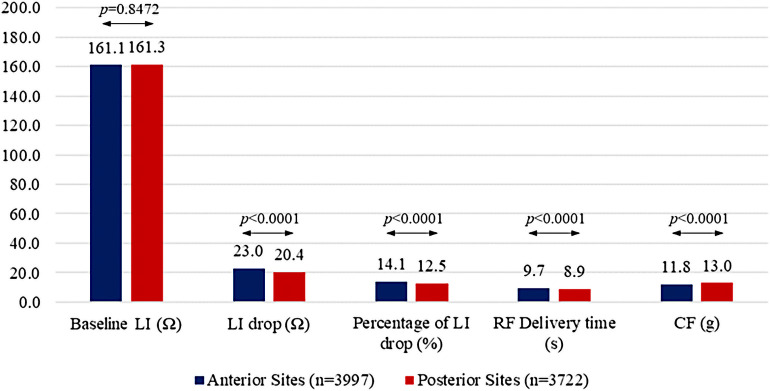
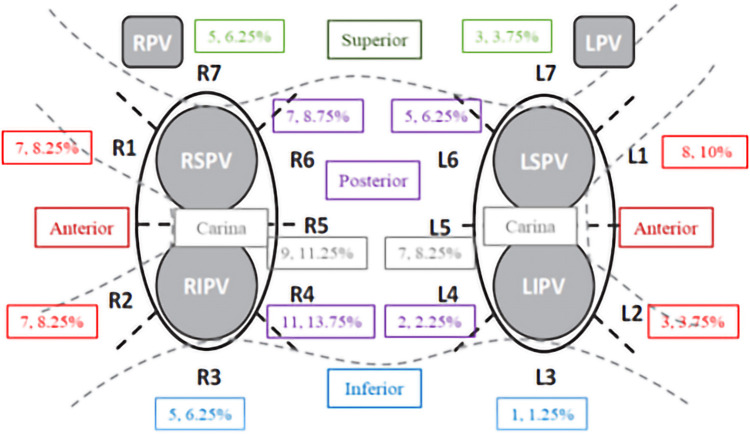
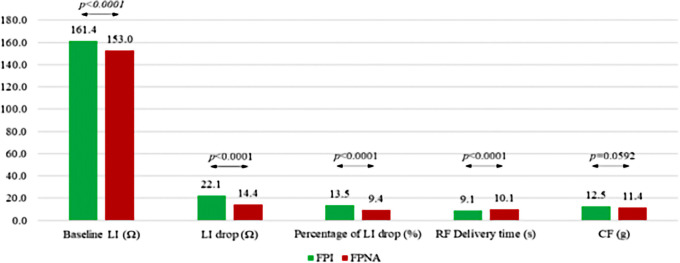
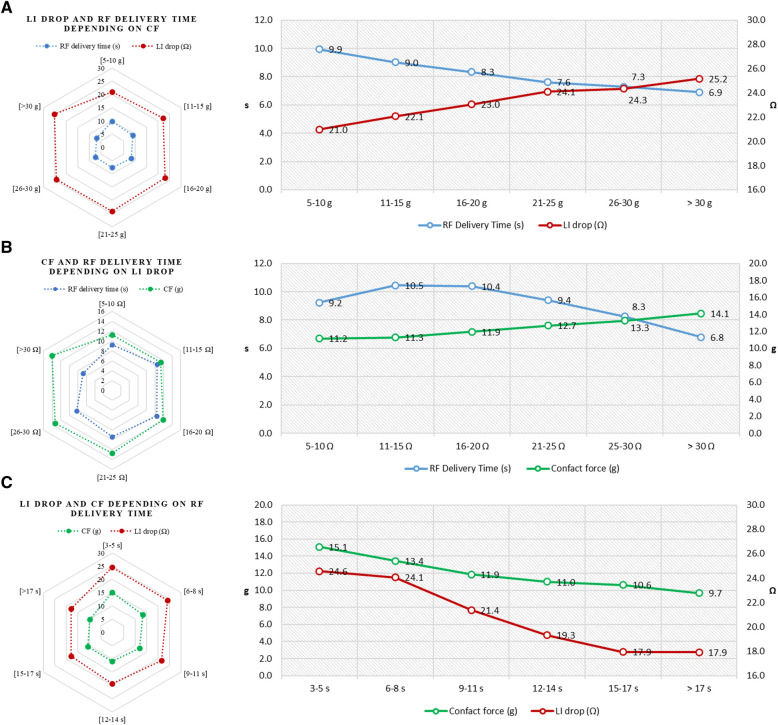
Results: In all, 13,891 radiofrequency (RF) applications of ≥3 s duration were assessed. The first-pass PV isolation rate was 93.3%. A total of 80 PV gaps were detected. At successful ablation spots, baseline LI and absolute LI drop were larger than at PV gap spots (161.4 ± 19 Ω vs. 153.0 ± 13 Ω, p < 0.0001 for baseline LI; 22.1 ± 9 Ω vs. 14.4 ± 5 Ω, p < 0.0001 for LI drop). On the basis of Receiver operating characteristic curve analysis, the ideal LI drop, which predicted successful ablation, was >21 Ω at anterior sites and >18 Ω at posterior sites. There was a non-linear association between the magnitude of LI drop and contact-force (CF) (r = 0.14, 95% CI: 0.13-0.16, p < 0.0001) whereas both CF and LI drop were inversely related with delivery time (DT) (-0.22, -0.23 to -0.20, p < 0.0001 for CF; -0.27, -0.29 to -0.26, p < 0.0001 for LI drop).
Conclusion: An LI drop >21 Ω at anterior sites and >18 Ω at posterior sites predicts successful ablation. A higher CF was associated with an increased likelihood of ideal LI drop. The combination of good CF and adequate LI drop allows a significant reduction in RF DT.
Clinical trial registration: http://clinicaltrials.gov/, identifier: NCT03793998.
Keywords: atrial fibrillation; catheter ablation; contact force; lesion formation; local impedance; pulmonary vein isolation.
© 2023 Lepillier, Maggio, De Sanctis, Malacrida, Stabile, Zakine, Champ-Rigot, Anselmino, Segreti, Dell'Era, Garnier, Mascia, Pandozi, Dello Russo, Scaglione, Cosaro, Ferraro, Paziaud, Maglia and Solimene.
Conflict of interest statement
MM and GC are employees of Boston Scientific. MA is a consultant for Boston Scientific and Biosense Webster and a clinical proctor for Medtronic, and has received educational fees from Abbott. The remaining authors declare that the research was conducted in the absence of any commercial or financial relationships that could be construed as a potential conflict of interest. The handling editor TS declared a past co-authorship with the author FS.
Figures
References
-
- Shi LB, Wang YC, Chu SY, De Bortoli A, Schuster P, Solheim E, et al. The impacts of contact force, power and application time on ablation effect indicated by serial measurements of impedance drop in both conventional and high-power short-duration ablation settings of atrial fibrillation. J Interv Card Electrophysiol. (2022) 64:333–9. 10.1007/s10840-021-00990-4 - DOI - PMC - PubMed
Associated data
LinkOut - more resources
Full Text Sources
Medical
Miscellaneous
