


Vascular variants in seed plants-a developmental perspective
- PMID: 37476579
- PMCID: PMC10355320
- DOI: 10.1093/aobpla/plad036
Vascular variants in seed plants-a developmental perspective
Erratum in
-
Correction to: Vascular variants in seed plants-a developmental perspective.AoB Plants. 2023 Aug 5;15(4):plad050. doi: 10.1093/aobpla/plad050. eCollection 2023 Jul. AoB Plants. 2023. PMID: 37545745 Free PMC article.
Abstract
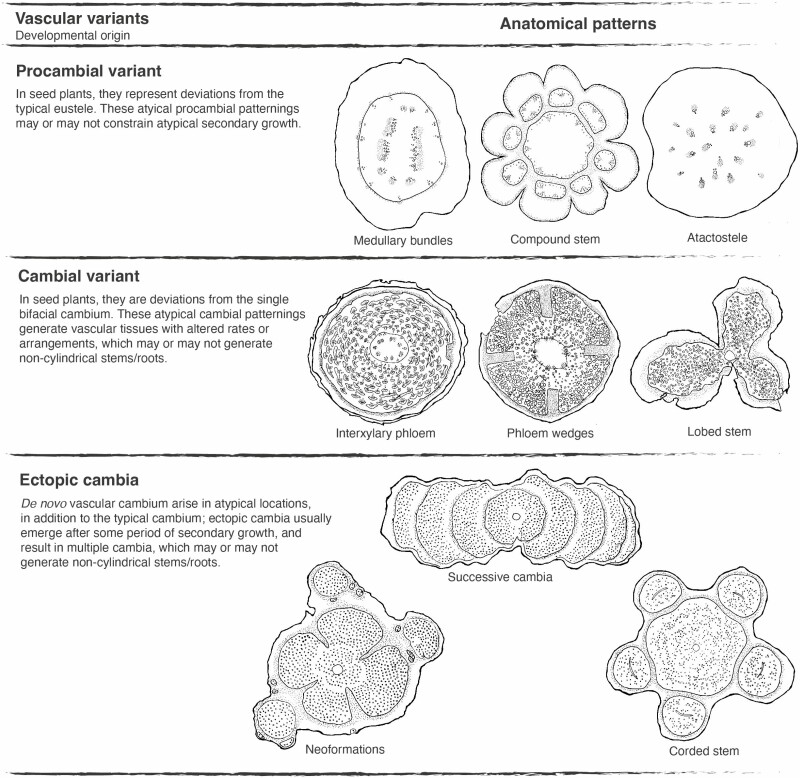
Over centuries of plant morphological research, biologists have enthusiastically explored how distinct vascular arrangements have diversified. These investigations have focused on the evolution of steles and secondary growth and examined the diversity of vascular tissues (xylem and phloem), including atypical developmental pathways generated through modifications to the typical development of ancestral ontogenies. A shared vernacular has evolved for communicating on the diversity of alternative ontogenies in seed plants. Botanists have traditionally used the term 'anomalous secondary growth' which was later renamed to 'cambial variants' by late Dr. Sherwin Carlquist (1988). However, the term 'cambial variants' can be vague in meaning since it is applied for developmental pathways that do not necessarily originate from cambial activity. Here, we review the 'cambial variants' concept and propose the term 'vascular variants' as a more inclusive overarching framework to interpret alternative vascular ontogenies in plants. In this framework, vascular variants are defined by their developmental origin (instead of anatomical patterns), allowing the classification of alternative vascular ontogenies into three categories: (i) procambial variants, (ii) cambial variants and (iii) ectopic cambia. Each category includes several anatomical patterns. Vascular variants, which represent broader developmental based groups, can be applied to both extant and fossil plants, and thereby offer a more adequate term from an evolutionary perspective. An overview of the developmental diversity and phylogenetic distribution of vascular variants across selected seed plants is provided. Finally, this viewpoint discusses the evolutionary implications of vascular variants.
Keywords: cambium; development; ectopic cambia; evolution; meristems; plant anatomy; procambium; vascular tissue.
© The Author(s) 2023. Published by Oxford University Press on behalf of the Annals of Botany Company.
Conflict of interest statement
The author declare no conflicts of interest.
Figures



References
-
- Acevedo-Rodríguez P. 1993. Systematics of Serjania (Sapindaceae) part I: a revision of Serjania sect. Platycoccus. Memoirs of the New York Botanical Garden .:2–91.
-
- Acevedo-Rodríguez P. 2015. (onwards). Lianas and climbing plants of the Neotropics. https://naturalhistory.si.edu/research/botany/research/lianas-and-climbi....
-
- Angyalossy V, Angeles G, Pace MR, Lima AC, Dias-Leme CL, Lohmann LG, Madero-Vega C. 2012. An overview of the anatomy, development and evolution of the vascular system of lianas. Plant Ecology and Diversity .:167–182.
-
- Angyalossy V, Angeles G, Pace M, Lima AC. 2015. Liana anatomy: a broad perspective on structural evolution of the vascular system. In: Schnitzer SA, Bongers F, Burnham RJ, eds. Ecology of lianas. Chinchester: JohnWiley & Sons, 253–287.
-
- Araújo GUC, Costa CG. 2006. Cambial variant in the stem of Serjania corrugata (Sapindaceae). IAWA Journal 2.:269–280.
Publication types
LinkOut - more resources
Full Text Sources
