


Ceramides as Risk Markers for Future Cardiovascular Events and All-Cause Mortality in Long-standing Type 1 Diabetes
- PMID: 37478203
- PMCID: PMC10545556
- DOI: 10.2337/db23-0052
Ceramides as Risk Markers for Future Cardiovascular Events and All-Cause Mortality in Long-standing Type 1 Diabetes
Abstract
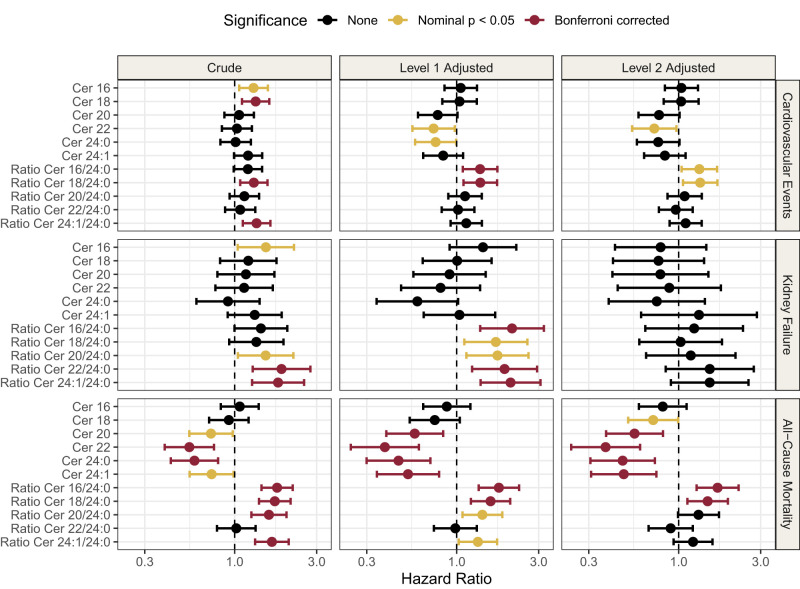
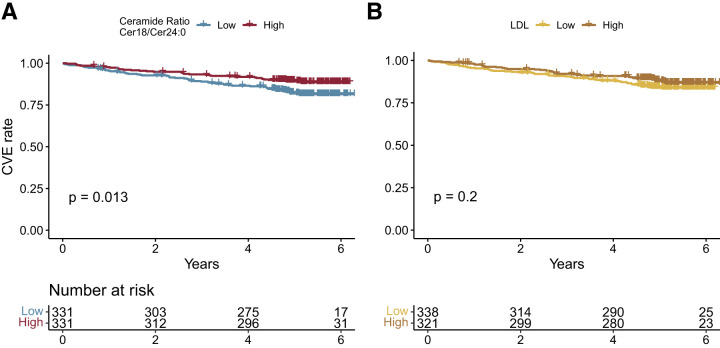
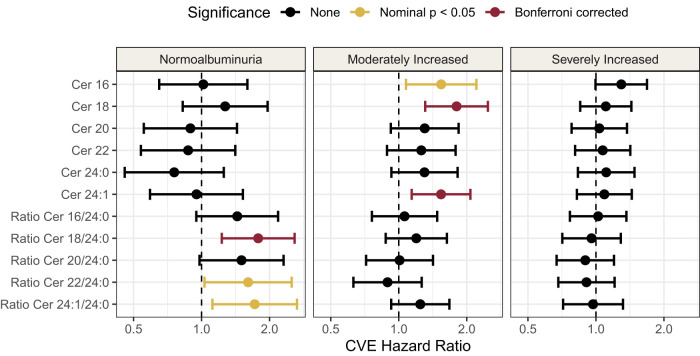
Ceramides are lipid molecules involved in inflammation-related signaling. Recent studies have shown that higher amounts of specific circulating ceramides and their ratios are associated with future development of cardiovascular (CV) disease (CVD). We examined the associations between serum ceramide levels with CVD, kidney failure, and all-cause mortality in individuals with long-standing type 1 diabetes (T1D). We included 662 participants with T1D and 6-year follow-up, with a mean age of 55 years and mean diabetes duration of 33 years. Baseline serum samples were analyzed using liquid chromatography-mass spectrometry. Six predefined ceramide levels were measured, and predefined ratios were calculated. Adjusted Cox regression analyses on ceramide levels in relation to future CV events (CVE), kidney failure, and all-cause mortality were performed, with and without adjustment for age, sex, BMI, LDL, triglycerides, systolic blood pressure, HbA1c, history of CVD, smoking status, statin use, estimated glomerular filtration rate (eGFR), and urinary albumin excretion rate (UAER). The ceramide ratio cer(d18:1/18:0)/cer(d18:1/24:0) was significantly associated with risk of CVE (hazard ratio [HR] = 1.33, P = 0.01) and all-cause mortality (HR = 1.48, P = 0.01) before and after adjustments. All five investigated ceramide ratios were associated with kidney failure, before adjusting for the kidney markers eGFR and UAER. In this study, we demonstrate specific ceramides and ratios associated with 6-year cardiovascular risk and all-cause mortality in a T1D cohort. This highlights the strength of ceramide association with vascular complications and presents a new potential tool for early risk assessment if validated in other cohorts.
Article highlights: Improved tools for assessing risk for diabetes complication before onset will help in complication prevention. We investigated a set of six predefined ceramides and their ratios versus 6-year outcomes of cardiovascular events, kidney failure, and all-cause mortality in people with long-standing type 1 diabetes, using Cox regression with and without adjustment for potential confounders. We found that several ceramides and ceramide ratios associated with cardiovascular events and all-cause mortality. The ratio of cer(d18:1/18:0)/cer(d18:1/24:0) was an especially robust marker. These finding show that ceramides can be biomarkers of cardiovascular disease and all-cause mortality in individuals with long-standing type 1 diabetes.
© 2023 by the American Diabetes Association.
Conflict of interest statement
Figures
References
-
- Patterson CC, Karuranga S, Salpea P, et al. . Worldwide estimates of incidence, prevalence and mortality of type 1 diabetes in children and adolescents: Results from the International Diabetes Federation Diabetes Atlas, 9th edition. Diabetes Res Clin Pract 2019;157:107842. - PubMed
-
- Jørgensen ME, Almdal TP, Carstensen B. Time trends in mortality rates in type 1 diabetes from 2002 to 2011. Diabetologia 2013;56:2401–2404 - PubMed
-
- Bjerg L, Hulman A, Carstensen B, Charles M, Witte DR, Jørgensen ME. Effect of duration and burden of microvascular complications on mortality rate in type 1 diabetes: an observational clinical cohort study. Diabetologia 2019;62:633–643 - PubMed
-
- de Boer IH, Gao X, Cleary PA, et al. .; Diabetes Control and Complications Trial/Epidemiology of Diabetes Interventions and Complications (DCCT/EDIC) Research Group . Albuminuria changes and cardiovascular and renal outcomes in type 1 diabetes: the DCCT/EDIC study. Clin J Am Soc Nephrol 2016;11:1969–1977 - PMC - PubMed
Publication types
MeSH terms
Substances
LinkOut - more resources
Full Text Sources
Medical
Research Materials
Miscellaneous
