. 2023 Sep;22(9):100622.
doi: 10.1016/j.mcpro.2023.100622. Epub 2023 Jul 20.

Glycoproteomics of a Single Protein: Revealing Tens of Thousands of Myozyme Glycoforms by Hybrid HPLC-MS Approaches

Affiliations

Glycoproteomics of a Single Protein: Revealing Tens of Thousands of Myozyme Glycoforms by Hybrid HPLC-MS Approaches

Fiammetta Di Marco et al. Mol Cell Proteomics. 2023 Sep.

Abstract

Characterization of highly glycosylated biopharma-ceuticals by mass spectrometry is challenging because of the huge chemical space of coexistent glycoforms present. Here, we report the use of an array of HPLC-mass spectrometry-based approaches at different structural levels of released glycan, glycopeptide, and hitherto unexplored intact glycoforms to scrutinize the biopharmaceutical Myozyme, containing the highly complex lysosomal enzyme recombinant acid α-glucosidase. The intrinsic heterogeneity of recombinant acid α-glucosidase glycoforms was unraveled using a novel strong anion exchange HPLC-mass spectrometry approach involving a pH-gradient of volatile buffers to facilitate chromatographic separation of glycoforms based on their degree of sialylation, followed by the acquisition of native mass spectra in an Orbitrap mass spectrometer. Upon considering the structures of 60 different glycans attached to seven glycosylation sites in the intact protein, the large set of interdependent data acquired at different structural levels was integrated using a set of bioinformatic tools and allowed the annotation of intact glycoforms unraveling more than 1,000,000 putative intact glycoforms. Detectable isoforms also included several mannose-6-phosphate variants, which are essential for directing the drug toward its target, the lysosomes. Finally, for the first time, we sought to validate the intact glycoform annotations by integrating experimental data on the enzymatically dissected proteoforms, which reduced the number of glycoforms supported by experimental evidence to 42,104. The latter verification clearly revealed the strengths but also intrinsic limitations of this approach for fully characterizing such highly complex glycoproteins by mass spectrometry.

Keywords: MoFi; Myozyme; SAX-HPLC-MS; annotations; data integration; enzymatic dissection; glycoforms; glycoproteomics; glycosylation; hybrid HPLC-MS; intact protein; mannose-6-phosphate; phosphorylated glycoforms; recombinant human acid alpha-glucosidase.


Conflict of interest statement

Conflict of interest The authors declare the following competing financial interest(s): Novartis AG/Sandoz GmbH as well as Thermo Fisher Scientific provided financial support for the Christian Doppler Laboratory for Innovative Tools for Biosimilar Characterization. The salaries of W. E.-S. and T. W. were fully funded; C. G. H. salary was partly funded by the Christian Doppler Laboratory for Biosimilar Characterization. The authors declare no other competing financial interest.

Figures
None
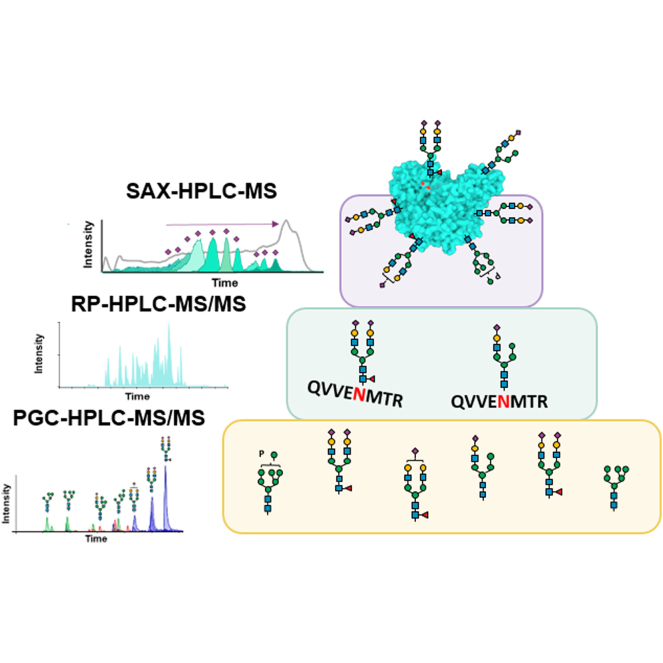
Graphical abstract
Fig. 1
Fig. 1
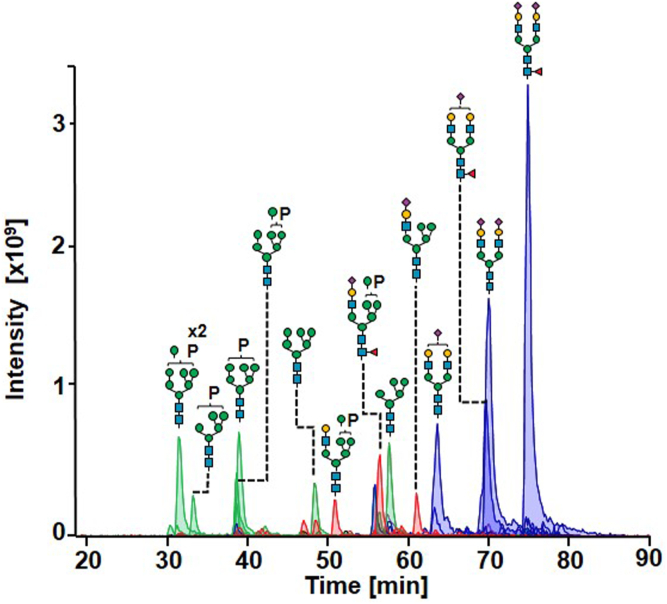
Released N-glycan analysis of r-hGAA by PGC-HPLC-MS/MS. Extracted ion chromatograms (XICs) of the most abundant glycan structures involving different classes are as follows: oligomannose (green), hybrid (red), and complex (blue) type. P indicates the presence of a phosphoryl group on a mannose residue. MS/MS, tandem mass spectrometry; PGC, porous graphitized carbon; r-hGAA, recombinant human acid alpha-glucosidase.
Fig. 2
Fig. 2
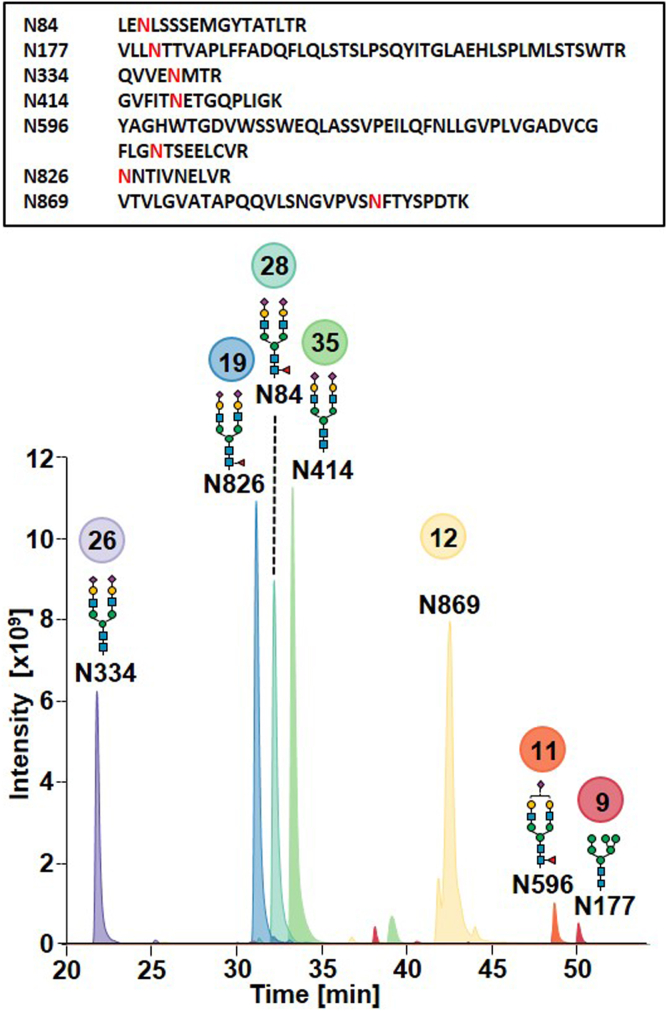
Tryptic glycopeptide analysis by nano-RP-HPLC-MS/MS. Extracted ion chromatograms (XICs) of the most abundant N-glycan structures for each glycosylation site retrieved from Skyline are reported. Site N869 is mainly deglycosylated. The number of glycovariants identified for each site is indicated in colored circles. In the upper box, the peptide sequences with glycosylation sites highlighted in red can be found. MS/MS, tandem mass spectrometry; RP, reversed-phase; XIC, extracted ion chromatogram.
Fig. 3
Fig. 3
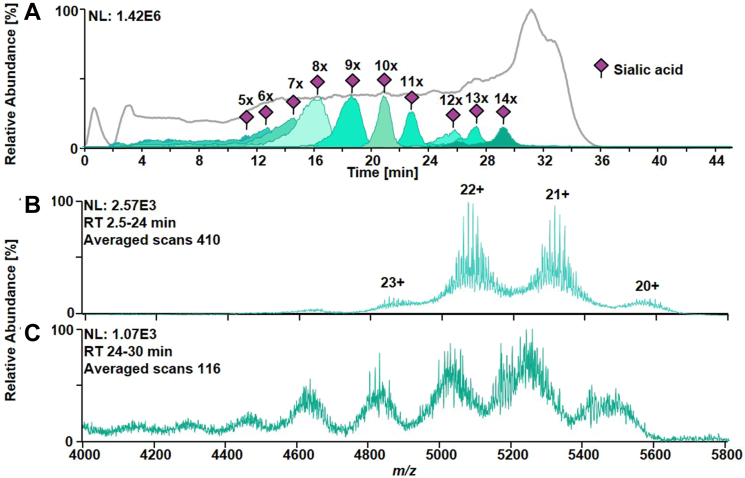
SAX-HPLC-MS analysis of intact glycoforms of Myozyme.A, in gray, the total ion current chromatogram (TICC) obtained upon elution of glycoforms in a range of approximately 30 min is reported. The extracted ion chromatograms (XICs) of different ions of r-hGAA glycoforms carrying an increasing number of sialic acids are represented in green shading. Increased chromatographic retention is correlated with a higher degree of sialylation of glycoforms. B, raw mass spectrum associated to the retention time window from 2.5 to 24 min (410 averaged scans). A charge state distribution from 20 to 23 positive charges indicates the preservation of a quasi-native state of the glycoforms during the chromatographic separation. C, raw mass spectrum associated to the retention time window from 24 to 30 min (116 averaged scans). Despite the acidic conditions of the mobile phases (≈ pH 4–3) in this range of the gradient, only slight denaturation of the protein was observed as indicated by an increased number of charge states. MS, mass spectrometry; r-hGAA, recombinant human acid alpha-glucosidase; SAX, strong anion exchange.
Fig. 4
Fig. 4
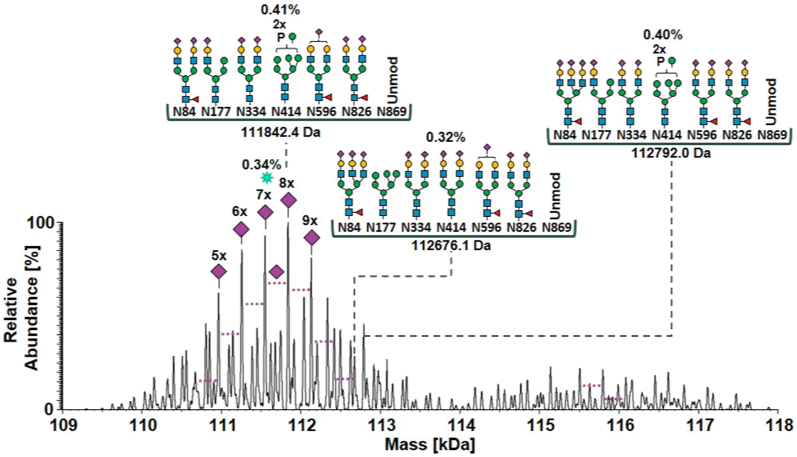
Deconvoluted mass spectrum obtained by SAX-HPLC-MS analysis of intact glycoforms of Myozyme. The four most abundant glycoforms annotated by MoFi are reported (see Supplement csv file, Intact Myozyme annotations filtered 0.01cut-off, for the complete annotation lists). The percentage indicates the fractional abundance carried by the glycoform. The third most abundant glycoform is indicated by green asterisks, and it carries the same structures of the glycoform of the mass 111842.4 Da with one sialic acid less on site N826 (sixth glycan). The second distribution of peaks (from 114 kDa to 118 kDa) is due to glycoforms where the site N869 is mainly glycosylated. MS, mass spectrometry; SAX, strong anion exchange.
Fig. 5
Fig. 5
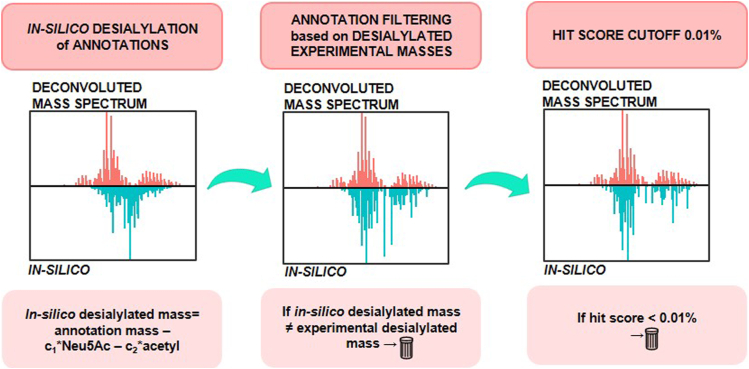
Schematic workflow of in silico filtering of intact glycoform annotations based on experimentally desialylated protein data. The upper panels show the deconvoluted experimental mass spectrum of r-hGAA after the neuraminidase digestion, while the lower panels show the simulated spectrum created upon in silico removal of sialic acids from all the potential MoFi annotations. Annotations were filtered based on a maximum mass error between the calculated and measured desialylated masses of 5 Da and subsequentially based on a hit score >0.01%. Magnified figures of the simulated spectra versus the experimentally desialylated spectrum are reported in supplemental Fig. S15. r-hGAA, recombinant human acid alpha-glucosidase.

References

    1. Wilhelm M., Schlegl J., Hahne H., Gholami A.M., Lieberenz M., Savitski M.M., et al. Mass-spectrometry-based draft of the human proteome. Nature. 2014;509:582–587. - PubMed
    1. Aebersold R., Agar J.N., Amster I.J., Baker M.S., Bertozzi C.R., Boja E.S., et al. How many human proteoforms are there? Nat. Chem. Biol. 2018;14:206. - PMC - PubMed
    1. Čaval T., Tian W., Yang Z., Clausen H., Heck A.J.R. Direct Quality Control of Glycoengineered Erythropoietin Variants. Nat. Commun. 2018;9:3342–3349. - PMC - PubMed
    1. Wohlschlager T., Scheffler K., Forstenlehner I.C., Skala W., Senn S., Damoc E., et al. Native mass spectrometry combined with enzymatic dissection unravels glycoform heterogeneity of biopharmaceuticals. Nat. Commun. 2018;9:1713. - PMC - PubMed
    1. Lebede M., Di Marco F., Esser-Skala W., Hennig R., Wohlschlager T., Huber C.G. Exploring the chemical space of protein glycosylation in noncovalent protein complexes: an expedition along different structural levels of human chorionic gonadotropin by employing mass spectrometry. Anal. Chem. 2021;93:10424–10434. - PMC - PubMed

Publication types

MeSH terms

LinkOut - more resources