. 2023 Jul 21;24(1):172.
doi: 10.1186/s13059-023-03001-z.

Predicting disease severity in metachromatic leukodystrophy using protein activity and a patient phenotype matrix

Affiliations

Predicting disease severity in metachromatic leukodystrophy using protein activity and a patient phenotype matrix

Marena Trinidad et al. Genome Biol. .

Abstract

Background: Metachromatic leukodystrophy (MLD) is a lysosomal storage disorder caused by mutations in the arylsulfatase A gene (ARSA) and categorized into three subtypes according to age of onset. The functional effect of most ARSA mutants remains unknown; better understanding of the genotype-phenotype relationship is required to support newborn screening (NBS) and guide treatment.

Results: We collected a patient data set from the literature that relates disease severity to ARSA genotype in 489 individuals with MLD. Patient-based data were used to develop a phenotype matrix that predicts MLD phenotype given ARSA alleles in a patient's genotype with 76% accuracy. We then employed a high-throughput enzyme activity assay using mass spectrometry to explore the function of ARSA variants from the curated patient data set and the Genome Aggregation Database (gnomAD). We observed evidence that 36% of variants of unknown significance (VUS) in ARSA may be pathogenic. By classifying functional effects for 251 VUS from gnomAD, we reduced the incidence of genotypes of unknown significance (GUS) by over 98.5% in the overall population.

Conclusions: These results provide an additional tool for clinicians to anticipate the disease course in MLD patients, identifying individuals at high risk of severe disease to support treatment access. Our results suggest that more than 1 in 3 VUS in ARSA may be pathogenic. We show that combining genetic and biochemical information increases diagnostic yield. Our strategy may apply to other recessive diseases, providing a tool to address the challenge of interpreting VUS within genotype-phenotype relationships and NBS.

Keywords: Genotype–phenotype relationship; Mass spectrometry; Metachromatic leukodystrophy; Mutation; Newborn screening; Phenotype.


Conflict of interest statement

MT, JS, and HPN were fulltime employees of BioMarin Pharmaceutical Inc, during the conduct of the study. SF, JHL, and WTC are fulltime employees of BioMarin Pharmaceutical Inc. XH, HPN, MC, DS, TS, and MHG declare that they have no competing interests.

Figures
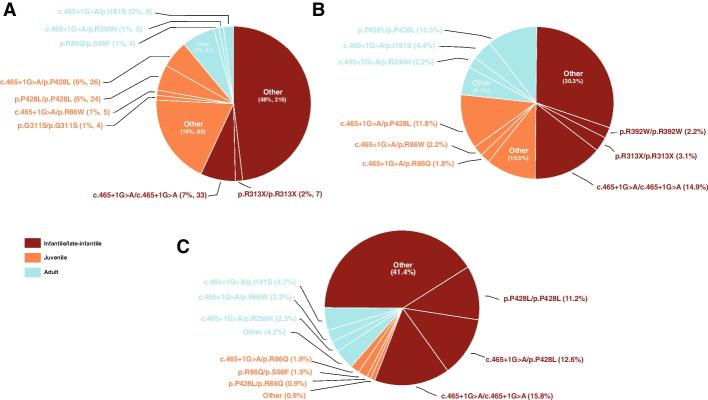
Fig. 1
Fig. 1
Pie charts of phenotypes and ARSA genotypes. A Phenotypes in the curated patient data set. The three most common ARSA genotypes associated with each severity phenotype are highlighted (n = 486). B Predicted phenotypes based on the allele frequencies from gnomAD and the patient-based severity ruleset and phenotype matrix. The three most prevalent ARSA genotypes for each predicted phenotype are indicated. C Predicted phenotypes based on the allele frequencies from gnomAD and ARSA enzyme activities measured in transfected HEK293T cells. The three most prevalent ARSA genotypes for each predicted phenotype are indicated. ARSA, arylsulfatase A; gnomAD, Genome Aggregation Database
Fig. 2
Fig. 2
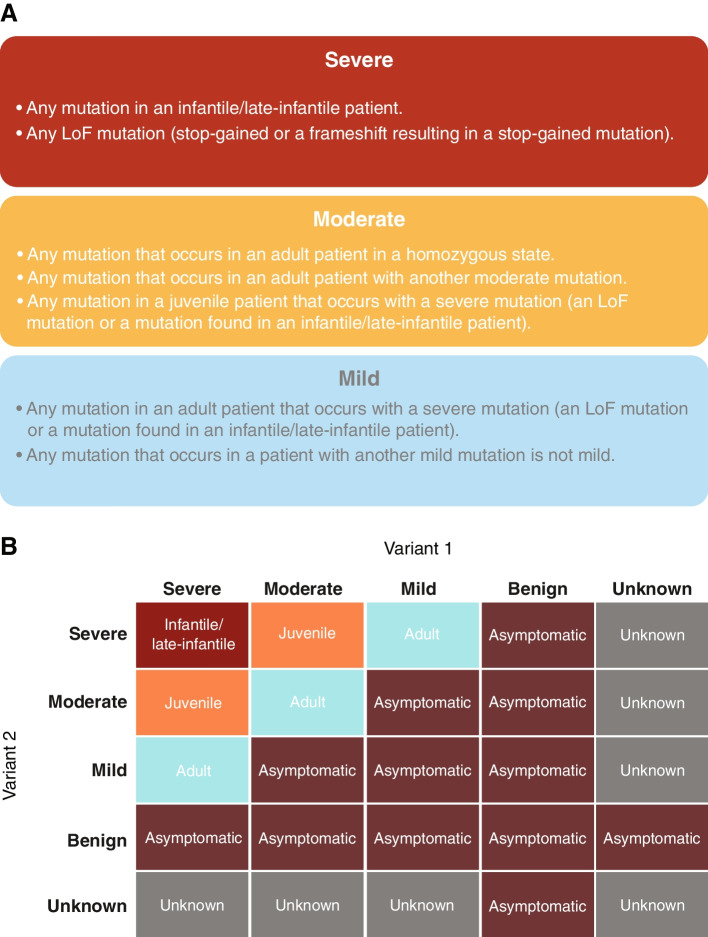
The patient-based severity ruleset and the phenotype matrix. A Ruleset for determining patient-based severity of ARSA variants. B The phenotype matrix used for prediction of phenotype from variant severity. The exterior labels of this matrix represent the severity assignments (severe, moderate, mild, benign, unknown) for each variant in the genotype. The interior cells represent the expected MLD phenotype (infantile/late-infantile, juvenile, adult, asymptomatic, unknown) produced by the combination of variants. ARSA, arylsulfatase A
Fig. 3
Fig. 3
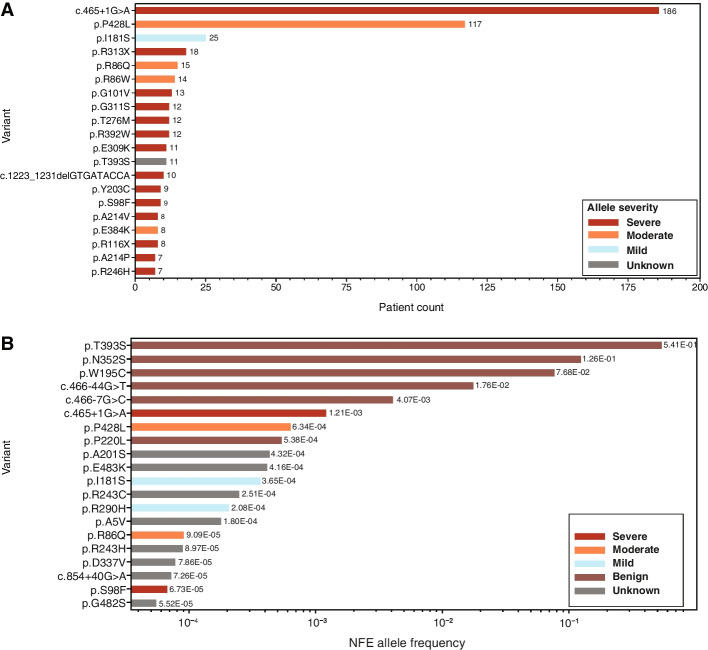
The most prevalent ARSA variants. A The 20 most prevalent ARSA variants in the curated patient data set, according to patient-based severity assignments. B The 20 most prevalent ARSA variants in the gnomAD NFE population, according to patient-based severity assignments. ARSA, arylsulfatase A; NFE, non-Finnish European
Fig. 4
Fig. 4
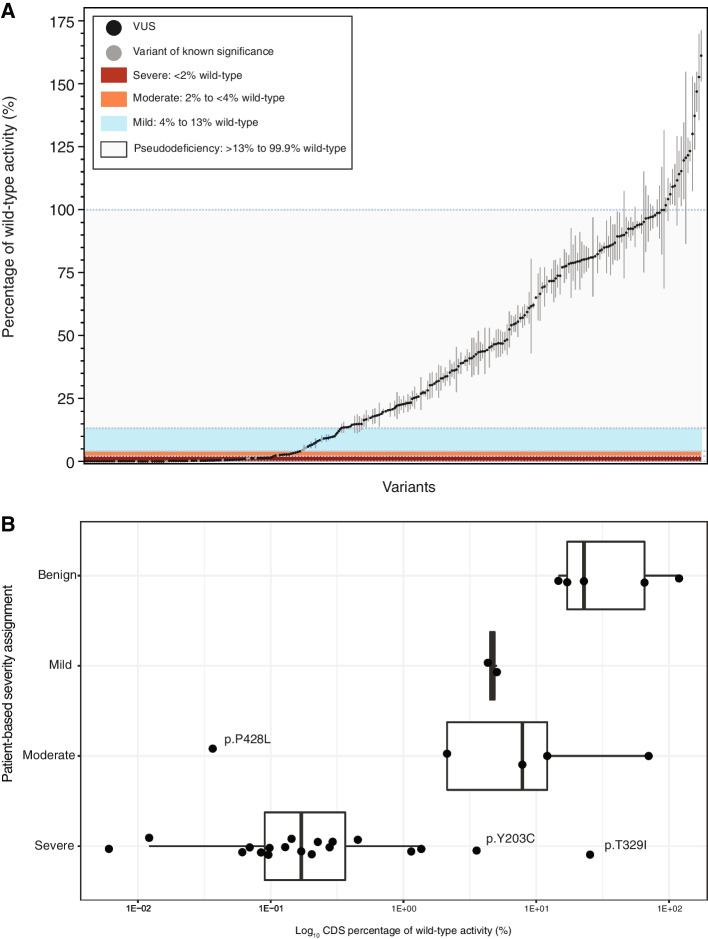
ARSA enzyme activity. A CDS enzymatic activities of ARSA variants. Percent of wild-type CDS enzymatic activities normalized to BLA levels for all 281 variants are plotted along with standard deviations (based on measurement of three separate wells of transfected HEK293T cells per variant). Brackets of activity-based severity are delimited by blue dashed lines. B ARSA enzymatic activity by patient-based severity categories. Box and whisker plot of CDS ARSA activity displayed by variants classified as benign, mild, moderate, or severe by the patient-based severity ruleset. Boxes indicate the interquartile range, with the median shown as a vertical line, and whiskers indicate the full range of data. ARSA, arylsulfatase A; CDS, coding sequence
Fig. 5
Fig. 5
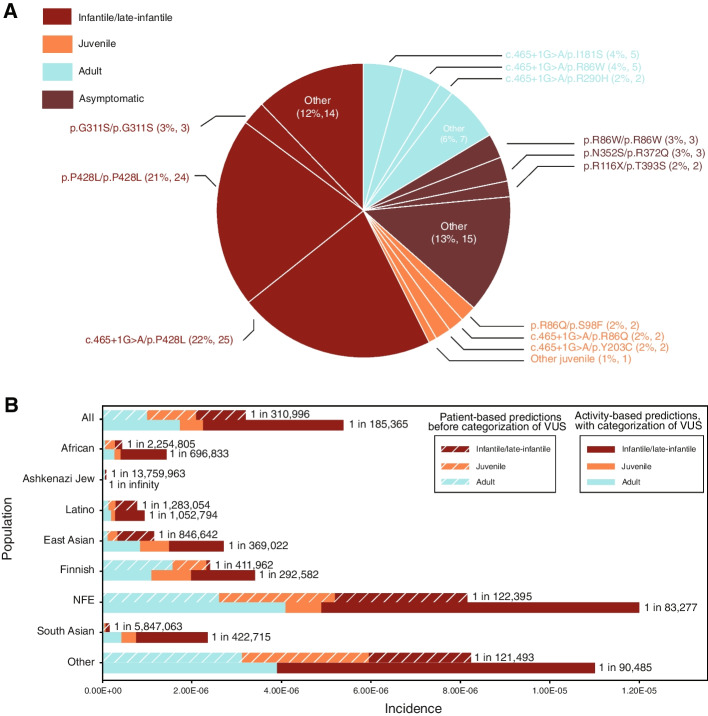
Frequently inconsistent MLD genotypes and estimated burden of MLD. A Summary of the genotypes whose phenotypes did not match the patient data set and were predicted incorrectly using the phenotype matrix. These genotypes manifested with multiple phenotypes within the patient data set. We considered genotypes where each mutation occurred at least five times in the overall patient data set and ignored any patient where two mutations were not identified. We then considered the predicted phenotype based on the finalized severity of each mutation. For each genotype, we counted the number of times the predicted phenotype agreed with the observed phenotype. B Classifying VUS improves the accuracy of MLD disease burden estimates using allele frequencies from multiple subpopulations in gnomAD. This is demonstrated by estimation of the burden of MLD in a bar chart including the proportion of each MLD subtype. These calculations were carried out before (light bars) and after (saturated bars) VUS were characterized for ARSA enzymatic activity in HEK293T cells. Classifying VUS decreased the number of GUS, improving the estimates of disease burden. ARSA, arylsulfatase A; gnomAD, Genome Aggregation Database; NFE, non-Finnish European; VUS, variants of unknown significance

References

    1. van Rappard DF, Boelens JJ, Wolf NI. Metachromatic leukodystrophy: disease spectrum and approaches for treatment. Best Pract Res Clin Endocrinol Metab. 2015;29(2):261–273. doi: 10.1016/j.beem.2014.10.001. - DOI - PubMed
    1. Biffi A, Cesani M, Fumagalli F, Del Carro U, Baldoli C, Canale S, et al. Metachromatic leukodystrophy – mutation analysis provides further evidence of genotype–phenotype correlation. Clin Genet. 2008;74(4):349–357. doi: 10.1111/j.1399-0004.2008.01058.x. - DOI - PubMed
    1. Hong X, Daiker J, Sadilek M, Ruiz-Schultz N, Kumar AB, Norcross S, et al. Toward newborn screening of metachromatic leukodystrophy: results from analysis of over 27,000 newborn dried blood spots. Genet Med. 2021;23(3):555–561. doi: 10.1038/s41436-020-01017-5. - DOI - PMC - PubMed
    1. Hong X, Kumar AB, Daiker J, Yi F, Sadilek M, De Mattia F, et al. Leukocyte and dried blood spot arylsulfatase A assay by tandem mass spectrometry. Anal Chem. 2020;92(9):6341–6348. doi: 10.1021/acs.analchem.9b05274. - DOI - PMC - PubMed
    1. Biffi A, Montini E, Lorioli L, Cesani M, Fumagalli F, Plati T, et al. Lentiviral hematopoietic stem cell gene therapy benefits metachromatic leukodystrophy. Science. 2013;341(6148):1233158. doi: 10.1126/science.1233158. - DOI - PubMed

Publication types