


Long-Term Efficacy and Safety of Paliperidone 6-Month Formulation: An Open-Label 2-Year Extension of a 1-Year Double-Blind Study in Adult Participants With Schizophrenia
- PMID: 37480362
- PMCID: PMC10464922
- DOI: 10.1093/ijnp/pyad028
Long-Term Efficacy and Safety of Paliperidone 6-Month Formulation: An Open-Label 2-Year Extension of a 1-Year Double-Blind Study in Adult Participants With Schizophrenia
Abstract
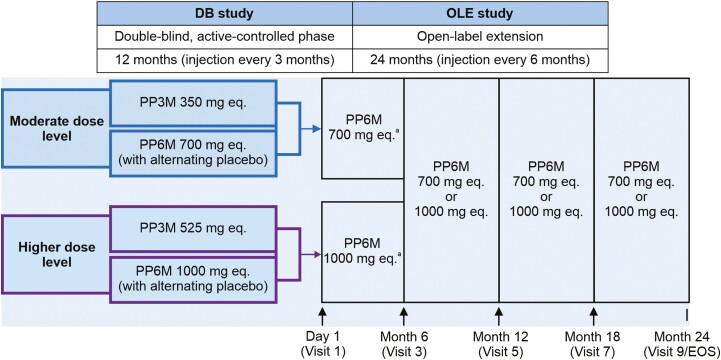
Background: Paliperidone palmitate 6-month (PP6M) demonstrated noninferiority to paliperidone palmitate 3-month in preventing relapse in patients with schizophrenia in a phase 3 double-blind (DB) study (NCT03345342). Here, we report long-term efficacy and safety results from a 2-year single-arm, open-label extension (OLE; NCT04072575) of this DB study.
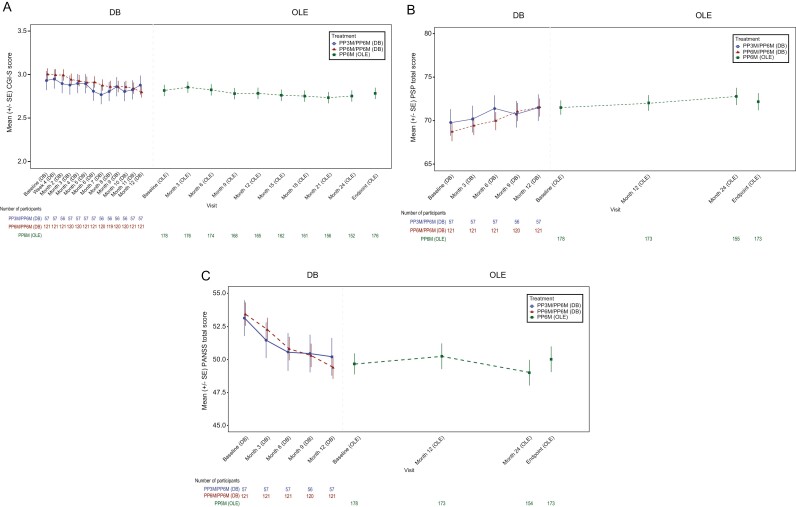
Methods: Participants who completed the DB study without relapse were enrolled and followed-up every 3 months up to 2 years. Participants received 4 PP6M gluteal injections (700/1000 mg eq.) at baseline, 6-month, 12-month, and 18-month visits. Efficacy endpoints included assessment of relapse, Positive and Negative Syndrome Scale total score, Personal and Social Performance score, and Clinical Global Impression-Severity scale change from baseline. Safety was assessed by treatment-emergent adverse events (TEAEs), physical examinations, and laboratory tests.
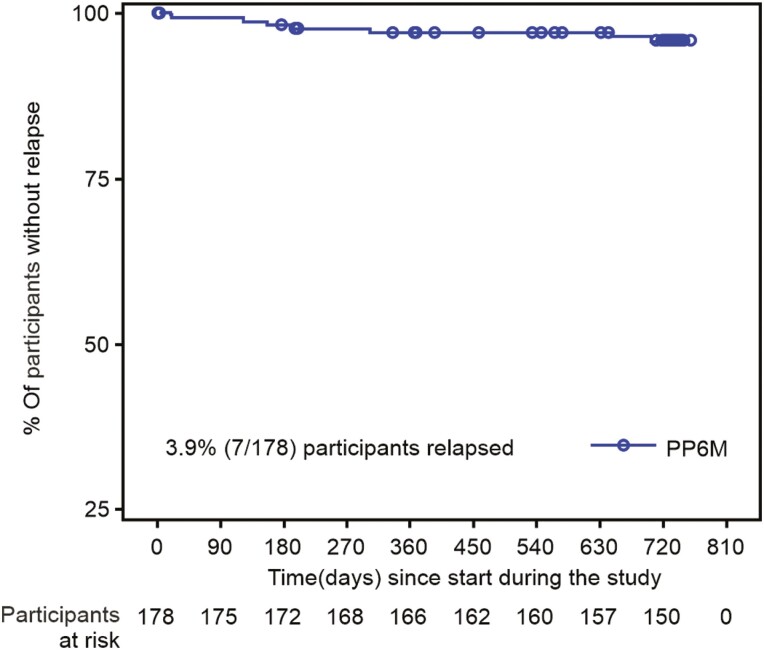
Results: Of 178 participants enrolled, 154 (86.5%) completed the OLE (mean age: 40.4 years, men: 70.8%; mean duration of PP6M exposure during OLE: 682.1 days). Overall, 7/178 (3.9%) participants relapsed between 20 and 703 days after enrolment. Mean (SD) changes from baseline to endpoint were as follows: Positive and Negative Syndrome Scale total score, 0.7 (8.22); Clinical Global Impression-Severity, 0.0 (0.51); and Personal and Social Performance Scale, 0.5 (7.47). Overall, 111/178 participants (62.4%) reported ≥1 TEAE; most common (>5%) TEAEs were headache (13.5%) and increased blood prolactin/hyperprolactinemia (18.0%); 8/178 (4.5%) participants experienced serious TEAEs, and 6/178 (3.4%) participants withdrew due to TEAEs. No deaths were reported.
Conclusions: The relapse rate observed with PP6M during the 2-year OLE was low (3.9%). Clinical and functional improvements demonstrated in the DB study were maintained during OLE, and no new safety concerns were identified.
Trial registration: ClinicalTrials.gov Identifier: NCT04072575; EudraCT number: 2018-004532-30.
Keywords: Long-term efficacy; long-acting injectable; open-label extension; paliperidone palmitate 6-month; schizophrenia.
© The Author(s) 2023. Published by Oxford University Press on behalf of CINP.
Figures
References
-
- Anderson JP, Icten Z, Alas V, Benson C, Joshi K (2017) Comparison and predictors of treatment adherence and remission among patients with schizophrenia treated with paliperidone palmitate or atypical oral antipsychotics in community behavioral health organizations. BMC Psychiatry 17:346. - PMC - PubMed
-
- Berwaerts J, Liu Y, Gopal S, Nuamah I, Xu H, Savitz A, Coppola D, Schotte A, Remmerie B, Maruta N, Hough DW (2015) Efficacy and safety of the 3-month formulation of paliperidone palmitate vs placebo for relapse prevention of schizophrenia: a randomized clinical trial. JAMA Psychiatry 72:830–839. - PubMed
-
- Bioque M, Parellada E, García-Rizo C, Amoretti S, Fortea A, Oriolo G, Palau P, Boix-Quintana E, Safont G, Bernardo M (2020) Clozapine and paliperidone palmitate antipsychotic combination in treatment-resistant schizophrenia and other psychotic disorders: a retrospective 6-month mirror-image study. Eur Psychiatry 63:e71. - PMC - PubMed
Publication types
MeSH terms
Substances
Associated data
LinkOut - more resources
Full Text Sources
Medical
Miscellaneous
