


Performance of noninvasive prenatal testing for twin pregnancies in South China
- PMID: 37480419
- PMCID: PMC10440307
- DOI: 10.1007/s10815-023-02881-1
Performance of noninvasive prenatal testing for twin pregnancies in South China
Abstract
Objective: The purpose of this study was to evaluate the performance of noninvasive prenatal testing (NIPT) for the detection of chromosomal aneuploidies and copy number variations (CNVs) in twin pregnancies.
Method: A cohort of 2010 women with twin pregnancies was recruited. 1331 patients opted for NIPT, and 679 patients opted for expanded NIPT (NIPT-plus). All high-risk patients were advised to undergo invasive prenatal diagnosis. All participants were followed up until 6 months after birth.
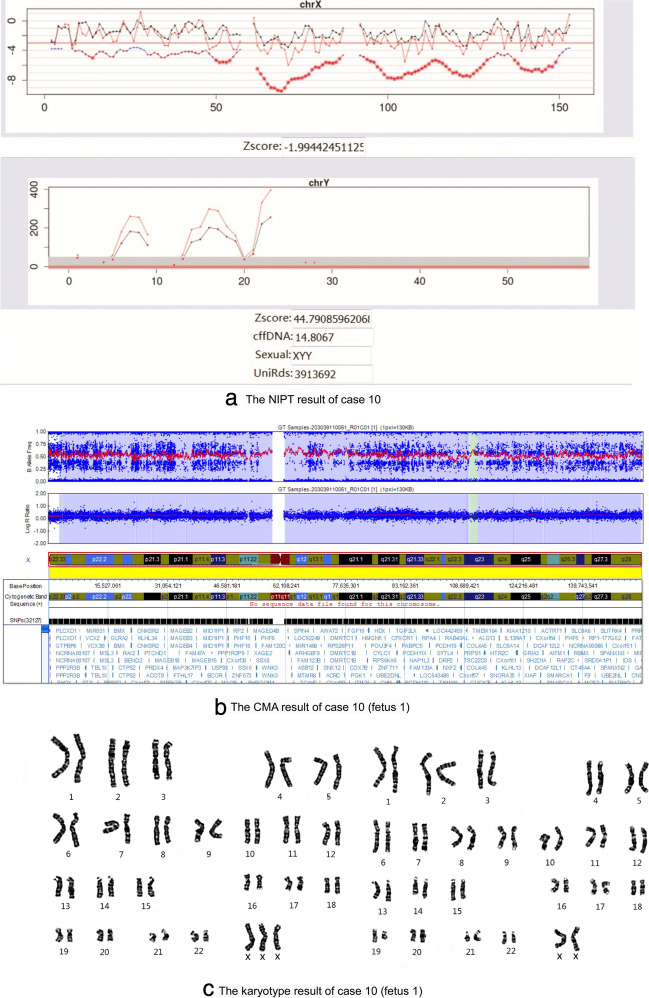
Results: Twenty-two cases were predicted to have a high risk of chromosome abnormalities by NIPT, of which 14 pregnant women underwent invasive prenatal diagnosis. The 14 cases included 3 cases of trisomy 21, 1 case of trisomy 18, 1 case of trisomy 7, 2 cases of sex chromosome aneuploidies (SCAs), and 7 cases of CNVs, of which the confirmed cases numbered 2, 1, 0, 1, and 0, respectively. Twenty cases were predicted to have a high risk of chromosome abnormalities by NIPT-plus, of which 16 pregnant women underwent invasive prenatal diagnosis. The 16 cases included 1 case of trisomy 21, 1 case of trisomy 7, 7 cases of SCAs, and 7 cases of CNVs, of which were confirmed in 1, 0, 3, and 2, respectively. No false-negative result was reported during the follow-up period.
Conclusion: The NIPT/NIPT-plus has excellent performance in the detection of chromosome aneuploidies in twin pregnancies. But for CNVs, the effectiveness of NIPT is poor, and the NIPT-plus have a certain detection efficiency. It is worth noting that pre- and post-genetic counseling is especially important, and the chorionicity, mode of conception, clinical indications, and fetal fraction should be considered as influencing factors.
Keywords: Chromosome abnormalities; Expanded noninvasive prenatal testing (NIPT-plus); Noninvasive prenatal testing (NIPT); Sensitivity; Specificity; Twin pregnancies.
© 2023. The Author(s).
Conflict of interest statement
The authors declare no competing interests.
Figures
References
-
- Ministry of Health, PRC . Report on prevention and treatment of birth defects in China. Beijing: Ministry of Health, PRC; 2012.
-
- Sebat J, Lakshmi B, Troge J, Alexander J, Young J, Lundin P, Maner S, Massa H, Walker M, Chi M, Navin N, Lucito R, Healy J, Hicks J, Ye K, Reiner A, Gilliam TC, Trask B, Patterson N, Wigler M. Large-Scale Copy Number Polymorphism in the Human Genome. Sci. 2004;305(5683):525–528. doi: 10.1126/science.1098918. - DOI - PubMed
-
- Gregg AR, Skotko BG, Benkendorf JL, Monaghan KG, Bajaj K, Best RG, Klugman S, Watson MS. Noninvasive prenatal screening for fetal aneuploidy, 2016 update: a position statement of the American College of Medical Genetics and Genomics. Genet Med. 2016;18(10):1056–1065. doi: 10.1038/gim.2016.97. - DOI - PubMed
-
- Cooper GM, Coe BP, Girirajan S, Rosenfeld JA, Vu TH, Baker C, Williams C, Stalker H, Hamid R, Hannig V, Abdel-Hamid H, Bader P, McCracken E, Niyazov D, Leppig K, Thiese H, Hummel M, Alexander N, Gorski J, Eichler EE. A copy number variation morbidity map of developmental delay. Nature Genetics. 2011;43(9):838–846. doi: 10.1038/ng.909. - DOI - PMC - PubMed
MeSH terms
Grants and funding
LinkOut - more resources
Full Text Sources
Medical
