. 2023 Jul 22;3(1):103.
doi: 10.1038/s43856-023-00331-8.

Adverse perinatal outcomes attributable to HIV in sub-Saharan Africa from 1990 to 2020: Systematic review and meta-analyses

Affiliations

Adverse perinatal outcomes attributable to HIV in sub-Saharan Africa from 1990 to 2020: Systematic review and meta-analyses

Claudia Murray et al. Commun Med (Lond). .

Erratum in

Abstract

Background: Maternal HIV infection and antiretroviral drugs (ARVs) are associated with increased risks of adverse perinatal outcomes. The vast majority of pregnant women living with HIV (WLHIV) reside in sub-Saharan Africa. We aimed to determine the burden of adverse perinatal outcomes attributable to HIV and ARVs in sub-Saharan Africa between 1990 and 2020.

Methods: We conduct a systematic review of studies on the association of pregnant WLHIV with adverse perinatal outcomes in sub-Saharan Africa. We perform random-effects meta-analyses to determine the risk difference (attributable risk, AR) of perinatal outcomes among WLHIV receiving no ARVs, monotherapy, or combination antiretroviral therapy (cART) initiated antenatally or preconception, compared to HIV-negative women. We estimate numbers of perinatal outcomes attributable to HIV and ARVs by combining the AR values with numbers of WLHIV receiving different ARV regimens in each country in sub-Saharan Africa annually between 1990 and 2020.

Results: We find that WLHIV receiving no ARVs or cART initiated antenatally or preconception, but not monotherapy, have an increased risk of preterm birth (PTB), low birthweight (LBW) and small for gestational age (SGA), compared to HIV-negative women. Between 1990 and 2020, 1,921,563 PTBs, 2,119,320 LBWs, and 2,049,434 SGAs are estimated to be attributable to HIV and ARVs in sub-Saharan Africa, mainly among WLHIV receiving no ARVs, while monotherapy and preconception and antenatal cART averted many adverse outcomes. In 2020, 64,585 PTBs, 58,608 LBWs, and 61,112 SGAs were estimated to be attributable to HIV and ARVs, the majority among WLHIV receiving preconception cART.

Conclusions: As the proportion of WLHIV receiving preconception cART increases, the burden of adverse perinatal outcomes among WLHIV in sub-Saharan Africa is likely to remain high.

Systematic review registration number: CRD42021248987.

Plain language summary

Pregnant women living with HIV (WLHIV) are at higher risk of adverse birth outcomes, such as babies born too soon (premature birth), babies born too small (low birthweight) or small-for-gestational-age (smaller than expected based on the weeks of pregnancy). It is unknown how many cases of these outcomes are attributable to HIV in sub-Saharan Africa, where most pregnant WLHIV reside. We conduct a search for published studies to determine the risk of adverse birth outcomes among WLHIV. We find that around 2 million premature births, low birthweight babies, and small-for-gestational-age babies are attributable to HIV in sub-Saharan Africa between 1990 and 2020. We conclude that adverse birth outcomes among WLHIV in sub-Saharan Africa are likely to remain high for the foreseeable future. Our findings could guide strategies to improve the health of WLHIV and their children in this region.


Conflict of interest statement

The authors declare no competing interests.

Figures
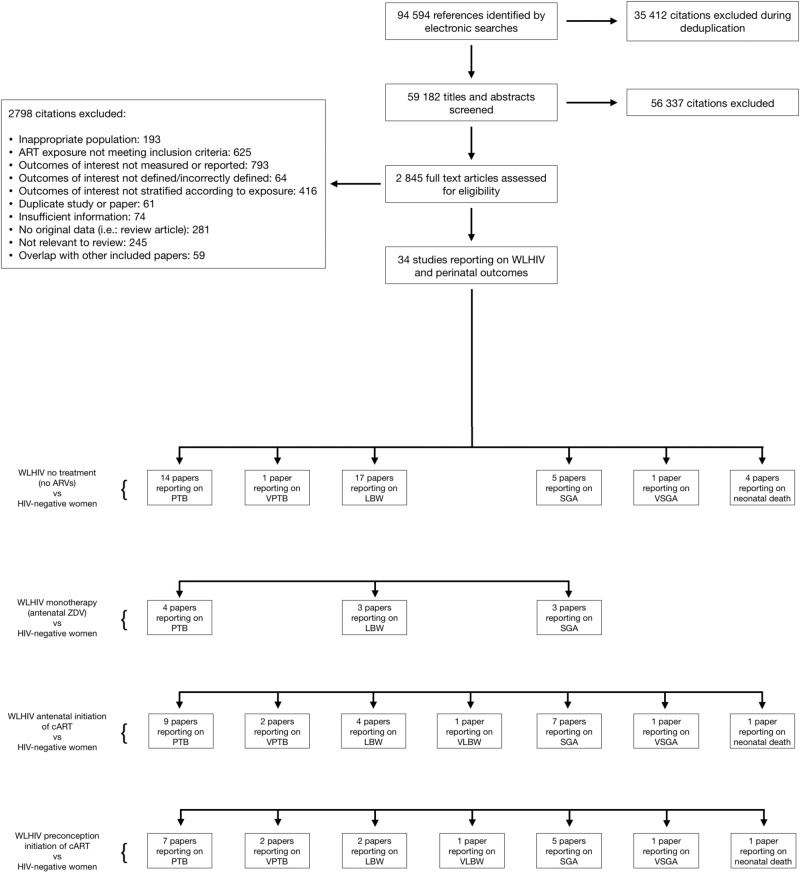
Fig. 1
Fig. 1. Study selection.
Flow chart demonstrating the process of the literature review, showing the number of citations remaining and removed at each stage. Citations removed at the eligibility assessment stage are sorted by reason for elimination. The number of included studies reporting on each perinatal outcome for each exposure comparison are given. ARVs Antiretroviral drugs, cART Combination antiretroviral therapy, HIV Human immunodeficiency virus, LBW Low birthweight, NND Neonatal death, PTB Preterm birth, SGA Small for gestational age, VLBW Very low birthweight, VPTB Very preterm birth, VSGA Very small for gestational age, WLHIV Women living with HIV. See Methods for definitions of perinatal outcomes.
Fig. 2
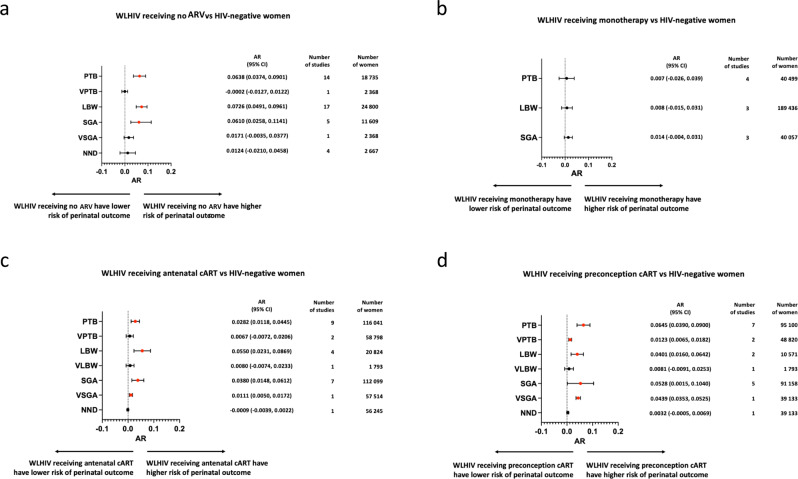
Fig. 2. Perinatal outcomes of women living with HIV receiving different ARV regimens, compared to HIV-negative women.
Results of random-effects meta-analyses to estimate attributable risk of perinatal outcomes associated with women living with HIV (WLHIV) receiving no ARVs (a), monotherapy (b) or cART initiated antenatally (c) and preconception (d), compared to HIV-negative women. Attributable risks, 95% confidence intervals and numbers of studies and women included in the analysis of each perinatal outcome for each comparison are displayed. Forest plots of meta-analyses can be found in Supplementary Figs. 1–24. Statistically significant results are presented with red dots and non-significant results with black dots. AR Attributable risk, ARVs Antiretroviral drugs, cART Combination antiretroviral therapy, CI Confidence interval, LBW Low birth weight, NND Neonatal death, PTB Preterm birth, SGA Small for gestational age, VPTB Very PTB, VLBW Very LBW, VSGA Very SGA, WLHIV Women living with HIV.
Fig. 3
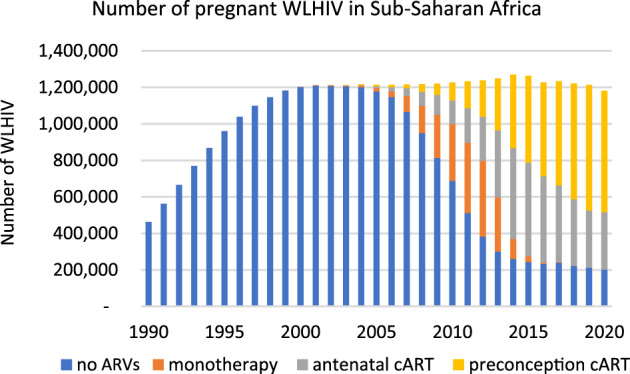
Fig. 3. Pregnant women living with HIV receiving different ARV regimens in sub-Saharan Africa in 1990–2020.
Number of pregnant women living with HIV receiving different ART regimens annually in sub-Saharan Africa between 1990 and 2020 (for data see Supplementary Data 1). ARVs Antiretroviral drugs, cART Combination antiretroviral therapy, WLHIV Women living with HIV.
Fig. 4
Fig. 4. Adverse perinatal outcomes attributable to HIV and ARVs in sub-Saharan Africa in 1990–2020.
Numbers of adverse perinatal outcomes attributable to HIV and ARVs annually between 1990 and 2020 (Supplementary Data 1). Pregnant women living with HIV received no ARVs, monotherapy, or cART initiated antenatally or preconception. Perinatal outcomes analysed: preterm birth (a), very preterm birth (b), low birthweight (c), very low birthweight (d), small for gestational age (e), very small for gestational age (f). Note that not all treatment groups of WLHIV had data for all perinatal outcomes and that not all comparisons to HIV-negative women were statistically significant (Fig. 2). Hence, not all categories in the legends (no ARVs, monotherapy, and antenatal and preconception cART) are represented in the graph for each perinatal outcome. Notably, data for very low birthweight and neonatal death was either not available or not statistically significant (Fig. 2a–d). ARVs Antiretroviral drugs, cART Combination antiretroviral therapy, HIV Human immunodeficiency virus.
Fig. 5
Fig. 5. Adverse perinatal outcomes averted and contributed by ARVs in sub-Saharan Africa in 1990–2020.
Numbers of adverse perinatal outcomes averted or contributed by ARVs annually between 1990 and 2020, compared to no ARVs. Positive numbers represent contribution by ARVs, i.e. if no ARVs were given, outcomes would not have occurred; negative numbers represent aversion by ART, i.e. prevented by ARVs, compared to no ARVs (Supplementary Data 1). Pregnant women living with HIV received monotherapy, cART initiated antenatally or preconception. Perinatal outcomes analysed: preterm birth (a), very preterm birth (b), low birthweight (c), small for gestational age (d), very small for gestational age (e). Note that not all treatment groups of WLHIV had data for all perinatal outcomes and that not all comparisons to WLHIV receiving no ARVs were statistically significant. Hence, not all categories in the legends (monotherapy, and antenatal and preconception cART) are represented in the graph for each perinatal outcome. Notably, data for very low birthweight and neonatal death was either not available or not statistically significant (Fig. 2). ARVs Antiretroviral drugs, cART Combination antiretroviral therapy.
Fig. 6
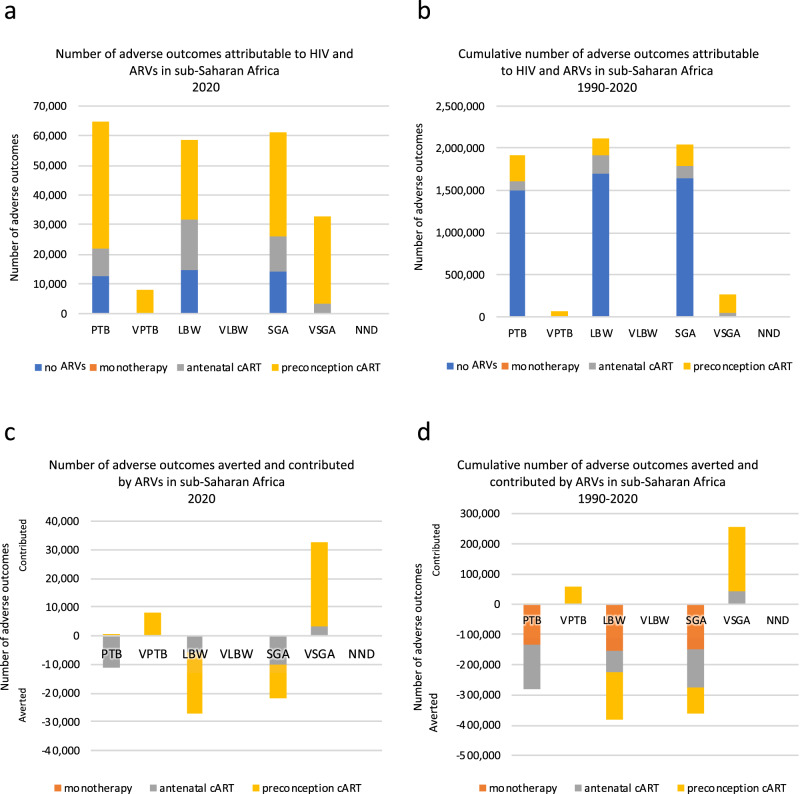
Fig. 6. Adverse perinatal outcomes associated with HIV and ARVs, and averted and contributed by ARVs, in sub-Saharan Africa in 2020 and during 1990–2020.
a Numbers of adverse perinatal outcomes attributable to HIV and ARVs in 2020 (Supplementary Data 1). b Cumulative number of adverse perinatal outcomes attributable to HIV and ARVs over 1990–2020 (Supplementary Data 1). c Numbers of adverse perinatal outcomes averted and contributed by ARVs in 2020 (Supplementary Data 1). d Cumulative number of adverse perinatal outcomes averted and contributed by ARVs over 1990–2020 (Supplementary Data 1). Note that not all treatment groups of WLHIV had data for all perinatal outcomes and that not all comparisons to HIV-negative women and WLHIV receiving no ARVs were statistically significant. Hence, not all categories in the legends (no ARVs, monotherapy, and antenatal and preconception cART) are represented in the graph for each perinatal outcome. Notably, data for very low birthweight and neonatal death was either not available or not statistically significant (Fig. 2a–d). ARVs Antiretroviral drugs, cART Combination antiretroviral therapy, HIV Human immunodeficiency virus, LBW Low birth weight, NND Neonatal death, PTB Preterm birth, SGA Small for gestational age, VPTB Very PTB, VLBW Very LBW, VSGA Very SGA.
Fig. 7
Fig. 7. Pregnant women living with HIV and adverse perinatal outcomes associated with HIV and ARVs in countries in sub-Saharan Africa in 2020.
a Number of pregnant women living with HIV in countries in sub-Saharan Africa in 2020 (Supplementary Data 1). b Number of preterm births in countries in sub-Saharan Africa in 2020 (Supplementary Data 1). c Number of low birthweight infants in countries in sub-Saharan Africa in 2020 (Supplementary Data 1). d Number of small for gestational age infants in countries in sub-Saharan Africa in 2020 (Supplementary Data 1). ARVs Antiretroviral drugs, WLHIV Women living with HIV.

References

    1. GBD. 2019 Diseases and Injuries Collaborators. Global burden of 369 diseases and injuries in 204 countries and territories, 1990–2019: a systematic analysis for the Global Burden of Disease Study 2019. Lancet. 2020;396:1204–1222. doi: 10.1016/S0140-6736(20)30925-9. - DOI - PMC - PubMed
    1. United Nations. Transforming our world: The 2030 agenda for sustainable development. (2015).
    1. GBD. Under-5 Mortality Collaborators. Global, regional, and national progress towards Sustainable Development Goal 3.2 for neonatal and child health: all-cause and cause-specific mortality findings from the Global Burden of Disease Study 2019. Lancet. 2021;398:870–905. doi: 10.1016/S0140-6736(21)01207-1. - DOI - PMC - PubMed
    1. Liu L, et al. Global, regional, and national causes of under-5 mortality in 2000-15: an updated systematic analysis with implications for the Sustainable Development Goals. Lancet. 2016;388:3027–3035. doi: 10.1016/S0140-6736(16)31593-8. - DOI - PMC - PubMed
    1. Chawanpaiboon S, et al. Global, regional, and national estimates of levels of preterm birth in 2014: a systematic review and modelling analysis. Lancet Glob. Health. 2019;7:e37–e46. doi: 10.1016/S2214-109X(18)30451-0. - DOI - PMC - PubMed