. 2023 Aug 2;25(30):20657-20667.
doi: 10.1039/d2cp05020j.

Revisiting the origin of the bending in group 2 metallocenes AeCp2 (Ae = Be-Ba)

Affiliations

Revisiting the origin of the bending in group 2 metallocenes AeCp2 (Ae = Be-Ba)

Tetiana Sergeieva et al. Phys Chem Chem Phys. .

Abstract

Metallocenes are well-established compounds in organometallic chemistry, and can exhibit either a coplanar structure or a bent structure according to the nature of the metal center (E) and the cyclopentadienyl ligands (Cp). Herein, we re-examine the chemical bonding to underline the origins of the geometry and stability observed experimentally. To this end, we have analysed a series of group 2 metallocenes [Ae(C5R5)2] (Ae = Be-Ba and R = H, Me, F, Cl, Br, and I) with a combination of computational methods, namely energy decomposition analysis (EDA), polarizability model (PM), and dispersion interaction densities (DIDs). Although the metal-ligand bonding nature is mainly an electrostatic interaction (65-78%), the covalent character is not negligible (33-22%). Notably, the heavier the metal center, the stronger the d-orbital interaction with a 50% contribution to the total covalent interaction. The dispersion interaction between the Cp ligands counts only for 1% of the interaction. Despite that orbital contributions become stronger for heavier metals, they never represent the energy main term. Instead, given the electrostatic nature of the metallocene bonds, we propose a model based on polarizability, which faithfully predicts the bending angle. Although dispersion interactions have a fair contribution to strengthen the bending angle, the polarizability plays a major role.


Conflict of interest statement

There are no conflicts to declare.

Figures

Fig. 1
Fig. 1. Illustration of models used to explain the bending of metallocenes. (A) Molecular orbital theory model (i). (B) Polarization model (ii). (C) Weak interaction concept (iii). (D) Agostic interaction model (iv).
Fig. 2
Fig. 2. Optimized geometries of group 2 metallocenes [Ae(Cp)2] (Ae = Be–Ba) at the B3LYP-D3(BJ)/def2-TZVPP level of theory along with β angles in [°].
Fig. 3
Fig. 3. Optimized geometries of metallocenes for [Ae(Cp*)2] (Ae = Be–Ba) at the B3LYP-D3(BJ)/def2-TZVPP level of theory along with angles in degrees. Ae = Be–Ba and Cp* = a methylated cyclopentadienyl anion. Hydrogens are omitted for clarity.
Fig. 4
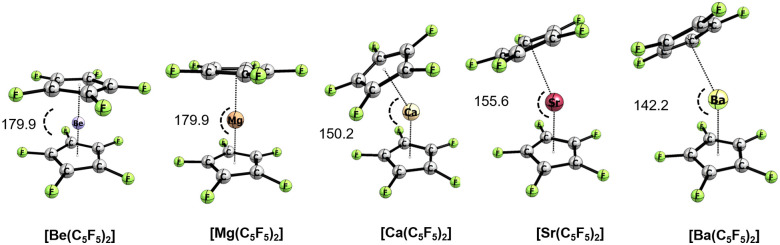
Fig. 4. Optimized geometries of group 2 metallocenes [Ae(C5F5)2] (Ae = Be–Ba) at the B3LYP-D3(BJ)/def2-TZVPP level of theory along with angles in [°].
Fig. 5
Fig. 5. Rigid potential energy surface scans of planar vs. bent metalloceneanions (Cp)22− as a function of the CpX–CpX distance performed at the B3LYP-D3(BJ)/def2-TZVPP level of theory (ΔErel = EbentElinear).
Fig. 6
Fig. 6. Dispersion interaction density (DID) plots calculated at the PAO-LMP2/cc-pCVTZ&cc-pVTZ level of theory. The brown zones indicate regions of electron density in a molecule which interacts strongly by dispersion interactions with the other molecule. Blue stands for weaker/diffuse contributions.
Fig. 7
Fig. 7. Energy decomposition analysis at the BP86-D3(BJ)/TZ2P level of theory for the [Ae(C5R5)2] complexes. Ae = Be–Ba and R = H, Me, and F–I. Energy values are given in kcal mol−1. (A) Orbital interaction, (B) electrostatic interaction, (C) dispersion interaction, and (D) Pauli repulsion.
Fig. 8
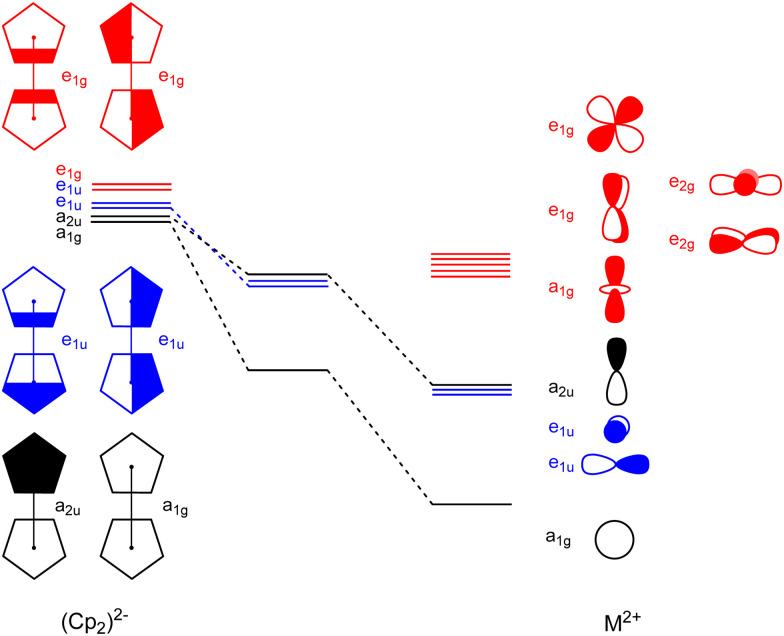
Fig. 8. Schematic orbital correlation diagram for the coplanar complex Mg(Cp)2.
Fig. 9
Fig. 9. Plot of the deformation densities Δρ of the pairwise orbital interactions between Mg2+ in its A10 electronic state and (Cp2)2−, associated energies ΔE (in kcal mol−1) and eigenvalues ν (in a.u.). The red color shows the charge outflow, whereas the blue color shows the charge density accumulation. The shape of the most important interacting occupied and vacant orbitals of the fragments.
Fig. 10
Fig. 10. CpX–Ae–CpX angle depending on the polarizability of the constituent metal centre atom, where Ae = Ca, Sr, and Ba and CpX is the indication of the H substitution in the Cp molecules (see the text).

References

    1. Kealy T. J. Pauson P. L. Nature. 1951;168:1039–1040. doi: 10.1038/1681039b0. - DOI
    1. Miller S. A. Tebboth J. A. Tremaine J. F. J. Chem. Soc. 1952:632–635. doi: 10.1039/JR9520000632. - DOI
    1. Fischer E. O. Pfab W. Z. Naturforsch. B. 1952;7:377–379. doi: 10.1515/znb-1952-0701. - DOI
    1. Eiland P. F. Pepinsky R. J. Am. Chem. Soc. 1952;74:4971. doi: 10.1021/ja01139a527. - DOI
    1. Dunitz J. D. Orgel L. E. Nature. 1953;171:121–122. doi: 10.1038/171121a0. - DOI