


Transverse oscillations and an energy source in a strongly magnetized sunspot
- PMID: 37483848
- PMCID: PMC10356614
- DOI: 10.1038/s41550-023-01973-3
Transverse oscillations and an energy source in a strongly magnetized sunspot
Abstract
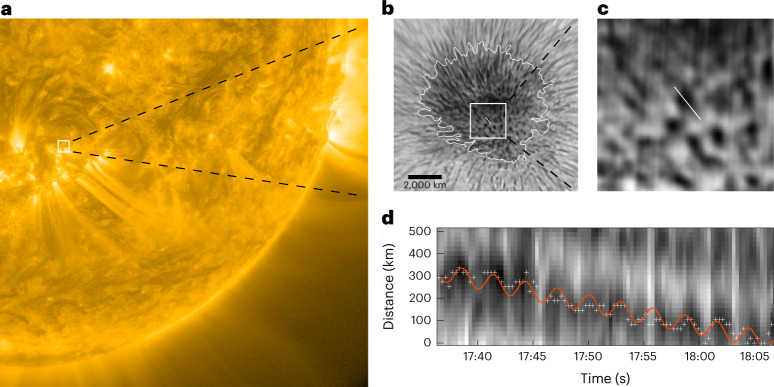
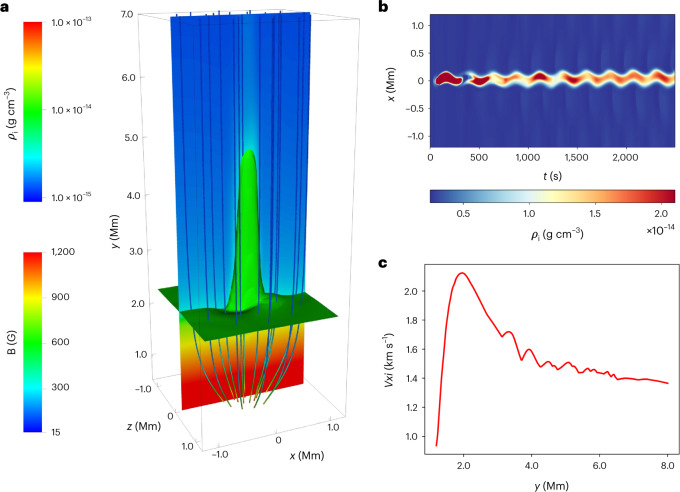
The solar corona is two to three orders of magnitude hotter than the underlying photosphere, and the energy loss of coronal plasma is extremely strong, requiring a heating flux of over 1,000 W m-2 to maintain its high temperature. Using the 1.6 m Goode Solar Telescope, we report a detection of ubiquitous and persistent transverse waves in umbral fibrils in the chromosphere of a strongly magnetized sunspot. The energy flux carried by these waves was estimated to be 7.52 × 10⁶ W m-2, three to four orders of magnitude stronger than the energy loss rate of plasma in active regions. Two-fluid magnetohydrodynamic simulations reproduced the high-resolution observations and showed that these waves dissipate significant energy, which is vital for coronal heating. Such transverse oscillations and the associated strong energy flux may exist in a variety of magnetized regions on the Sun, and could be the observational target of next-generation solar telescopes.
Keywords: Solar physics.
© The Author(s) 2023.
Conflict of interest statement
Competing interestsThe authors declare no competing interests.
Figures

References
-
- Bahauddin SM, Bradshaw SJ, Winebarger AR. The origin of reconnection-mediated transient brightenings in the solar transition region. Nat. Astron. 2021;5:237–245.
-
- Cargill PJ, Klimchuk JA. Nanoflare heating of the corona revisited. Astrophys. J. 2004;605:911–920.
-
- Jafari A, Vishniac ET, Xu S. Nanoflare theory revisited. Astrophys. J. 2021;906:109.
-
- Srivastava AK, et al. On the observations of rapid forced reconnection in the solar corona. Astrophys. J. 2019;887:137.
-
- Su Y, et al. Imaging coronal magnetic-field reconnection in a solar flare. Nat. Phys. 2013;9:489–493.
LinkOut - more resources
Full Text Sources