


Disability doesn't discriminate: health inequities at the intersection of race and disability
- PMID: 37484601
- PMCID: PMC10357509
- DOI: 10.3389/fresc.2023.1075775
Disability doesn't discriminate: health inequities at the intersection of race and disability
Abstract
Objectives: Given the prevalence of discrimination experienced by racial and ethnic minorities living with disabilities, it is likely that racism experienced by Black, Indigenous, and people of color (BIPOC) is compounded by the ableism experienced by people with disabilities, widening disparities in health and healthcare outcomes. To address this, we described unmet healthcare needs of a sample of Black, non-Hispanic, and Hispanic adults with and without disabilities. The following research question was examined exploratively: Are Black and Hispanic adults with disabilities at increased risk of unmet healthcare needs compared to Black and Hispanic adults without disabilities according to the 2018 National Health Interview Survey?
Methods: Survey data was examined from the 2018 National Health Interview Survey (NHIS), a nationally representative survey of community-dwelling adults in the United States.
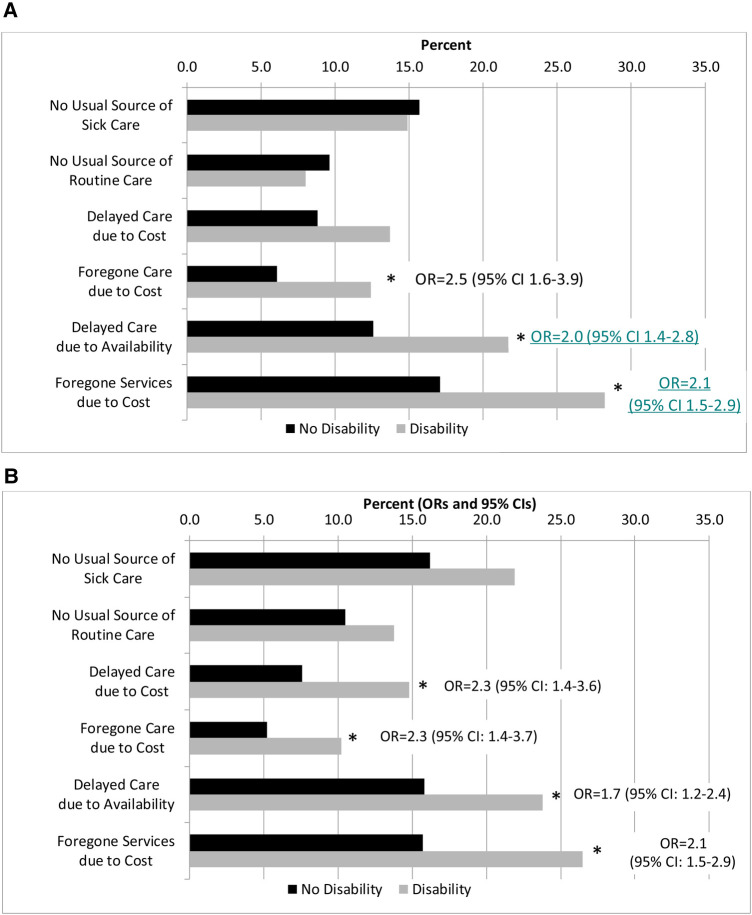
Results: Black and non-Hispanic adults most commonly reported mobility only disabilities. People with disabilities were significantly more likely to delay or forego care than their peers without disabilities within each racial/ethnic group. Among non-Hispanic Black and Hispanic adults, nearly 30% of people with disabilities forewent services due to cost compared to persons without disabilities.
Conclusions: Black and Hispanic adults with disabilities experience greater disparities in access to healthcare than Black and Hispanic adults without disabilities. Therefore, health disparities experienced by racial and ethnic minorities living with disabilities is likely influenced by the dual systemic factors of racism and ableism.
Keywords: BIPOC; disability; discrimination; disparities (health, racial); survey data.
© 2023 Dorsey Holliman, Stransky, Dieujuste and Morris.
Conflict of interest statement
The authors declare that the research was conducted in the absence of any commercial or financial relationships that could be construed as a potential conflict of interest.
Figures
References
-
- Institute of medicine committee on understanding eliminating racial ethnic disparities in health care. In: Smedley BD, Stith AY, Nelson AR, editors. Unequal treatment: Confronting racial and ethnic disparities in health care. Washington, DC: National Academies Press (US) (2003). - PubMed
LinkOut - more resources
Full Text Sources
