


Use of artificial intelligence in forecasting glaucoma progression
- PMID: 37484617
- PMCID: PMC10361424
- DOI: 10.4103/tjo.TJO-D-23-00022
Use of artificial intelligence in forecasting glaucoma progression
Abstract
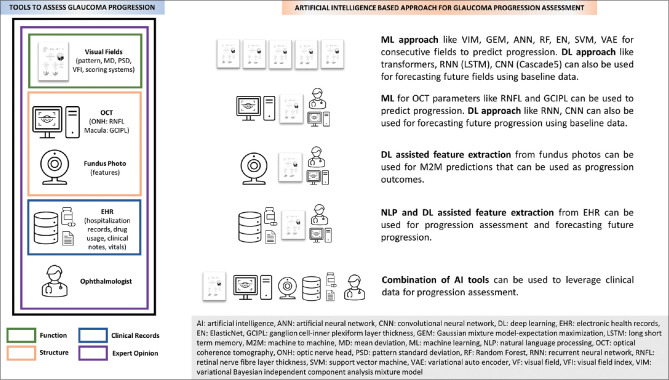
Artificial intelligence (AI) has been widely used in ophthalmology for disease detection and monitoring progression. For glaucoma research, AI has been used to understand progression patterns and forecast disease trajectory based on analysis of clinical and imaging data. Techniques such as machine learning, natural language processing, and deep learning have been employed for this purpose. The results from studies using AI for forecasting glaucoma progression however vary considerably due to dataset constraints, lack of a standard progression definition and differences in methodology and approach. While glaucoma detection and screening have been the focus of most research that has been published in the last few years, in this narrative review we focus on studies that specifically address glaucoma progression. We also summarize the current evidence, highlight studies that have translational potential, and provide suggestions on how future research that addresses glaucoma progression can be improved.
Keywords: Artificial intelligence; deep learning; forecasting; glaucoma; prediction; progression.
Copyright: © 2023 Taiwan J Ophthalmol.
Conflict of interest statement
The authors declare that there are no conflicts of interest in this paper.
Figures
References
-
- Tham YC, Li X, Wong TY, Quigley HA, Aung T, Cheng CY. Global prevalence of glaucoma and projections of glaucoma burden through 2040: A systematic review and meta-analysis. Ophthalmology. 2014;121:2081–90. - PubMed
-
- Weinreb RN, Garway-Heath DF, Leung C, Crowston JG, Medeiros FA. World Glaucoma Association 8th Consensus Meeting: Progression of Glaucoma. The Netherlands: Kugler Publications; 2017. [Last accessed on 2023 Feb 14]. Available from:https://wga.one/wga/consensus-8 .
-
- Jaumandreu L, Antón A, Pazos M, Rodriguez-Uña I, Rodriguez Agirretxe I, Martinez de la Casa JM, et al. Glaucoma progression. Clinical practice guide. Arch Soc Esp Oftalmol (Engl Ed) 2023;98:40–57. - PubMed
-
- Chaurasia AK, Greatbatch CJ, Hewitt AW. Diagnostic accuracy of artificial intelligence in glaucoma screening and clinical practice. J Glaucoma. 2022;31:285–99. - PubMed
Publication types
LinkOut - more resources
Full Text Sources