


Building blocks of microphysiological system to model physiology and pathophysiology of human heart
- PMID: 37485060
- PMCID: PMC10358860
- DOI: 10.3389/fphys.2023.1213959
Building blocks of microphysiological system to model physiology and pathophysiology of human heart
Abstract
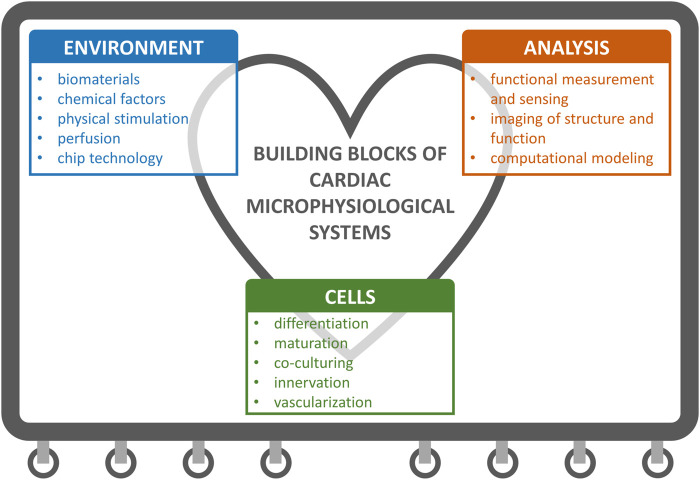
Microphysiological systems (MPS) are drawing increasing interest from academia and from biomedical industry due to their improved capability to capture human physiology. MPS offer an advanced in vitro platform that can be used to study human organ and tissue level functions in health and in diseased states more accurately than traditional single cell cultures or even animal models. Key features in MPS include microenvironmental control and monitoring as well as high biological complexity of the target tissue. To reach these qualities, cross-disciplinary collaboration from multiple fields of science is required to build MPS. Here, we review different areas of expertise and describe essential building blocks of heart MPS including relevant cardiac cell types, supporting matrix, mechanical stimulation, functional measurements, and computational modelling. The review presents current methods in cardiac MPS and provides insights for future MPS development with improved recapitulation of human physiology.
Keywords: biomaterials; cardiac modeling; co-cultures; environmental control; imaging; in silico; in vitro; microphysiological systems.
Copyright © 2023 Vuorenpää, Björninen, Välimäki, Ahola, Kroon, Honkamäki, Koivumäki and Pekkanen-Mattila.
Conflict of interest statement
The authors declare that the research was conducted in the absence of any commercial or financial relationships that could be construed as a potential conflict of interest.
Figures
References
-
- Ahola A., Kiviaho A. L., Larsson K., Honkanen M., Aalto-Setälä K., Hyttinen J. (2014). Video image-based analysis of single human induced pluripotent stem cell derived cardiomyocyte beating dynamics using digital image correlation. Biomed. Eng. OnLine 13, 39. 10.1186/1475-925X-13-39 - DOI - PMC - PubMed
-
- Amsden B. (1998). Solute diffusion within hydrogels. Mechanisms and models. Macromolecules 31, 8382–8395. 10.1021/ma980765f - DOI
Publication types
LinkOut - more resources
Full Text Sources
