


Effect of the Online Mindfulness-Based Stress Reduction on Anxiety and Depression Status of COVID-19 Patients Treated in Fangcang Hospitals: A Randomized Controlled Trial
- PMID: 37485280
- PMCID: PMC10362863
- DOI: 10.2147/PRBM.S414553
Effect of the Online Mindfulness-Based Stress Reduction on Anxiety and Depression Status of COVID-19 Patients Treated in Fangcang Hospitals: A Randomized Controlled Trial
Abstract
Background: As the focal point of epidemic prevention and control, the mental health of COVID-19 patients cannot be ignored. Online Mindfulness-Based Stress Reduction (MBSR) allows for the provision of conveniently accessible, effective and low-cost interventions on a large scale. We aim to evaluate the effectiveness of an online MBSR intervention in alleviating anxiety and depression among asymptomatic/mild patients limited by COVID-19-related restrictions.
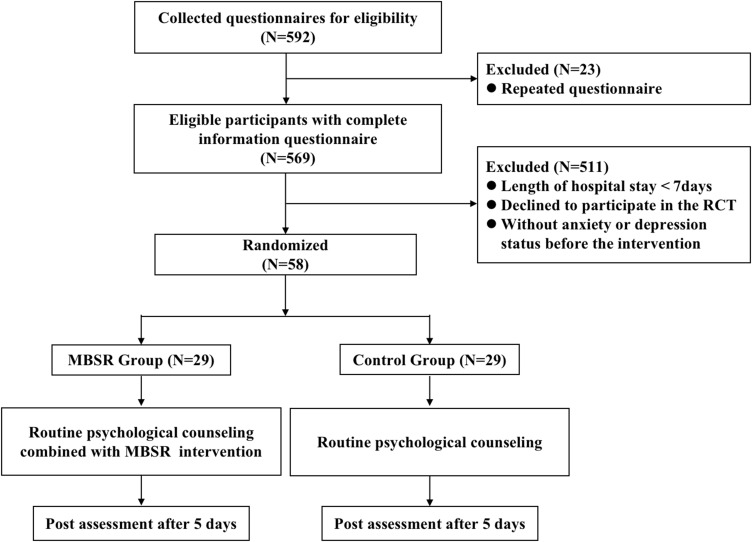
Methods: Fifty-eight patients treated in Sanya Fangcang hospital were randomly allocated to either to the experimental group (n = 29) following daily, for 5 days, an online-based mindfulness intervention or to the control group (n = 29). Patients from both groups underwent online questionnaires including assessment of anxiety and depression status at pre- and post-tests using Self-rating Anxiety Scale and Self-Rating Depression Scale.
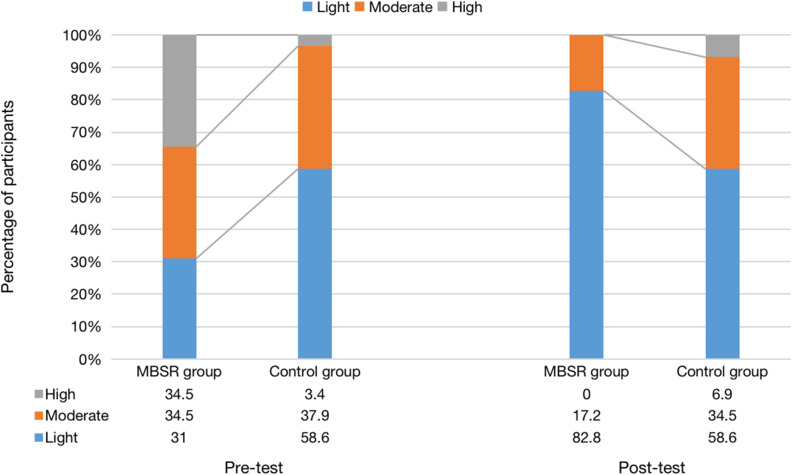
Results: After the online-based MBSR program, the anxiety and depression scores of the patients in the MBSR group decreased significantly in comparison to the scores of those in the control group (respectively η2 = 0.175, η2 = 0.215, p < 0.001). And the proportion of severe anxiety and depression patients in the MBSR group decreased to 0% which lower than the control group, and the proportion of light anxiety and depression patients was significantly more than that in the control group after the MBSR intervention.
Conclusion: The online-based MBSR intervention appears to be an effective way of alleviating anxiety and depression symptoms among COVID-19 patients with associated quarantine in Fangcang hospital. Given the seriousness of mental health threat that could be posed by this ongoing pandemic, our study provides a new idea and method for cost-effective and time-efficient interventions in the future of epidemic prevention and control.
Keywords: COVID-19 patients; anxiety; depression; online mindfulness; psychological intervention.
© 2023 Li et al.
Conflict of interest statement
The authors report no conflicts of interest in this work.
Figures
References
-
- World Health Organization. WHO Coronavirus (COVID-19) Dashboard. Available from: https://covid19.who.int/. Accessed January 10, 2023.
-
- Aleem A, Akbar Samad AB, Slenker AK. Emerging variants of SARS-CoV-2 and novel therapeutics against Coronavirus (COVID-19). In: StatPearls. Treasure Island: StatPearls Publishing LLC; 2022. - PubMed
LinkOut - more resources
Full Text Sources
Research Materials
