


Substance use trajectories among emerging adult Black men: Risk factors and consequences
- PMID: 37486247
- PMCID: PMC10805973
- DOI: 10.1111/dar.13728
Substance use trajectories among emerging adult Black men: Risk factors and consequences
Abstract
Introduction: Young, Black American men experience greater social, legal and economic consequences of substance use compared with White men for comparable levels of consumption. The development of tailored interventions requires prospective information on their substance use patterns, risk factors and consequences. We identified longitudinal substance use profiles and examined their links to childhood adversity, racial discrimination and young adult problem substance use and mental health.
Methods: Emerging adult Black men (n = 504, mean age = 20.26, SD = 1.08) provided fours waves of data between January 2012 and March 2021. We conducted a parallel process latent class growth analysis for three substances to explore conjoint longitudinal use patterns and investigated the risk factors and consequences of each pattern.
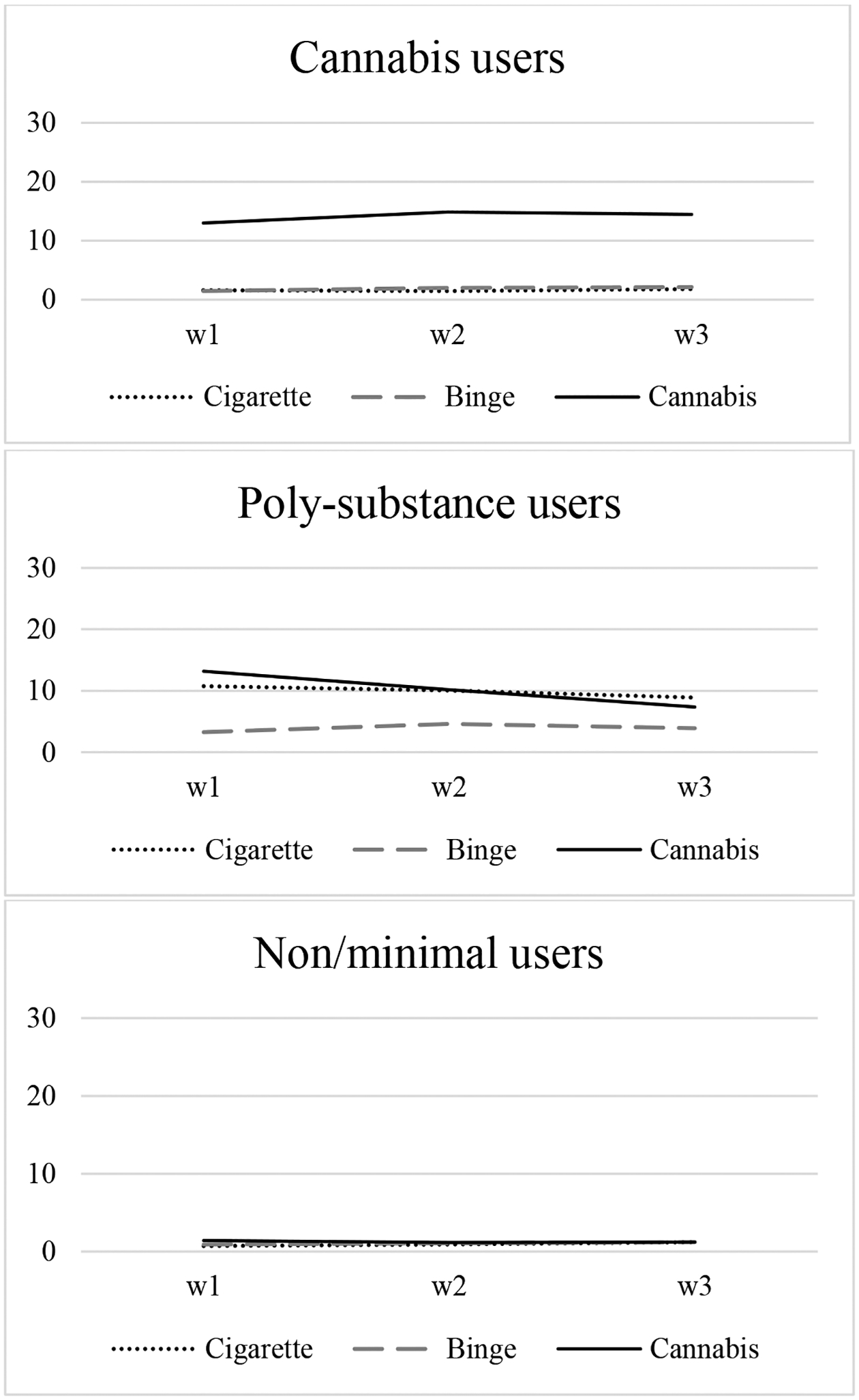
Results: Three trajectory classes emerged: non-using (n = 201, 39.9%), cannabis using (n = 202, 40.1%) and poly-substance using (n = 101, 20%) groups. Threat-based childhood adversity and racial discrimination were associated with higher odds of being members of cannabis or poly-substance groups than non-using group. Deprivation-based adversity was associated with higher odds for membership in poly-substance than non-using group. At Wave 4, elevated depressive symptoms were more prevalent among poly-substance compared with cannabis using group.
Discussion and conclusions: Heterogeneous substance use patterns emerged among Black American men and each pattern has distinct risk factors and outcomes in young adulthood. For prevention, more attention is needed for cannabis use patterns and psychosocial adversities that are unique to Black population.
Keywords: Black American; childhood adversity; mental health; substance use trajectory.
© 2023 Australasian Professional Society on Alcohol and other Drugs.
Conflict of interest statement
Conflict of Interest
None to declare.
Figures
Similar articles
-
Racial identity, discrimination, and polysubstance use: Examining culturally relevant correlates of substance use profiles among Black young adults.Psychol Addict Behav. 2021 Mar;35(2):224-230. doi: 10.1037/adb0000690. Epub 2020 Dec 28. Psychol Addict Behav. 2021. PMID: 33370128
-
The influence of substance use on depressive symptoms among young adult black men: The sensitizing effect of early adversity.Am J Addict. 2017 Jun;26(4):400-406. doi: 10.1111/ajad.12555. Epub 2017 Apr 20. Am J Addict. 2017. PMID: 28426146 Free PMC article.
-
Trajectory classes of cannabis use and heavy drinking among rural African American adolescents: multi-level predictors of class membership.Addiction. 2018 Aug;113(8):1439-1449. doi: 10.1111/add.14200. Epub 2018 Mar 30. Addiction. 2018. PMID: 29453937 Free PMC article.
-
Pathways linking adverse environments to emerging adults' substance abuse and depressive symptoms: A prospective analysis of rural African American men.Dev Psychopathol. 2021 Oct;33(4):1496-1506. doi: 10.1017/S0954579420000632. Dev Psychopathol. 2021. PMID: 32693849 Free PMC article.
-
Mental health and substance use among women and men at the intersections of identities and experiences of discrimination: insights from the intersectionality framework.BMC Public Health. 2019 Jan 23;19(1):108. doi: 10.1186/s12889-019-6430-0. BMC Public Health. 2019. PMID: 30674293 Free PMC article.
Cited by
-
Herbal Cannabis and Depression: A Review of Findings Published over the Last Three Years.Pharmaceuticals (Basel). 2024 May 27;17(6):689. doi: 10.3390/ph17060689. Pharmaceuticals (Basel). 2024. PMID: 38931356 Free PMC article. Review.
-
Cannabis use disorder and severe sepsis outcomes in cancer patients: Insights from a national inpatient sample.World J Crit Care Med. 2025 Jun 9;14(2):100844. doi: 10.5492/wjccm.v14.i2.100844. eCollection 2025 Jun 9. World J Crit Care Med. 2025. PMID: 40491879 Free PMC article.
-
Alcohol and Cannabis Use in the Context of Violence Experiences and Traditional Masculinity Attitudes Among Black Emerging Adult Men in Baltimore, Maryland.J Interpers Violence. 2025 May 26:8862605251336350. doi: 10.1177/08862605251336350. Online ahead of print. J Interpers Violence. 2025. PMID: 40420513 Free PMC article.
References
-
- Watt TT. The race/ethnic age crossover effect in drug use and heavy drinking. J Ethn Subst Abuse. 2008;7:93–114. - PubMed
-
- Nelson SE, Van Ryzin MJ, Dishion TJ. Alcohol, marijuana, and tobacco use trajectories from age 12 to 24 years: Demographic correlates and young adult substance use problems. Dev Psychopathol. 2015;27:253–77. - PubMed
Publication types
MeSH terms
Grants and funding
LinkOut - more resources
Full Text Sources
Medical
