


Student-led clinics and ePROs to accelerate diagnosis and treatment of patients with axial spondyloarthritis: results from a prospective pilot study
- PMID: 37486433
- PMCID: PMC10435605
- DOI: 10.1007/s00296-023-05392-5
Student-led clinics and ePROs to accelerate diagnosis and treatment of patients with axial spondyloarthritis: results from a prospective pilot study
Abstract
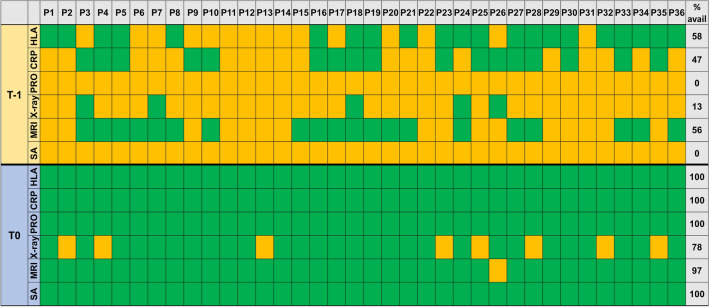
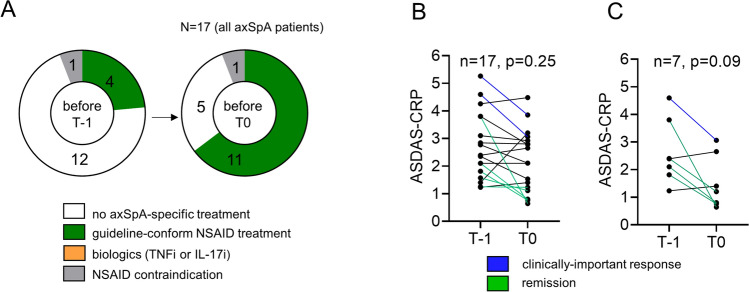
We aimed to investigate (1) student-led clinics and (2) electronic patient-reported outcomes (ePROs) to accelerate diagnosis and treatment of patients with axial spondyloarthritis (axSpA). Patients with suspected axSpA completed an initial student-led clinic visit (T-1) prior to their planned actual rheumatologist visit (T0). Acceleration of patient appointment and NSAID therapy start, availability of diagnostic findings, and treatment response at T0 were evaluated. Beginning at T-1, patients completed electronic BASDAI questionnaires every 2 weeks. Concordance of paper-based and electronic BASDAI was evaluated. Patient acceptance of ePRO reporting and student-led clinics was measured using the net promoter score (NPS). 17/36 (47.2%) included patients were diagnosed with axSpA. Student-led clinics (T-1) significantly accelerated patient appointments by more than 2 months (T0, T-1, p < 0.0001) and axSpA guideline-conform NSAID treatment (p < 0.0001). At T0, diagnostic workup was completed for all patients and 7/17 (41.2%) axSpA patients presented with a clinically important improvement or were in remission. 34/36 (94.4%) patients completed at least 80% of the ePROs between T-1 and T0. Electronic and paper-administered BASDAI correlated well (r = 0.8 p < 0.0001). Student-led clinics and ePROs were well accepted by patients with NPS scores of + 62.0% (mean ± SD 9.2/10.0 ± 0.9) and + 30.5% (mean ± SD 8.0/10.0 ± 1.7), respectively. In conclusion, student-led clinics and ePRO monitoring were well accepted, accelerated diagnostic workup and treatment in patients with axSpA.
Keywords: Axial spondyloarthritis; Diagnostic delay; Electronic patient-reported outcome; Student; axSpA; ePRO.
© 2023. The Author(s).
Conflict of interest statement
JK has received research support from and has received consulting/speaker’s fees from Novartis Pharma GmbH and ABATON. MG is founder and shareholder of ABATON GmbH. SK is founder and shareholder of MED.digital GmbH. The other authors have disclosed no conflicts of interest.
Figures
References
-
- Bohn R, Cooney M, Deodhar A, Curtis JR, Golembesky A. Incidence and prevalence of axial spondyloarthritis: methodologic challenges and gaps in the literature. Clin Exp Rheumatol. 2018;36(2):263–274. - PubMed
-
- Garrido-Cumbrera M, Navarro-Compan V, Bundy C, Mahapatra R, Makri S, Correa-Fernandez J, Christen L, Delgado-Dominguez CJ, Poddubnyy D, Group EW Identifying parameters associated with delayed diagnosis in axial spondyloarthritis: data from the European map of axial spondyloarthritis. Rheumatology (Oxford) 2022;61(2):705–712. doi: 10.1093/rheumatology/keab369. - DOI - PMC - PubMed
MeSH terms
Substances
Grants and funding
LinkOut - more resources
Full Text Sources
Medical
