


Impact of COVID-19 and effects of booster vaccination with BNT162b2 on six-month long COVID symptoms, quality of life, work productivity and activity impairment during Omicron
- PMID: 37486567
- PMCID: PMC10366033
- DOI: 10.1186/s41687-023-00616-5
Impact of COVID-19 and effects of booster vaccination with BNT162b2 on six-month long COVID symptoms, quality of life, work productivity and activity impairment during Omicron
Abstract
Background: Longitudinal estimates of long COVID burden during Omicron remain limited. This study characterized long-term impacts of COVID-19 and booster vaccination on symptoms, Health-Related Quality of Life (HRQoL), and Work Productivity Activity Impairment (WPAI).
Methods: Outpatients with ≥ 1 self-reported symptom and positive SARS-CoV-2 test at CVS Health United States test sites were recruited between 01/31 and 04/30/2022. Symptoms, EQ-5D and WPAI were collected via online surveys until 6 months following infection. Both observed and model-based estimates were analyzed. Effect sizes based on Cohen's d quantified the magnitude of outcome changes over time, within and between vaccination groups. Mixed models for repeated measures were conducted for multivariable analyses, adjusting for covariates. Logistic regression assessed odds ratio (OR) of long COVID between vaccination groups.
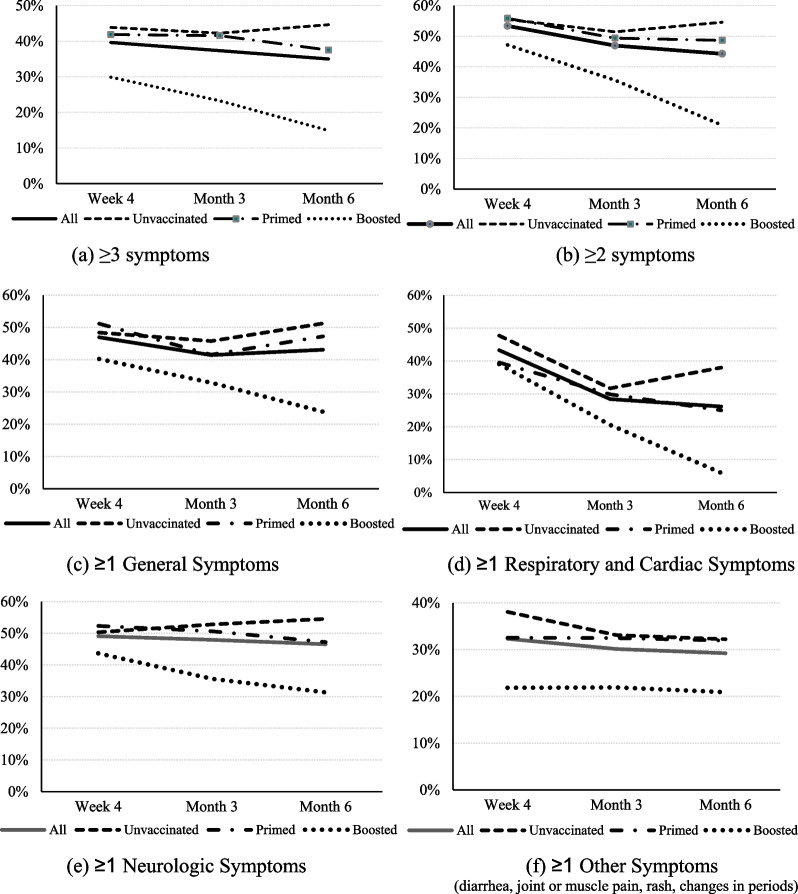
Results: At long COVID start (Week 4), 328 participants included 87 (27%) Boosted with BNT162b2, 86 (26%) with a BNT162b2 primary series (Primed), and 155 (47%) Unvaccinated. Mean age was 42.0 years, 73.8% were female, 26.5% had ≥ 1 comorbidity, 36.9% prior infection, and 39.6% reported ≥ 3 symptoms (mean: 3.1 symptoms). At Month 6, among 260 participants, Boosted reported a mean of 1.1 symptoms versus 3.4 and 2.8 in Unvaccinated and Primed, respectively (p < 0.001). Boosted had reduced risks of ≥ 3 symptoms versus Unvaccinated (observed: OR 0.22, 95% CI 0.10-0.47, p < 0.001; model-based: OR 0.36, 95% CI 0.15-0.87, p = 0.019) and Primed (observed: OR 0.29, 95% CI 0.13-0.67, p = 0.003; model-based: OR 0.59, 95% CI 0.21-1.65, p = 0.459). Results were consistent using ≥ 2 symptoms. Regarding HRQoL, among those with long COVID, Boosted had higher EQ-5D Utility Index (UI) than Unvaccinated (observed: 0.922 vs. 0.731, p = 0.014; model-based: 0.910 vs. 0.758, p-value = 0.038) and Primed (0.922 vs. 0.648, p = 0.014; model-based: 0.910 vs. 0.708, p-value = 0.008). Observed and model-based estimates for EQ-VAS and UI among Boosted were comparable with pre-COVID since Month 3. Subjects vaccinated generally reported better WPAI scores.
Conclusions: Long COVID negatively impacted HRQoL and WPAI. The BNT162b2 booster could have a beneficial effect in reducing the risk and burden of long COVID. Boosted participants reported fewer and less durable symptoms, which contributed to improve HRQoL and maintain WPAI levels. Limitations included self-reported data and small sample size for WPAI.
Keywords: BNT162b2; Booster vaccine; COVID-19; COVID-19 symptoms; HRQoL; Long COVID; SARS-CoV-2; WPAI.
© 2023. The Author(s).
Conflict of interest statement
MDF, MMM, JMZ, MBA, LP and JCC are employees of Pfizer and may hold stock or stock options of Pfizer. XS and HC are employees of CVS Health and may hold stock of CVS health. YPT was employee of CVS Health when current study was conducted.
Figures
References
-
- Centers for Disease Control and Prevention. Long COVID or Post-COVID Conditions. https://www.cdc.gov/coronavirus/2019-ncov/long-term-effects/index.html. Accessed May 5, 2023.
-
- Robertson M, Qasmieh S, Kulkarni S, Teasdale CA, Jones HE, McNairy M, Borrell LN, Nash D (2022) The epidemiology of long COVID in US adults two years after the start of the US SARS-CoV-2 pandemic. medRxiv
Publication types
MeSH terms
Substances
LinkOut - more resources
Full Text Sources
Medical
Miscellaneous
