


Few-shot learning for medical text: A review of advances, trends, and opportunities
- PMID: 37488023
- PMCID: PMC10940971
- DOI: 10.1016/j.jbi.2023.104458
Few-shot learning for medical text: A review of advances, trends, and opportunities
Abstract
Background: Few-shot learning (FSL) is a class of machine learning methods that require small numbers of labeled instances for training. With many medical topics having limited annotated text-based data in practical settings, FSL-based natural language processing (NLP) holds substantial promise. We aimed to conduct a review to explore the current state of FSL methods for medical NLP.
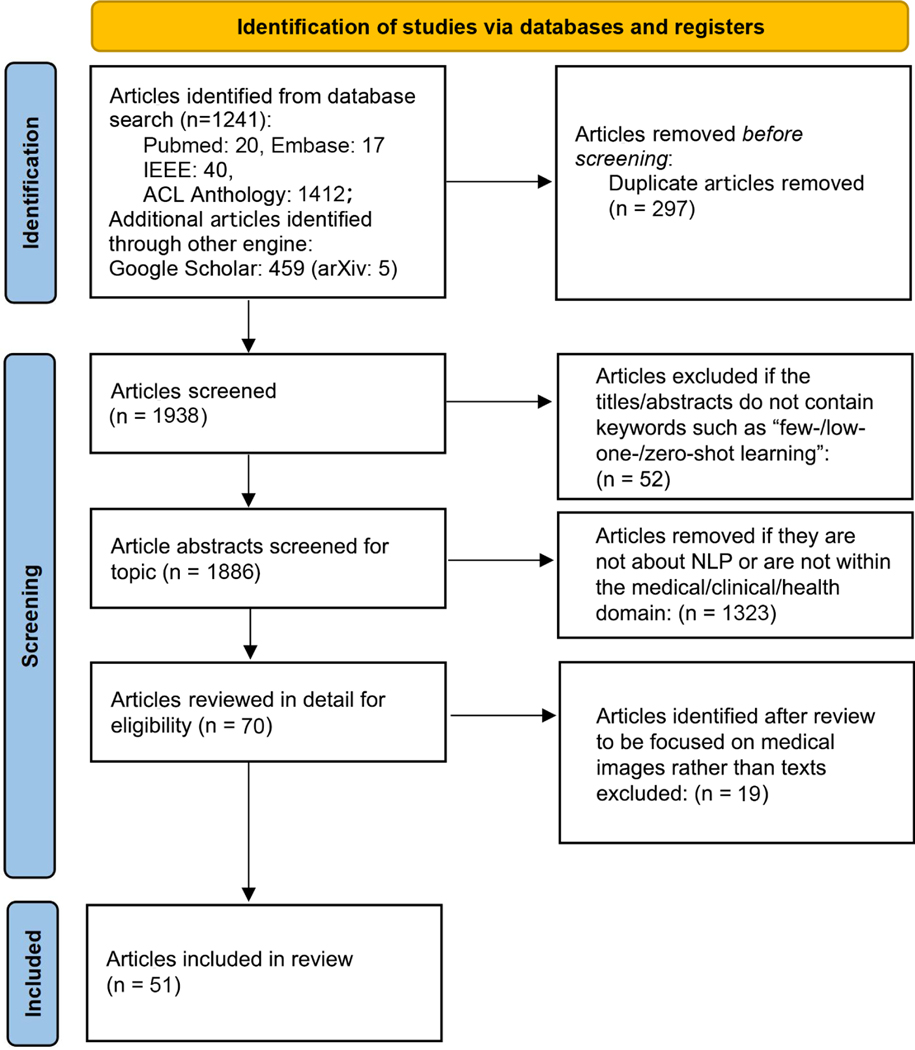
Methods: We searched for articles published between January 2016 and October 2022 using PubMed/Medline, Embase, ACL Anthology, and IEEE Xplore Digital Library. We also searched the preprint servers (e.g., arXiv, medRxiv, and bioRxiv) via Google Scholar to identify the latest relevant methods. We included all articles that involved FSL and any form of medical text. We abstracted articles based on the data source, target task, training set size, primary method(s)/approach(es), and evaluation metric(s).
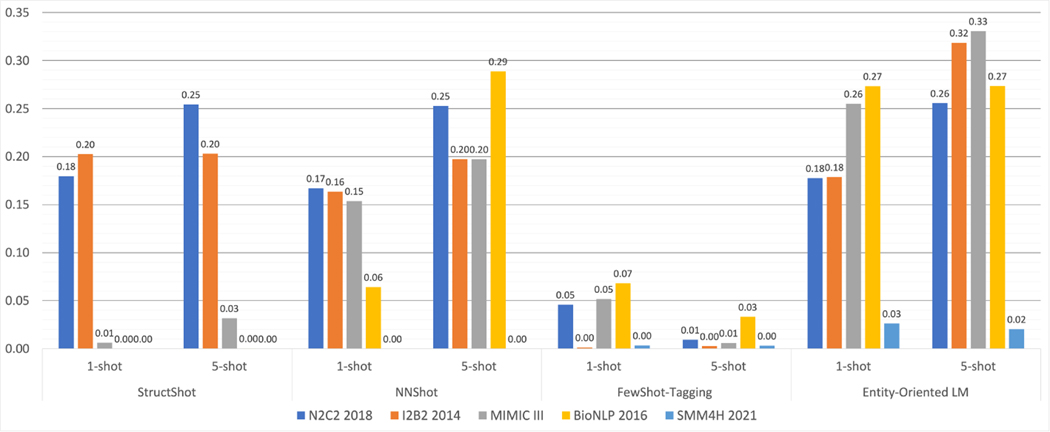
Results: Fifty-one articles met our inclusion criteria-all published after 2018, and most since 2020 (42/51; 82%). Concept extraction/named entity recognition was the most frequently addressed task (21/51; 41%), followed by text classification (16/51; 31%). Thirty-two (61%) articles reconstructed existing datasets to fit few-shot scenarios, and MIMIC-III was the most frequently used dataset (10/51; 20%). 77% of the articles attempted to incorporate prior knowledge to augment the small datasets available for training. Common methods included FSL with attention mechanisms (20/51; 39%), prototypical networks (11/51; 22%), meta-learning (7/51; 14%), and prompt-based learning methods, the latter being particularly popular since 2021. Benchmarking experiments demonstrated relative underperformance of FSL methods on biomedical NLP tasks.
Conclusion: Despite the potential for FSL in biomedical NLP, progress has been limited. This may be attributed to the rarity of specialized data, lack of standardized evaluation criteria, and the underperformance of FSL methods on biomedical topics. The creation of publicly-available specialized datasets for biomedical FSL may aid method development by facilitating comparative analyses.
Keywords: Biomedical informatics; Few-shot learning; Machine learning; Natural language processing.
Copyright © 2023 The Author(s). Published by Elsevier Inc. All rights reserved.
Conflict of interest statement
Declaration of competing interest The authors declare that they have no known competing financial interests or personal relationships that could have appeared to influence the work reported in this paper.
Figures

References
-
- Sung F, Yang Y, Zhang L, Xiang T, Torr PH, and Hospedales TM, “Learning to compare: Relation network for few-shot learning,” Proceedings of the IEEE Conference on Computer Vision and Pattern Recognition (CVPR), pp. 1199–1208, 2018. eprint: https://openaccess.thecvf.com/content_cvpr_2018/papers/Sung_Learning_to_....
-
- Snell J, Swersky K, and Zemel RS, “Prototypical networks for few-shot learning,” Advances in Neural Information Processing Systems, vol. 30, 2017. [Online]. Available: https://proceedings.neurips.cc/paper/2017/file/cb8da6767461f2812ae4290ea....
-
- Lake BM, Salakhutdinov R, and Tenenbaum JB, “One-shot learning by inverting a compositional causal process,” Advances in Neural Information Processing Systems, vol. 26, 2013. eprint: https://papers.nips.cc/paper/2013/file/52292e0c763fd027c6eba6b8f494d2eb-....
-
- Dong N. and Xing EP, “Few-Shot Semantic Segmentation with Prototype Learning,” in British Machine Vision Conference (BMVC), vol. 3, 2018. eprint: http://bmvc2018.org/contents/papers/0255.pdf.
-
- Li W, Wang L, Xu J, Huo J, Gao Y, and Luo J, “Revisiting Local Descriptor based Image-to-Class Measure for Few-shot Learning,” in Proceedings of the IEEE/CVF Conference on Computer Vision and Pattern Recognition, 2019, pp. 7260–7268. eprint: https://openaccess.thecvf.com/content_CVPR_2019/papers/Li_Revisiting_Loc....
Publication types
MeSH terms
Grants and funding
LinkOut - more resources
Full Text Sources
Miscellaneous
