


Social inequalities in mental and physical health derived from the COVID-19 pandemic in Spain beyond SARS-CoV-2 infection
- PMID: 37488575
- PMCID: PMC10367254
- DOI: 10.1186/s12939-023-01933-3
Social inequalities in mental and physical health derived from the COVID-19 pandemic in Spain beyond SARS-CoV-2 infection
Erratum in
-
Correction: Social inequalities in mental and physical health derived from the COVID-19 pandemic in Spain beyond SARS-CoV-2 infection.Int J Equity Health. 2023 Sep 19;22(1):192. doi: 10.1186/s12939-023-01997-1. Int J Equity Health. 2023. PMID: 37726713 Free PMC article. No abstract available.
Abstract
Background: Understanding the impact of the COVID-19 crisis on health involves conducting longitudinal studies to evaluate the inequalities that may have been exacerbated by the pandemic. The purpose of this study was to estimate differences in physical and mental health derived from the COVID-19 pandemic, beyond SARS-CoV-2 infection, in the Spanish general population according to the participants' level of education; and to assess the evolution of these differences from June 2020 (just after the lockdown) to nine months later (February-March 2021).
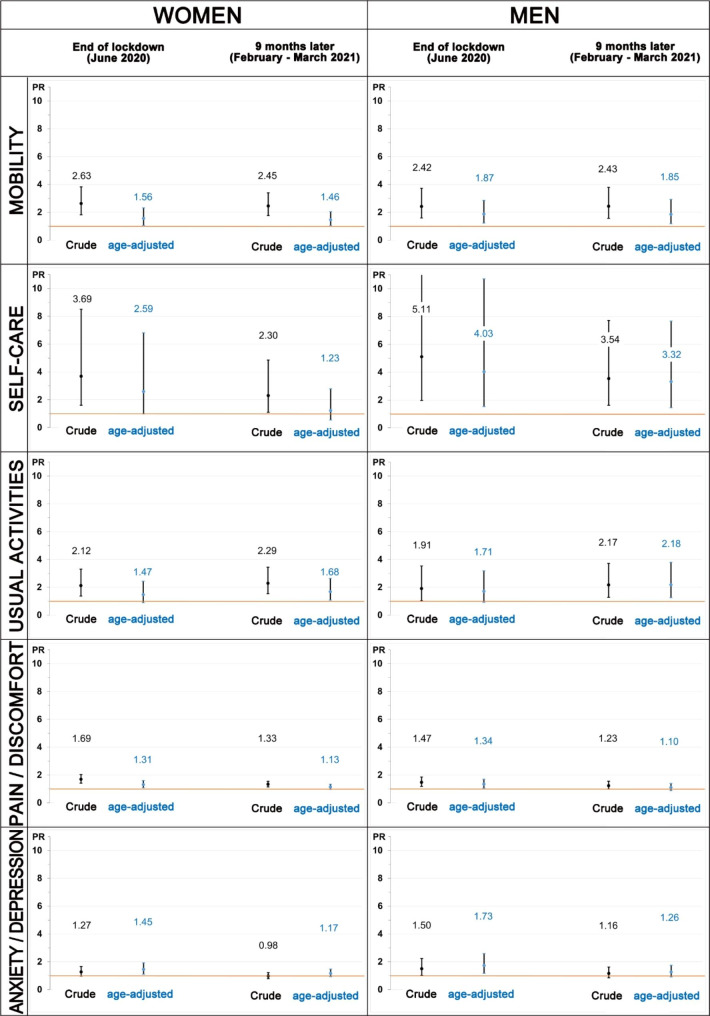
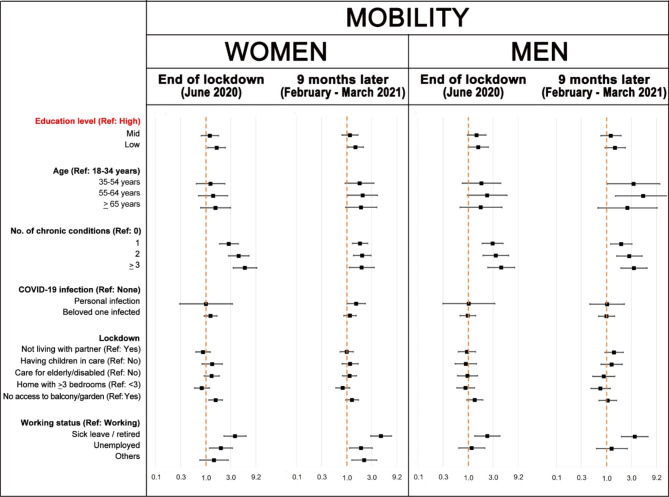
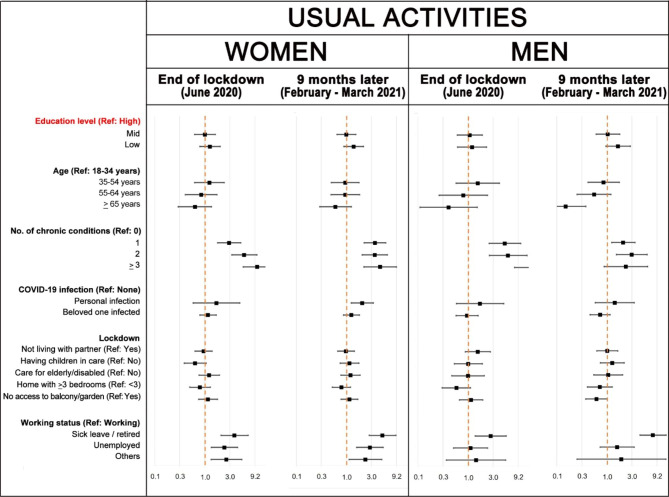
Methods: This is a longitudinal prospective study of a representative sample of non-institutionalized Spanish adults, through computer-assisted telephone interviews. Mobility, self-care, usual activities, pain/discomfort and anxiety/depression problems were measured with EQ-5D-5L. Prevalence ratio (PR) between high and low education levels and adjusted PR were estimated by Poisson regression models. Analyses were stratified by gender.
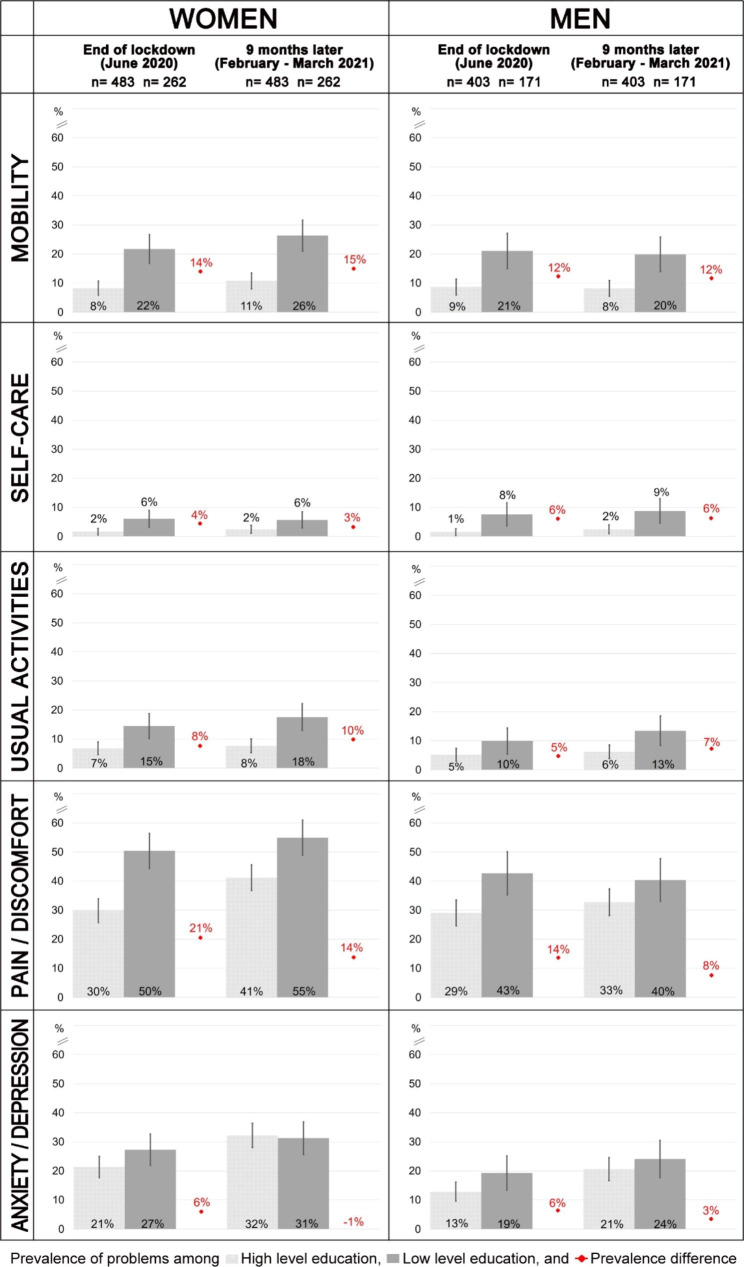
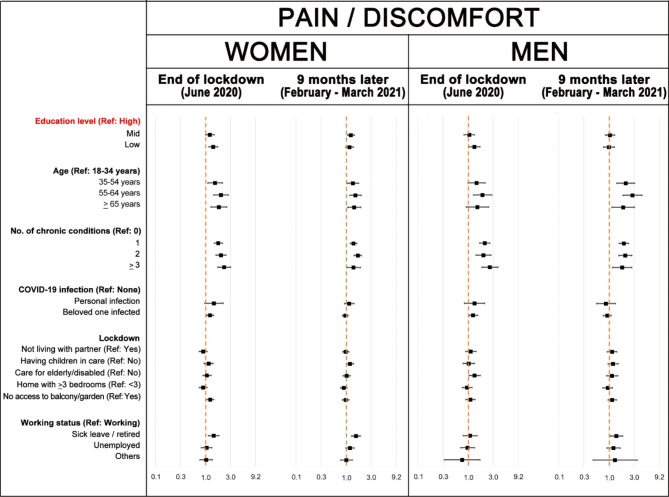
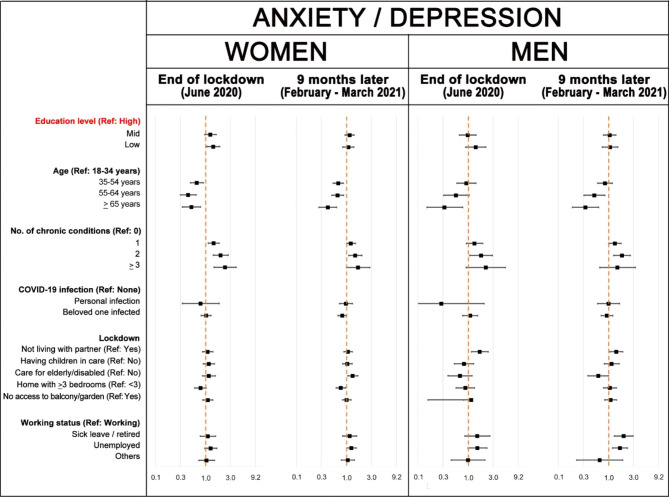
Results: A total of 2,000 participants answered both surveys. Individuals with low level of education reported more health problems in both genders, and absolute inequalities remained quite constant (mobility and self-care problems) or decreased (pain/discomfort and anxiety/depression problems). The greatest relative inequalities were observed just after the lockdown, with age-adjusted PR ranging from 1.31 (95%CI 1.08-1.59) for women and 1.34 (95%CI 1.05-1.69) for men in pain/discomfort to 2.59 (95%CI 0.98-6.81) for women and 4.03 (95%CI 1.52-10.70) for men in self-care; aPR decreased after nine months for most dimensions.
Conclusions: Prevalence of health problems increased during the COVID-19 pandemic in all education groups, but the increase was higher in women and men with a high level of education, suggesting that its impact appeared later in this group. Further analysis on the role of governmental economic aid given to vulnerable people might shed light on this evolution.
Keywords: COVID-19; EQ-5D-5L; Health inequalities; Indirect impact.
© 2023. The Author(s).
Conflict of interest statement
The authors declare no competing interests.
Figures
References
-
- de Jesus M, Moumni Z, Sougui ZH, Biswas N, Kubicz R, Pourtau L. “Living in confinement, stopped in Time”: migrant social vulnerability, coping and Health during the COVID-19 pandemic lockdown in France. Int J Environ Res Public Health 2022 Aug 15;19(16):10084; 10.3390/ijerph191610084. - PMC - PubMed
-
- di Girolamo C, Gnavi R, Landriscina T, Forni S, Falcone M, Calandrini E et al. Indirect impact of the COVID-19 pandemic and its containment measures on social inequalities in hospital utilisation in Italy. J Epidemiol Community Health (1978). 2022 Aug;76(8):707–15; 10.1136/jech-2021-218452. - PubMed
-
- Bann D, Villadsen A, Maddock J, Hughes A, Ploubidis GB, Silverwood R, et al. Changes in the behavioural determinants of health during the COVID-19 pandemic: gender, socioeconomic and ethnic inequalities in five british cohort studies. J Epidemiol Community Health (1978) 2021;75(12):1136–42. doi: 10.1136/jech-2020-215664. - DOI - PMC - PubMed
Publication types
MeSH terms
LinkOut - more resources
Full Text Sources
Medical
Research Materials
Miscellaneous
