. 2023 Aug;45(8):e2200138.
doi: 10.1002/bies.202200138.

Tau, microtubule dynamics, and axonal transport: New paradigms for neurodegenerative disease

Affiliations

Tau, microtubule dynamics, and axonal transport: New paradigms for neurodegenerative disease

Alisa Cario et al. Bioessays. 2023 Aug.

Abstract

The etiology of Tauopathies, a diverse class of neurodegenerative diseases associated with the Microtubule Associated Protein (MAP) Tau, is usually described by a common mechanism in which Tau dysfunction results in the loss of axonal microtubule stability. Here, we reexamine and build upon the canonical disease model to encompass other Tau functions. In addition to regulating microtubule dynamics, Tau acts as a modulator of motor proteins, a signaling hub, and a scaffolding protein. This diverse array of functions is related to the dynamic nature of Tau isoform expression, post-translational modification (PTM), and conformational flexibility. Thus, there is no single mechanism that can describe Tau dysfunction. The effects of specific pathogenic mutations or aberrant PTMs need to be examined on all of the various functions of Tau in order to understand the unique etiology of each disease state.

Keywords: MAP-Tau; Tau; Tauopathy; microtubule; microtubule associated protein; neurodegeneration.


Figures

Figure 1
Figure 1
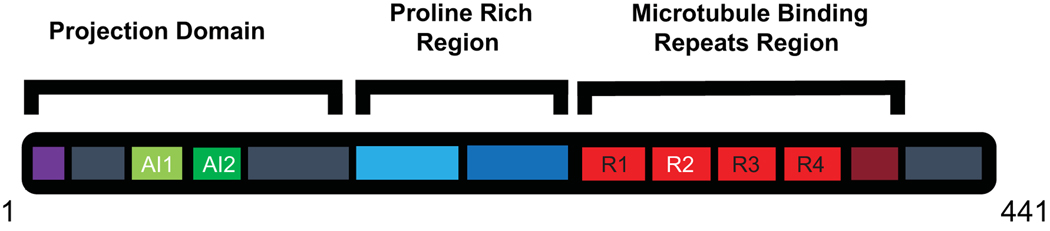
Schematic of Tau protein domains. Primary amino acid sequence showing the domains of Tau. Alternatively spliced regions are shown in white text. The projection domain contains the phosphatase activating region (purple) and alternatively spliced acidic inserts (green). The proline rich region (blue) is combined from two parts. The microtubule binding region contains 3 or 4 repeats (red) and a pseudo repeat (maroon).
Figure 2
Figure 2
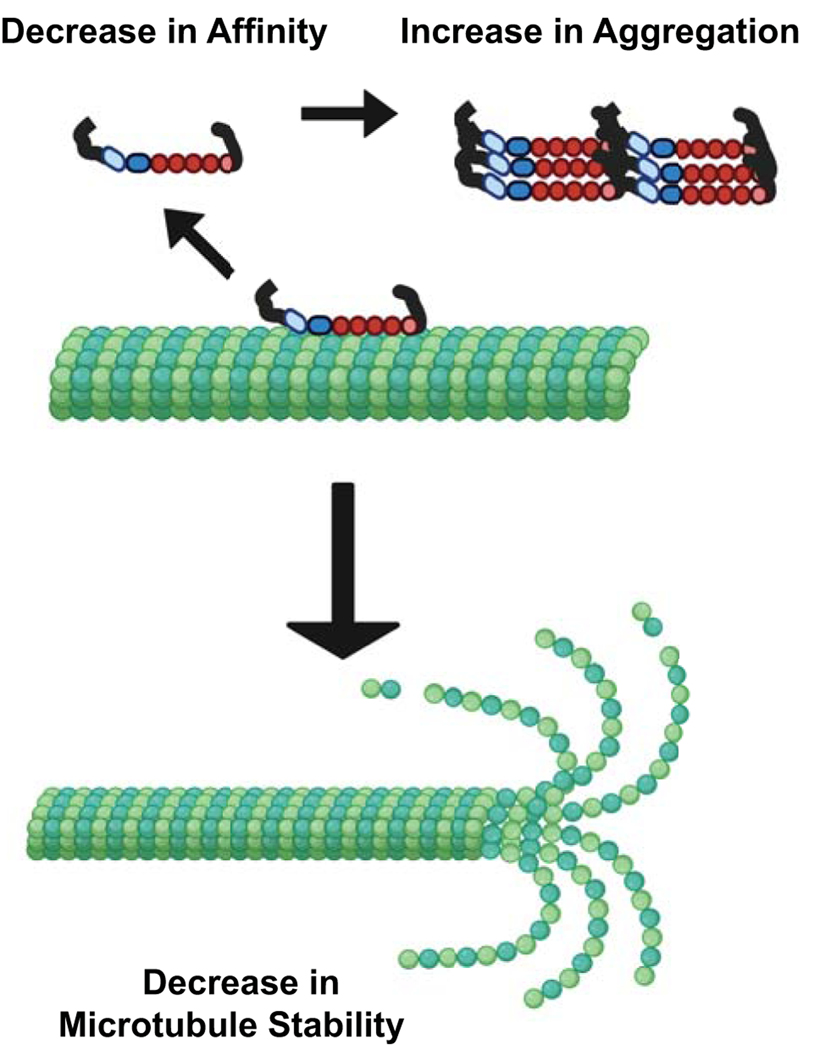
Canonical Disease Theory Mechanism. Tau disease onset is proposed to occur through a loss of Tau-microtubule interactions, either through decrease in microtubule affinity or increase in aggregation propensity. This is suggested to lead to a loss of microtubule stability. (Created with biorender.com)
Figure 3
Figure 3
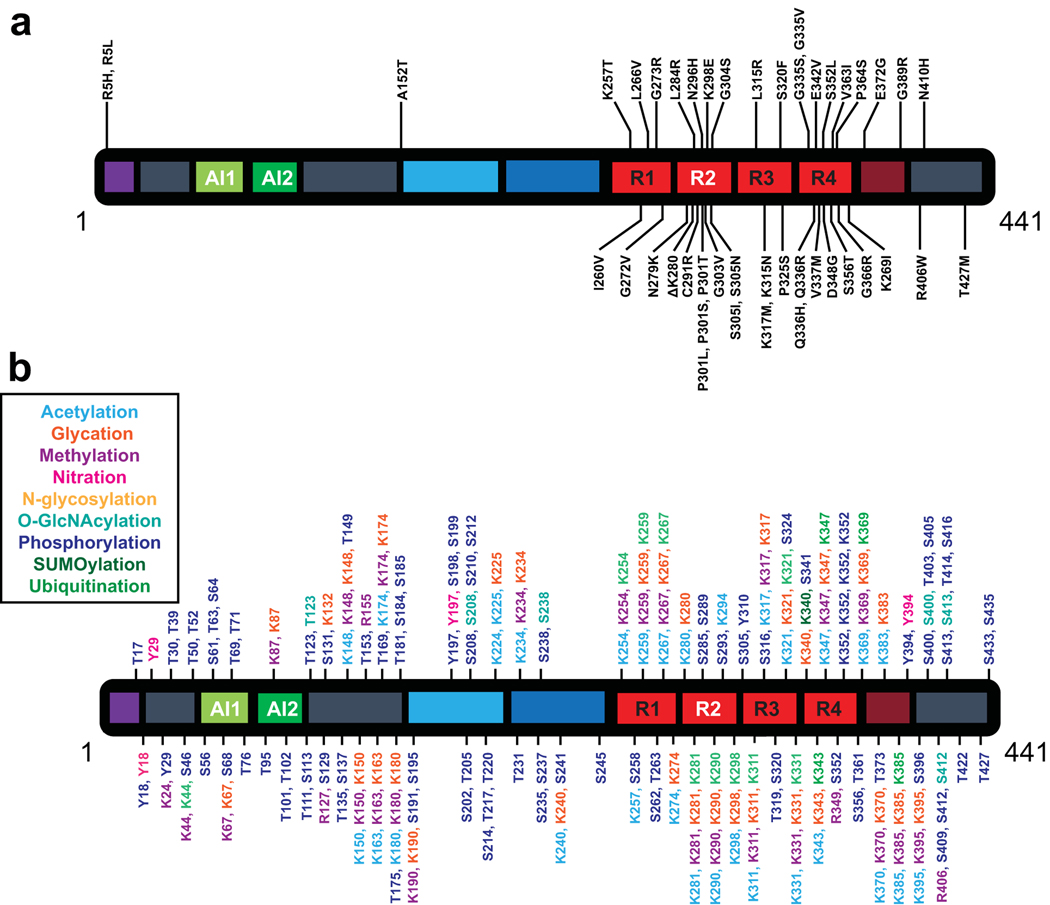
Schematic of Modifications to Tau protein. a). Disease associated mutations found in Tau protein. Figure based on [118]. b). Potential post-translational modifications of amino acids in Tau protein. Post-translational modifications include acetylation, glycation, methylation, nitration, N-glycosylation, O-GlcNAcylation, phosphorylation, SUMOylation, and ubiquitination. Figure based on [107].
Figure 4
Figure 4
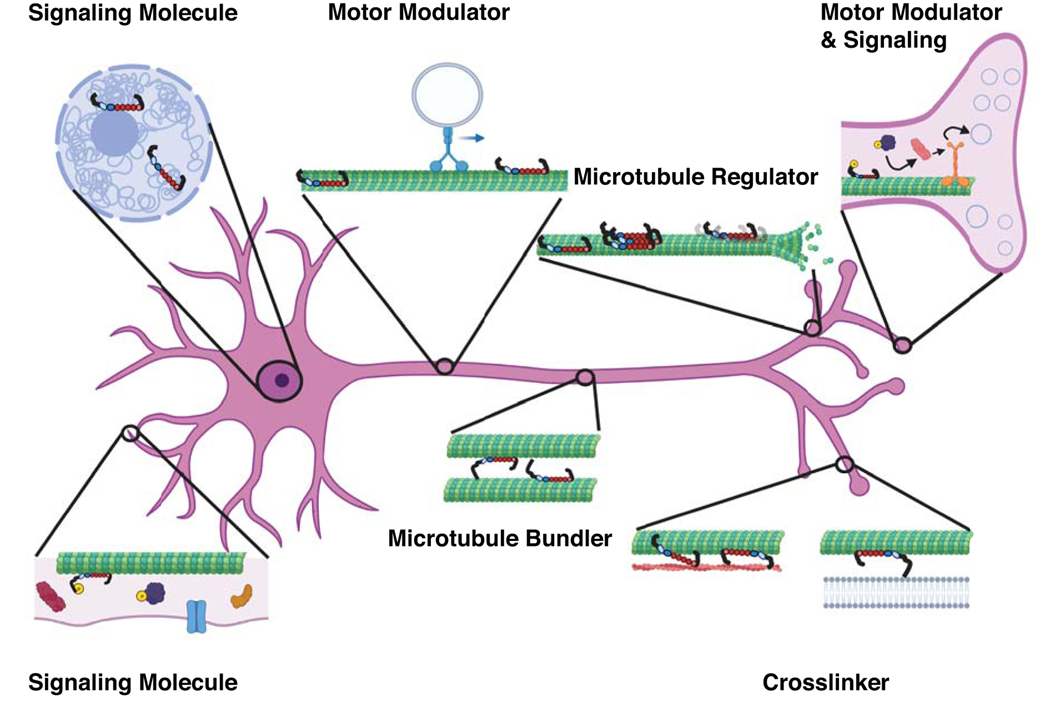
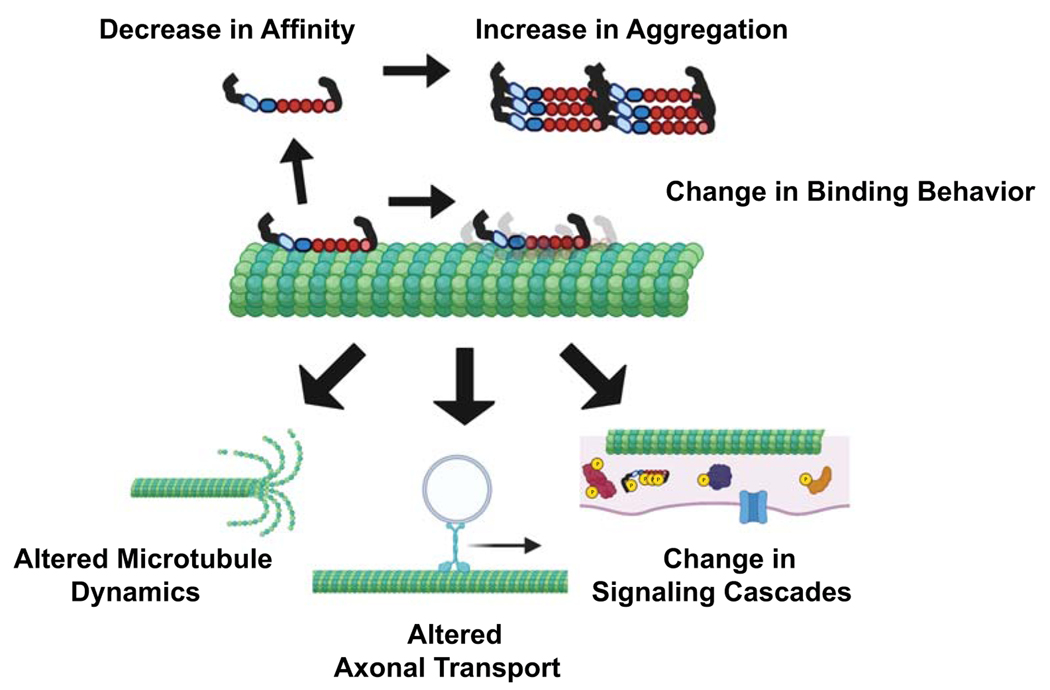
Multi-faceted functions of Tau protein. Tau has many interrelated functions that go beyond its role as a microtubule stabilizer. These additional functions, which occur at different regions in the neuron, include acting as a signaling molecule, cross-linker, and modulator of transport. Each of these interrelated functions can be modified by the Tau isoform, Tau binding behavior, post-translational modifications, and disease mutations. (Created with biorender.com)
Figure 5
Figure 5
Updated Tauopathy Disease Model. Tau disease onset is likely to occur through a number of different mechanisms including, decrease in microtubule affinity, increase in aggregation propensity, or altered binding behavior. This alters Tau functions including microtubule regulation, modulation of motor transport, participation of signaling cascades, etc. (created with biorender.com)

References

    1. Binder LI, Frankfurter A, Rebhun LI (1985). The distribution of tau in the mammalian central nervous system. J Cell Biol, 101, 1371–8. - PMC - PubMed
    1. Josephs KA (2017). Current Understanding of Neurodegenerative Diseases Associated With the Protein Tau. Mayo Clin Proc, 92, 1291–1303. - PMC - PubMed
    1. Dehmelt L, Halpain S (2005). The MAP2/Tau family of microtubule-associated proteins. Genome Biol, 6, 204. - PMC - PubMed
    1. Butner KA, Kirschner MW (1991). Tau protein binds to microtubules through a flexible array of distributed weak sites. J Cell Biol, 115, 717–30. - PMC - PubMed
    1. Gustke N, Trinczek B, Biernat J, Mandelkow EM, Mandelkow E. (1994). Domains of tau protein and interactions with microtubules. Biochemistry, 33, 9511–22. - PubMed

Publication types

MeSH terms