Review
. 2023 Jul;169(7):001367.
doi: 10.1099/mic.0.001367.

Killing in the name of: T6SS structure and effector diversity

Affiliations
Review

Killing in the name of: T6SS structure and effector diversity

Luke P Allsopp et al. Microbiology (Reading). 2023 Jul.

Abstract

The life of bacteria is challenging, to endure bacteria employ a range of mechanisms to optimize their environment, including deploying the type VI secretion system (T6SS). Acting as a bacterial crossbow, this system delivers effectors responsible for subverting host cells, killing competitors and facilitating general secretion to access common goods. Due to its importance, this lethal machine has been evolutionarily maintained, disseminated and specialized to fulfil these vital functions. In fact, T6SS structural clusters are present in over 25 % of Gram-negative bacteria, varying in number from one to six different genetic clusters per organism. Since its discovery in 2006, research on the T6SS has rapidly progressed, yielding remarkable breakthroughs. The identification and characterization of novel components of the T6SS, combined with biochemical and structural studies, have revealed fascinating mechanisms governing its assembly, loading, firing and disassembly processes. Recent findings have also demonstrated the efficacy of this system against fungal and Gram-positive cells, expanding its scope. Ongoing research continues to uncover an extensive and expanding repertoire of T6SS effectors, the genuine mediators of T6SS function. These studies are shedding light on new aspects of the biology of prokaryotic and eukaryotic organisms. This review provides a comprehensive overview of the T6SS, highlighting recent discoveries of its structure and the diversity of its effectors. Additionally, it injects a personal perspective on avenues for future research, aiming to deepen our understanding of this combative system.

Keywords: T6SS; T6SS assembly; Type VI secretion system; antieukaryotic effectors; antimicrobial effectors; baseplate; contractile sheath; inner tube; membrane complex; tail.


Conflict of interest statement

The authors declare no competing interest.

Figures
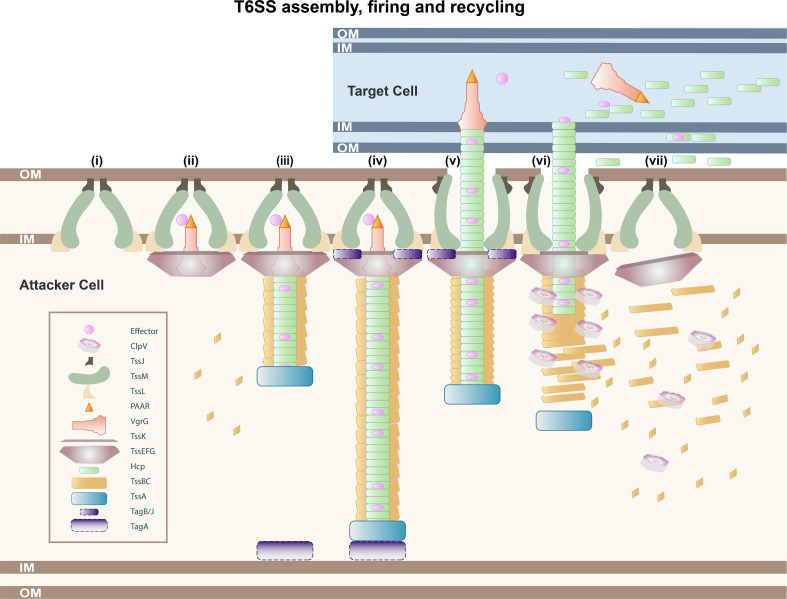
Fig. 1.
Fig. 1.
Schematic representation of a T6SS being assembled, fired and recycled. (i) The membrane complex (TssJLM) inserts and assembles in the membrane. This tethers the system to the cell envelope; (ii) and recruits the baseplate (TssEFGK) structure that is shown in brown. The VgrG/PAAR spike complex (red/orange) is the hub of the baseplate. Effectors (pink) can be loaded to the spike complex. (iii) TssA protein (blue) primes polymerization of the tail from the VgrG hub and is located at the end of the growing structure. The tail is composed of the inner Hcp tube (green) with loaded effectors (pink) and the outer contractile TssBC sheath (yellow). (iv) The tail polymerizes until it reaches the opposite side of the cell. Depending on the systems, the sheath can be stabilized by TagA or TagB/J accessory proteins (purple). TagA is recruited by TssA to clamp the end of the sheath to the opposing cell membrane alternatively TagB/J are recruited to the baseplate by TssA. (v) Upon a signal, a conformational change in the baseplate triggers the progressive contraction of the sheath from the baseplate that propels the inner tube, spike and the associated effectors outside and into the target cell (or environment). (vi) The contracted sheath is disassembled for recycling by the ATPase ClpV. (vii) The membrane complex remains and it can be reused to assemble a new T6SS. Model depicts a Gram-negative bacterial prey cell, but this could also be a eukaryotic cell or as recently shown a fungal cell or Gram-positive bacterium. (Inset) A key to the colours and shapes used to depict T6SS protein components.
Fig. 2.
Fig. 2.
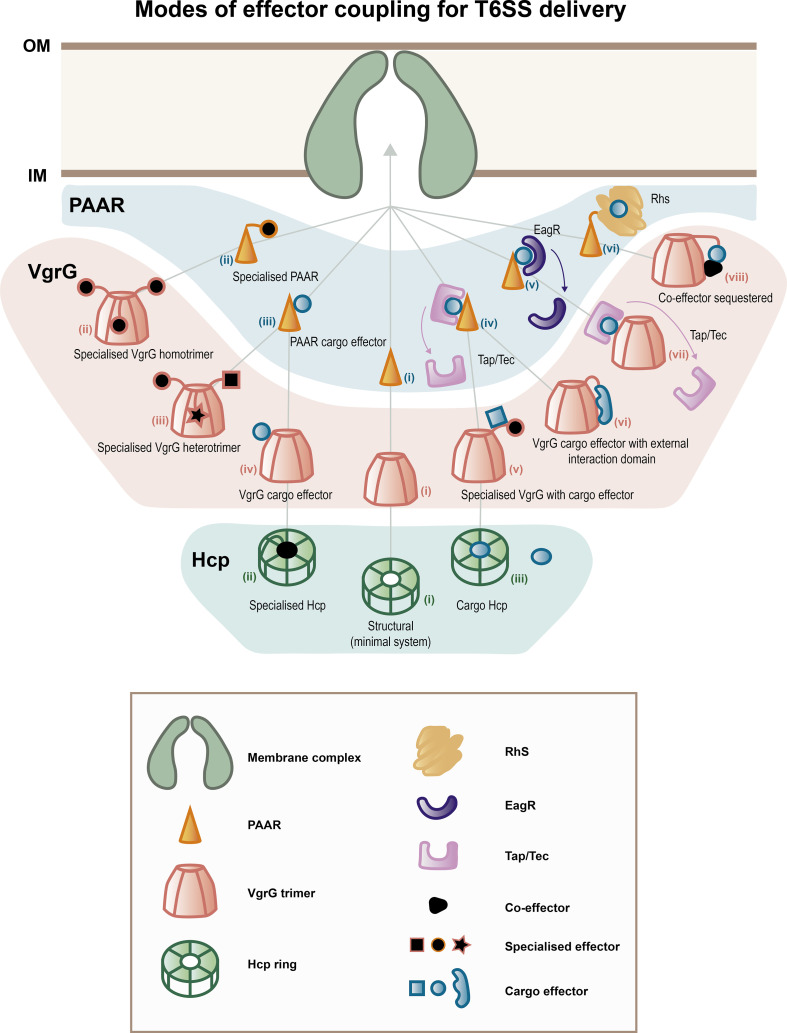
Modes of effector coupling to T6SS components for T6SS delivery. Model representing the variability encountered during assembly of the structural components of the T6SS that are secreted, i.e. the spike complex (PAAR and VgrG trimer) and the Hcp inner tube; both of which can be loaded with effectors. Exclusively one PAAR protein (shaded blue) is loaded per spike onto a trimer of VgrG proteins (shaded red) and followed by the addition of the Hcp rings (shaded green). Grey arrows represent step-wise binding and loading and are not restrictive paths, i.e. multiple potential combinations of the components can assemble a loaded system. (Note that different combinations of assemblies can also occur, e.g. different PAARs with different VgrGs or specialized VgrGs with VgrGs that load cargo effectors in the one trimer that are not depicted for simplicity). Pink/purple arrows depict components (chaperones/adaptors) that are required for loading effectors onto the system (Eag/Tec/Tap) (Note that Tec/Tap proteins can have additional interaction partners named co-Tec proteins that are not shown). The secretion of these proteins has not been demonstrated so are suggested to be stripped off during effector loading. Hcp proteins can either be ( i ) structural with no effector loaded, (ii) specialized (an extra effector domain of a Hcp protein) or (iii) Hcp acting as a chaperone for loading of a cargo effector. Models of VgrG trimers: (i) simplest configuration, with purely structural proteins depicted and no effectors loaded, (ii) specialized VgrG, where additional effector domains are present as extensions of the VgrG protein. Depending on the number of VgrGs secreted by a single system, they can have homotrimers or (iii) specialised VgrG heterotrimer with different effectors loaded. It can also have specialised VgrGs trimerising with purely structural VgrGs or VgrGs that bind cargo effectors (not shown). (iv) VgrG with cargo effector bound for secretion/delivery (can also have three VgrGs with each interacting with a cargo effector). (v) Specialized VgrG can encode additional domains that facilitate loading of a cargo effector. (vi) VgrG with cargo effector that has external interaction domains. (vii) VgrG with chaperone/adaptor assisted loading of an effector with a Tec/Tap protein. No evidence of Tec/Tap secretion. (viii) VgrG with co-effector. Effectors and co-effectors are required for binding to a VgrG and are both secreted. Models of PAAR proteins: ( i ) simplest configuration, with only a structural role for hardening of the T6SS spike complex and no effectors loaded. (ii) Specialized PAAR with effector domain encoded in the one protein. (iii) PAAR with cargo effector loaded. (iv) PAAR with cargo effector loaded that requires a Tap/Tec adaptor/chaperone protein for effector coupling. No evidence for Tap/Tec secretion. (v) PAAR with cargo effector loaded that requires a Eag adaptor/chaperone protein. No evidence for Eag secretion. (vi) PAAR with Rhs effector protein loaded. (Note that Rhs effectors can be specialized or cargo effectors and may require a chaperone/adaptor protein or domain that is not shown in this model for simplicity). Different combinations of PAAR, VgrG and Hcp proteins can result in a payload of effector proteins to the extracellular environment or directly into target cells. These effectors can have synergistic functions, but a combination of effectors also increases the chances that T6SS puncture will deliver effectors that are functional in different targets.
Fig. 3.
Fig. 3.
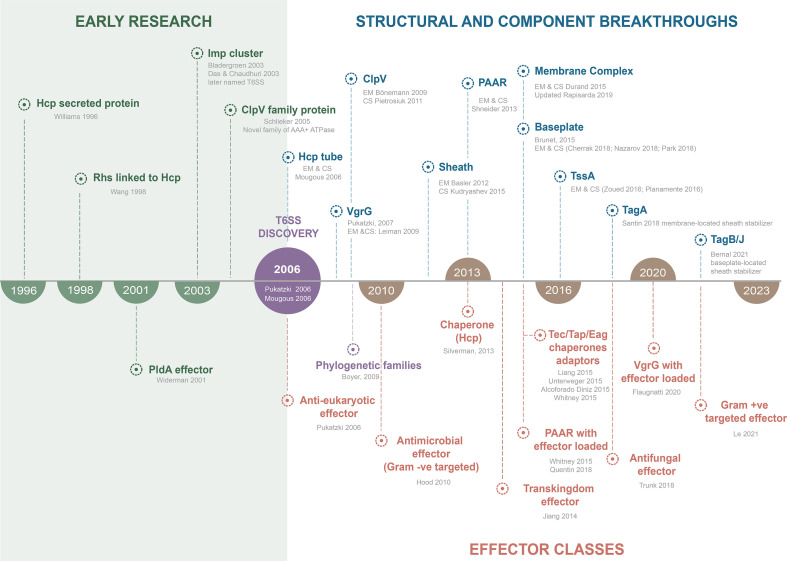
Timeline infographic of T6SS research covering early studies before the T6SS was coined to recent advancements. Graphic highlights key structural breakthroughs and milestones including when the effector classes were first identified in the literature. EM=electron microscopy, CS=crystal structure.

References

    1. Pukatzki S, Ma AT, Sturtevant D, Krastins B, Sarracino D, et al. Identification of a conserved bacterial protein secretion system in Vibrio cholerae using the Dictyostelium host model system. Proc Natl Acad Sci. 2006;103:1528–1533. doi: 10.1073/pnas.0510322103. - DOI - PMC - PubMed
    1. Trunk K, Peltier J, Liu Y-C, Dill BD, Walker L, et al. The type VI secretion system deploys antifungal effectors against microbial competitors. Nat Microbiol. 2018;3:920–931. doi: 10.1038/s41564-018-0191-x. - DOI - PMC - PubMed
    1. Yang X, Liu H, Zhang Y, Shen X. Roles of type VI secretion system in transport of metal ions. Front Microbiol. 2021;12:756136. doi: 10.3389/fmicb.2021.756136. - DOI - PMC - PubMed
    1. Wang T, Si M, Song Y, Zhu W, Gao F, et al. Type VI secretion system transports Zn²⁺ to combat multiple stresses and host immunity. PLoS Pathog. 2015;11:e1005020. doi: 10.1371/journal.ppat.1005020. - DOI - PMC - PubMed
    1. Hernandez RE, Gallegos-Monterrosa R, Coulthurst SJ. Type VI secretion system effector proteins: effective weapons for bacterial competitiveness. Cell Microbiol. 2020;22:e13241. doi: 10.1111/cmi.13241. - DOI - PubMed

Publication types

MeSH terms

Substances

LinkOut - more resources