


Impact of the Introduction of a Package of Diagnostic Tools, Diagnostic Algorithm, and Training and Communication on Outpatient Acute Fever Case Management at 3 Diverse Sites in Uganda: Results of a Randomized Controlled Trial
- PMID: 37490746
- PMCID: PMC10368415
- DOI: 10.1093/cid/ciad341
Impact of the Introduction of a Package of Diagnostic Tools, Diagnostic Algorithm, and Training and Communication on Outpatient Acute Fever Case Management at 3 Diverse Sites in Uganda: Results of a Randomized Controlled Trial
Erratum in
-
Correction to: Impact of the Introduction of a Package of Diagnostic Tools, Diagnostic Algorithm, and Training and Communication on Outpatient Acute Fever Case Management at 3 Diverse Sites in Uganda: Results of a Randomized Controlled Trial.Clin Infect Dis. 2024 Apr 10;78(4):1082-1083. doi: 10.1093/cid/ciad733. Clin Infect Dis. 2024. PMID: 38408198 Free PMC article. No abstract available.
Abstract
Background: Increasing trends of antimicrobial resistance are observed around the world, driven in part by excessive use of antimicrobials. Limited access to diagnostics, particularly in low- and middle-income countries, contributes to diagnostic uncertainty, which may promote unnecessary antibiotic use. We investigated whether introducing a package of diagnostic tools, clinical algorithm, and training-and-communication messages could safely reduce antibiotic prescribing compared with current standard-of-care for febrile patients presenting to outpatient clinics in Uganda.
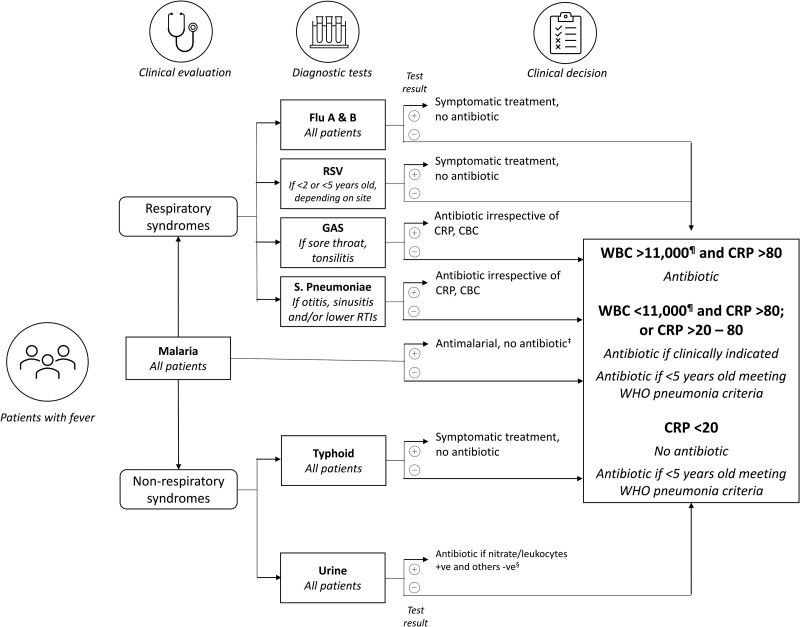
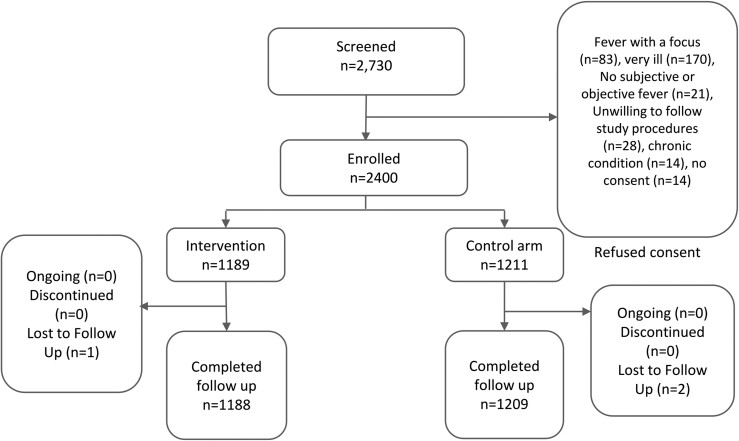
Methods: This was an open-label, multicenter, 2-arm randomized controlled trial conducted at 3 public health facilities (Aduku, Nagongera, and Kihihi health center IVs) comparing the proportions of antibiotic prescriptions and clinical outcomes for febrile outpatients aged ≥1 year. The intervention arm included a package of point-of-care tests, a diagnostic and treatment algorithm, and training-and-communication messages. Standard-of-care was provided to patients in the control arm.
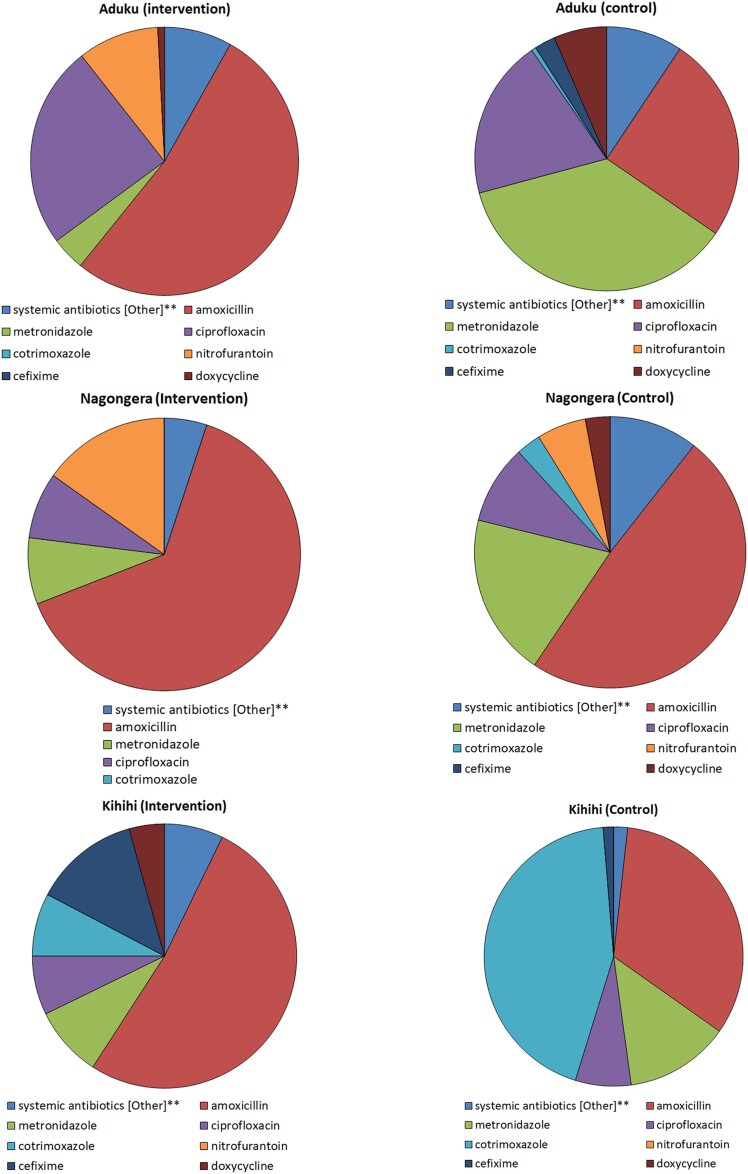
Results: A total of 2400 patients were enrolled, with 49.5% in the intervention arm. Overall, there was no significant difference in antibiotic prescriptions between the study arms (relative risk [RR]: 1.03; 95% CI: .96-1.11). In the intervention arm, patients with positive malaria test results (313/500 [62.6%] vs 170/473 [35.9%]) had a higher RR of being prescribed antibiotics (1.74; 1.52-2.00), while those with negative malaria results (348/688 [50.6%] vs 376/508 [74.0%]) had a lower RR (.68; .63-.75). There was no significant difference in clinical outcomes.
Conclusions: This study found that a diagnostic intervention for management of febrile outpatients did not achieve the desired impact on antibiotic prescribing at 3 diverse and representative health facility sites in Uganda.
Keywords: acute febrile illness; antimicrobial resistance; antimicrobial stewardship; behavior change; point-of-care tests.
© The Author(s) 2023. Published by Oxford University Press on behalf of Infectious Diseases Society of America.
Conflict of interest statement
Potential conflicts of interest. S. D., O. S., P. O., and J. N. were employees of FIND. P. H. reports research funding from FIND and an honoraria payment from Oxford International Biomedical Centre (OIBC). H. H. is a salaried employee of the London School of Hygiene and Tropical Medicine and received separate financial support from the study sponsors for some work on the project reported in this supplement. They receive salary support from the UK Foreign Commonwealth and Development Office. They receive royalties from UpToDate, a clinical decision support tool from Wolters Kluwer for authoring and maintaining the chapter on “Laboratory tools for diagnosis of malaria.” During the study period, they received honoraria for lecturing for the University of Virginia and for a doctoral thesis review for the University of Otago in New Zealand. They also hold index-linked mutual fund and retirement account investments. S. W. reports grant funding from FIND for statistical analysis and services from Agentur für Computeranwendungen in der Medizin (ACOMED). T. K. reports statistical design and analysis grant funding and consultation fees from FIND. All other authors report no potential conflicts. All authors have submitted the ICMJE Form for Disclosure of Potential Conflicts of Interest. Conflicts that the editors consider relevant to the content of the manuscript have been disclosed.
Figures
References
-
- World Health Organization. Global Action Plan on Antimicrobial Resistance . Available at: https://www.who.int/publications-detail-redirect/9789241509763. Accessed 4 December 2022.
-
- World Health Organization. Uganda: Antimicrobial Resistance National Action Plan 2018–2023 . Available at: https://www.who.int/publications/m/item/uganda-antimicrobial-resistance-.... Accessed 4 December 2022.
-
- GARP—Uganda Situation Analysis . Available at: https://onehealthtrust.org/publications/reports/garp-uganda-situation-an.... Accessed 4 December 2022.
Publication types
MeSH terms
Substances
LinkOut - more resources
Full Text Sources
Medical
