Substantial increase in stillbirth rate during the COVID-19 pandemic: results from a population-based study in the Indian state of Bihar
- PMID: 37491108
- PMCID: PMC10373740
- DOI: 10.1136/bmjgh-2023-013021
Substantial increase in stillbirth rate during the COVID-19 pandemic: results from a population-based study in the Indian state of Bihar
Abstract
Introduction: We report on the stillbirth rate (SBR) and associated risk factors for births during the COVID-19 pandemic, and change in SBR between prepandemic (2016) and pandemic periods in the Indian state of Bihar.
Methods: Births between July 2020 and June 2021 (91.5% participation) representative of Bihar were listed. Stillbirth was defined as fetal death with gestation period of ≥7 months where the fetus did not show any sign of life. Detailed interviews were conducted for all stillbirths and neonatal deaths, and for 25% random sample of surviving live births. We estimated overall SBR, and during COVID-19 peak and non-peak periods per 1000 births. Multiple logistic regression models were run to assess risk factors for stillbirth. The change in SBR for Bihar from 2016 to 2020-2021 was estimated.
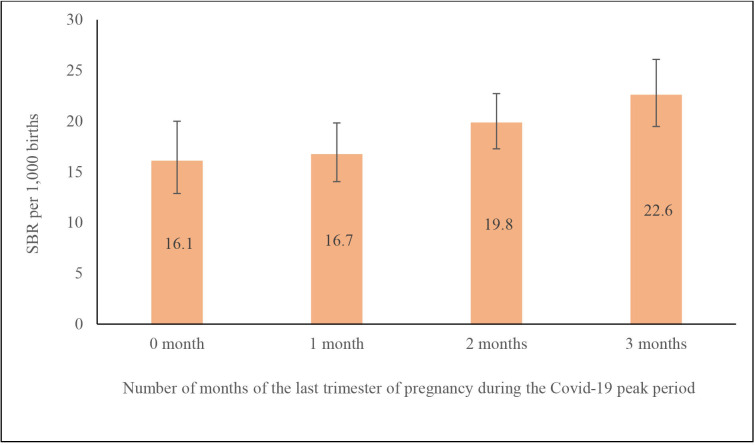
Results: We identified 582 stillbirths in 30 412 births with an estimated SBR of 19.1 per 1000 births (95% CI 17.7 to 20.7); SBR was significantly higher in private facility (38.4; 95% CI 34.3 to 43.0) than in public facility (8.6; 95% CI 7.3 to 10.1) births, and for COVID-19 peak (21.2; 95% CI 19.2 to 23.4) than non-peak period (16.3; 95% CI 14.2 to 18.6) births. Pregnancies with the last pregnancy trimester during the COVID-19 peak period had 40.4% (95% CI 10.3% to 70.4%) higher SBR than those who did not. Risk factor associations for stillbirths were similar between the COVID-19 peak and non-peak periods, with gestation age of <8 months with the highest odds of stillbirth followed by referred deliveries and deliveries in private health facilities. A statistically significant increase of 24.3% and 68.9% in overall SBR and intrapartum SBR was seen between 2016 and 2020-2021, respectively.
Conclusions: This study documented an increase in SBR during the COVID-19 pandemic as compared with the prepandemic period, and the varied SBR based on the intensity of the COVID-19 pandemic and by the place of delivery.
Keywords: COVID-19; community-based survey; health systems; maternal health; public health.
© Author(s) (or their employer(s)) 2023. Re-use permitted under CC BY. Published by BMJ.
Conflict of interest statement
Competing interests: None declared.
Figures
References
-
- Gajbhiye RK, Sawant MS, Kuppusamy P, et al. Differential impact of COVID-19 in pregnant women from high-income countries and Low- to middle-income countries: A systematic review and meta-analysis. Intl J Gynecology & Obste 2021;155:48–56. 10.1002/ijgo.13793 Available: https://onlinelibrary.wiley.com/toc/18793479/155/1 - DOI - PMC - PubMed
Publication types
MeSH terms
LinkOut - more resources
Full Text Sources
Medical