. 2023 Jul 26;290(2003):20231268.
doi: 10.1098/rspb.2023.1268. Epub 2023 Jul 26.

The price of being late: short- and long-term consequences of a delayed migration timing

Affiliations

The price of being late: short- and long-term consequences of a delayed migration timing

Iris D Bontekoe et al. Proc Biol Sci. .

Abstract

Choosing the right migration timing is critical for migrants because conditions encountered en route influence movement costs, survival, and, in social migrants, the availability of social information. Depending on lifetime stages, individuals may migrate at different times due to diverging constraints, affecting the composition of migration groups. To examine the consequences of a delayed migration timing, we artificially delayed the migration of juvenile white storks (Ciconia ciconia) and thereby altered their physical and social environment. Using nearly continuous 1 Hz GPS trajectories, we examined their migration behaviour, ranging from sub-second level performance to global long-distance movement, in relation to two control groups. We found that delayed storks experienced suboptimal soaring conditions, but better wind support and thereby achieved higher flight speeds than control storks. Delayed storks had a lower mortality rate than the control storks and wintered closer to the breeding area. In fact, none of the delayed storks reached the traditional African wintering areas. Thus, our results show that juvenile storks can survive migrating at the 'wrong' time. However, this had long-term consequences on migration decisions. We suggest that, when timing their migration, storks balance not just energy and time, but also the availability of social information.

Keywords: experiment; migration; movement ecology; social information; time–energy trade-off; white stork.


Conflict of interest statement

We declare we have no competing interests.

Figures
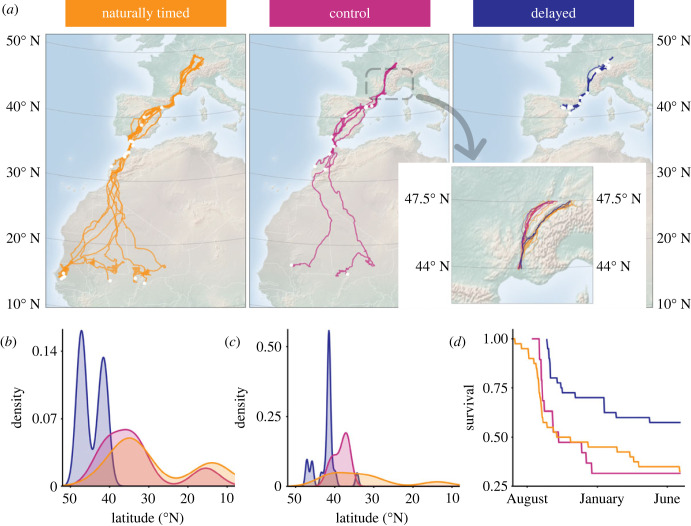
Figure 1.
Figure 1.
Differences in migration patterns and survival between naturally timed (orange), control (pink) and delayed (blue) storks. (a) Migration tracks from each of the three study groups (naturally timed: 23 individuals; control: 12 individuals; delayed: 32 individuals). White dots represent the location where the stork reached its most southern latitude. Inset: the migration segment. (b) Probability densities of wintering latitude for individuals from all three groups in their first migration year (naturally timed: 23 individuals; control: 12 individuals; delayed: 32 individuals), and (c) in their second migration year (naturally timed: 13 individuals; control: 5 individuals; delayed: 21 individuals). Wintering latitude is defined as the most southern latitude of each individual in the given year. (c) Survival (proportion of individuals in each group that were alive) against time of the year. For naturally timed storks (40 individuals), survival is shown from 1 June. For control (19 individuals) and delayed (40 individuals) storks, survival is only shown from their release dates. Probability densities are kernel density estimates based on histograms of the raw data, also referred to as smoothed histograms.
Figure 2.
Figure 2.
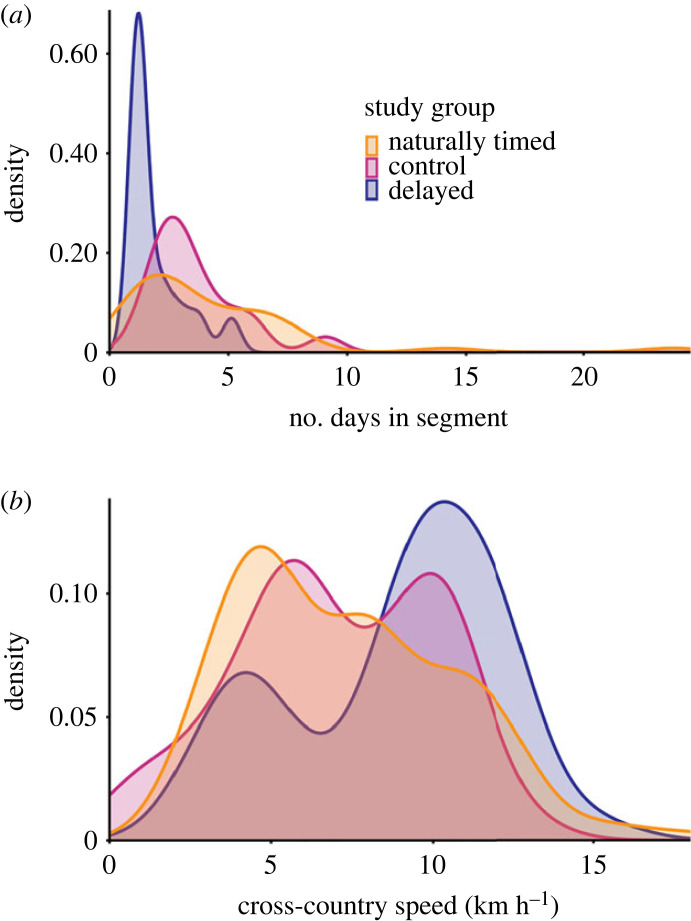
Differences in migration speed between naturally timed (orange, 36 individuals), control (pink, 17 individuals) and delayed (blue, 15 individuals) storks. (a) Probability densities of the number of days that individuals from each study group took to cover the migration segment. (b) Probability densities of cross-country speed per study group. Probability densities are kernel density estimates based on histograms of the raw data.
Figure 3.
Figure 3.
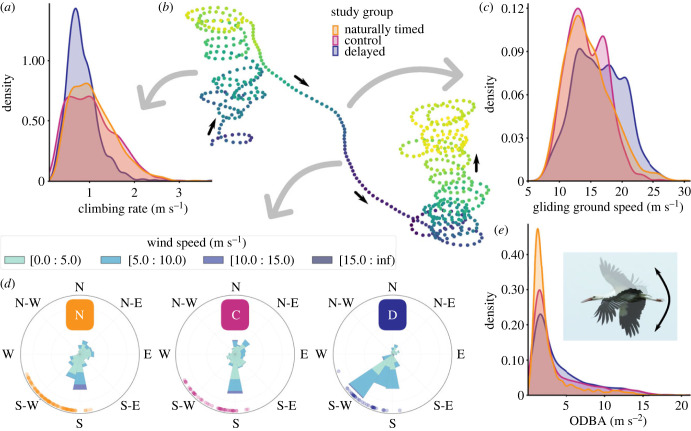
Differences in fine-scale flight performance between naturally timed (orange, 36 individuals), control (pink, 17 individuals) and delayed (blue, 15 individuals) storks. (a) Probability densities of climbing rates within the migration segment for each of the study groups. (b) Visualization of one 10-minute GPS-burst, consisting of two thermalling bouts with a gliding bout in between. Colours represent altitudes, ranging from blue (low altitudes) to yellow (high altitudes). (c) Probability densities of the ground speed during gliding bouts within the migration segment, for each of the study groups. (d) Windrose plots of experienced wind speed and direction during gliding bouts within the migration segment for each of the three study groups (N: naturally timed, C: control, D: delayed). Dots indicate the daily average heading of individuals during gliding bouts. (e) Probability densities of ODBA, an indication for the amount of flapping flight, for each of the study groups. Probability densities are kernel density estimates based on histograms of the raw data. The stork photo is taken by Iris Bontekoe.

References

    1. Fudickar AM, Jahn AE, Ketterson ED. 2021. Animal migration: an overview of one of nature's great spectacles. Annu. Rev. Ecol. Evol. Syst. 52, 479-497. (10.1146/annurev-ecolsys-012021-031035) - DOI
    1. Justen H, Delmore KE. 2022. The genetics of bird migration. Curr. Biol. 32, R1144-R1149. (10.1016/j.cub.2022.07.008) - DOI - PubMed
    1. Putman NF, Scanlan MM, Billman EJ, O'Neil JP, Couture RB, Quinn TP, Lohmann KJ, Noakes DLG. 2014. An inherited magnetic map guides ocean navigation in Juvenile Pacific Salmon. Curr. Biol. 24, 446-450. (10.1016/j.cub.2014.01.017) - DOI - PubMed
    1. Aikens EO, Bontekoe ID, Blumenstiel L, Schlicksupp A, Flack A. 2022. Viewing animal migration through a social lens. Trends Ecol. Evol. 37, 985-996. (10.1016/j.tree.2022.06.008) - DOI - PubMed
    1. Oestreich WK, Aiu KM, Crowder LB, McKenna MF, Berdahl AM, Abrahms B. 2022. The influence of social cues on timing of animal migrations. Nat. Ecol. Evol. 6, 1617-1625. (10.1038/s41559-022-01866-0) - DOI - PubMed

Publication types

LinkOut - more resources