


Sedation strategies for pulsed-field ablation of atrial fibrillation: focus on deep sedation with intravenous ketamine in spontaneous respiration
- PMID: 37494101
- PMCID: PMC10434732
- DOI: 10.1093/europace/euad230
Sedation strategies for pulsed-field ablation of atrial fibrillation: focus on deep sedation with intravenous ketamine in spontaneous respiration
Abstract
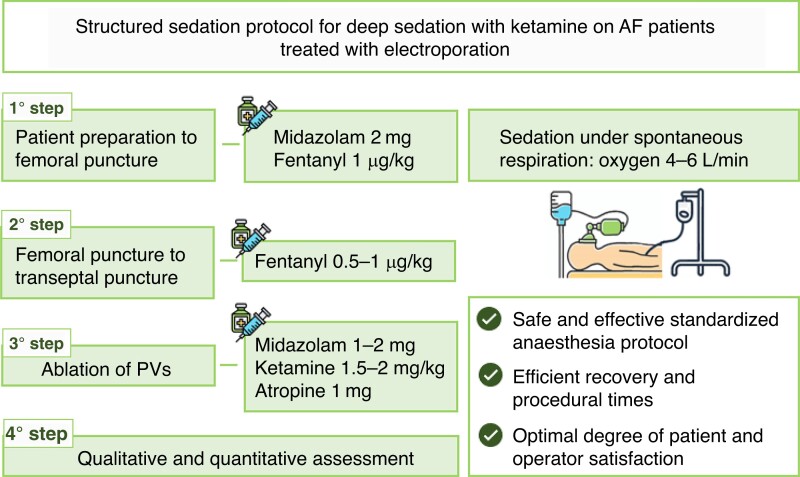
Aims: A standardized sedation protocol for pulsed-field ablation (PFA) of atrial fibrillation (AF) through irreversible cellular electroporation has not been well established. We report our experience of a protocol for deep sedation with ketamine in spontaneous respiration during the PFA of AF.
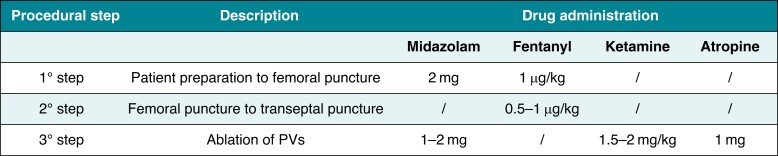
Methods and results: All consecutive patients undergoing PFA for AF at our center were included. Our sedation protocol involves the intravenous administration of fentanyl (1.5 mcg/kg) and midazolam (2 mg) at low doses before local anesthesia with lidocaine. A ketamine adjunct (1 mg/kg) was injected about 5 minutes before the first PFA delivery. We enrolled 66 patients (age = 59 ± 9 years, 78.8% males, body mass index = 28.8 ± 5 kg/m2, fluoroscopy time = 21[15-30] min, skin-to-skin time = 75[60-100] min and PFA LA dwell time = 25[22-28] min). By the end of the procedure, PVI had been achieved in all patients by means of PFA alone. The mean time under sedation was 56.4 ± 6 min, with 50 (76%) patients being sedated for less than 1 hour. A satisfactory Ramsey Sedation Scale level before ketamine infusion was achieved in all patients except one (78.8% of the patients with rank 3; 19.7% with rank 2). In all procedures, the satisfaction level was found to be acceptable by both the patient and the primary operator (Score = 0 in 98.5% of cases). All patients reported none or mild pain. No major procedure or anesthesia-related complications were reported.
Conclusion: Our standardized sedation protocol with the administration of drugs with rapid onset and pharmacological offset at low doses was safe and effective, with an optimal degree of patient and operator satisfaction.
Clinical trial registration: Advanced TecHnologies For SuccEssful AblatioN of AF in Clinical Practice (ATHENA). URL: http://clinicaltrials.gov/Identifier: NCT05617456.
Keywords: Anaesthesia; Atrial fibrillation; Cellular electroporation; Ketamine; Pulsed-field ablation; Sedation strategy.
© The Author(s) 2023. Published by Oxford University Press on behalf of the European Society of Cardiology.
Conflict of interest statement
Conflict of interest: M.M. is an employee of Boston Scientific. The other authors have no conflicts of interest to declare that are relevant to the content of this article.
Figures
Comment in
-
Deep sedation for pulsed field ablation by electrophysiology staff: can and should we do it?Europace. 2023 Aug 2;25(9):euad234. doi: 10.1093/europace/euad234. Europace. 2023. PMID: 37515587 Free PMC article. No abstract available.
References
-
- Garcia R, Waldmann V, Vanduynhoven P, Nesti M, Jansen de Oliveira Figueiredo M, Narayanan Ket al. Worldwide sedation strategies for atrial fibrillation ablation: current status and evolution over the last decade. Europace 2021;23:2039–45. - PubMed
-
- Hindricks G, Potpara T, Dagres N, Arbelo E, Bax JJ, Blomström-Lundqvist Cet al. 2020 ESC Guidelines for the diagnosis and management of atrial fibrillation developed in collaboration with the European Association for Cardio-Thoracic Surgery (EACTS): the Task Force for the diagnosis and management of atrial fibrillation of the European Society of Cardiology (ESC) developed with the special contribution of the European Heart Rhythm Association (EHRA) of the ESC. Eur Heart J 2021;42:373–498. - PubMed
-
- Parameswaran R, Al-Kaisey A, Kalman J. Catheter ablation for atrial fibrillation: current indications and evolving technologies. Nat Rev Cardiol 2021;18:210–25. - PubMed
Publication types
MeSH terms
Substances
Associated data
LinkOut - more resources
Full Text Sources
Medical
