Review
. 2023 Jul 26;12(1):37.
doi: 10.1186/s40035-023-00369-7.

Clinical evidence of human pathogens implicated in Alzheimer's disease pathology and the therapeutic efficacy of antimicrobials: an overview

Affiliations
Review

Clinical evidence of human pathogens implicated in Alzheimer's disease pathology and the therapeutic efficacy of antimicrobials: an overview

Celso S G Catumbela et al. Transl Neurodegener. .

Abstract

A wealth of pre-clinical reports and data derived from human subjects and brain autopsies suggest that microbial infections are relevant to Alzheimer's disease (AD). This has inspired the hypothesis that microbial infections increase the risk or even trigger the onset of AD. Multiple models have been developed to explain the increase in pathogenic microbes in AD patients. Although this hypothesis is well accepted in the field, it is not yet clear whether microbial neuroinvasion is a cause of AD or a consequence of the pathological changes experienced by the demented brain. Along the same line, the gut microbiome has also been proposed as a modulator of AD. In this review, we focus on human-based evidence demonstrating the elevated abundance of microbes and microbe-derived molecules in AD hosts as well as their interactions with AD hallmarks. Further, the direct-purpose and potential off-target effects underpinning the efficacy of anti-microbial treatments in AD are also addressed.

Keywords: Alzheimer’s disease; Amyloid-β; Infections; Pathogens.


Conflict of interest statement

The authors have no relevant conflicts of interest to disclose in regards to this article.

Figures
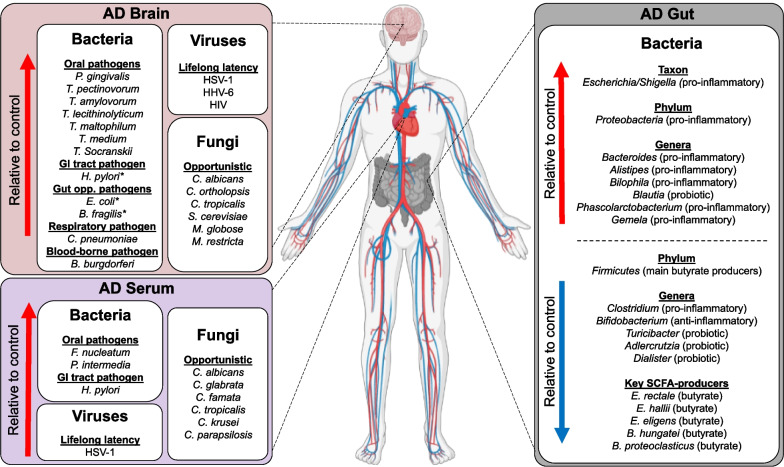
Fig. 1
Fig. 1
Diagram depicting major pathogens associated with Alzheimer’s disease in brain, gut and serum. Gut opp. pathogens: gut opportunistic pathogens; *indicates the cerebral presence of microbe-derived molecules only (e.g., associated LPS, toxins, and immunoglobulin G). Figure created using BioRender
Fig. 2
Fig. 2
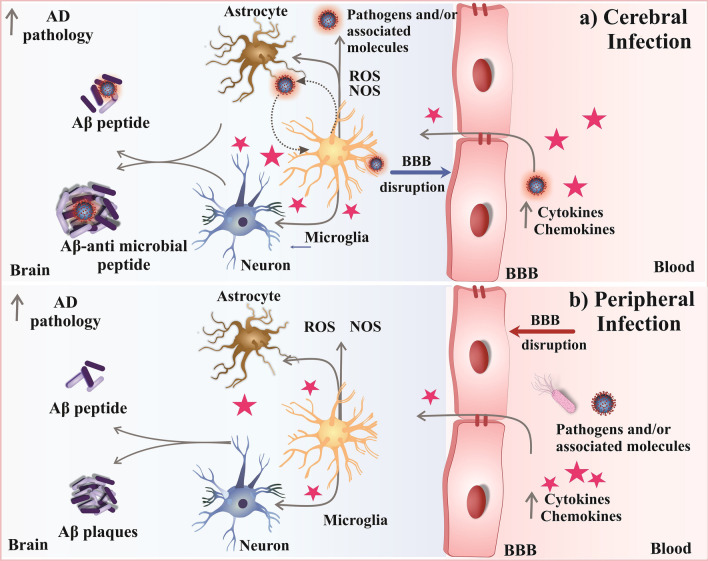
Potential mechanisms linking microbial infection with AD risks. a In the context of CNS infection, microglia recognize invading pathogens and engulf them. This activates inflammatory responses including the release of pro-inflammatory cytokines, increase of reactive oxygen species (ROS) and overactivation of nitric oxide synthase (NOS). Activated microglial cells lose homeostasis and produce more pro-inflammatory cytokines and chemokines, which help clear pathogens but also affect astrocytes and neuronal function. Alternatively, Aβ released from astrocytes and neuronal cells may act as an antimicrobial molecule after misfolding. However, the accumulation of misfolded Aβ species derived from this process may initiate AD pathology. b During peripheral infection, the excessive cytokines and chemokines present in blood infiltrate the BBB and activate microglia. Activated microglial cells lose homeostasis and produce high levels of pro-inflammatory cytokines and chemokines, activating astrocytes and damaging neurons. This cerebral inflammatory response exacerbates the deposition of Aβ in the brain parenchyma through multiple mechanisms, thus facilitating AD pathological cascades. AD: Alzheimer’s disease; Aβ: amyloid beta; BBB: blood–brain barrier; NOS: nitric oxide synthase; ROS: reactive oxygen species. Figure created using CorelDRAW

References

    1. Fulop T, Witkowski JM, Bourgade K, Khalil A, Zerif E, Larbi A, et al. Can an infection hypothesis explain the beta amyloid hypothesis of Alzheimer’s disease? Front Aging Neurosci. 2018;10:224. doi: 10.3389/fnagi.2018.00224. - DOI - PMC - PubMed
    1. Zhu J, Ge F, Zeng Y, Qu Y, Chen W, Yang H, et al. Physical and mental activity, disease susceptibility, and risk of dementia: a prospective cohort study based on UK biobank. Neurology. 2022;99:E799–813. doi: 10.1212/WNL.0000000000200701. - DOI - PMC - PubMed
    1. Maciejewska K, Czarnecka K, Szymański P. A review of the mechanisms underlying selected comorbidities in Alzheimer’s disease. Pharmacol Rep. 2021;73(6):1565–1581. doi: 10.1007/s43440-021-00293-5. - DOI - PMC - PubMed
    1. Zazzara MB, Vetrano DL, Carfì A, Liperoti R, Damiano C, Onder G. Comorbidity patterns in institutionalized older adults affected by dementia. Alzheimers Dement. 2022;14:e12320. - PMC - PubMed
    1. Lagisetty Y, Bourquard T, Al-Ramahi I, Mangleburg CG, Mota S, Soleimani S, et al. Identification of risk genes for Alzheimer’s disease by gene embedding. Cell Genom. 2022;2:100162. doi: 10.1016/j.xgen.2022.100162. - DOI - PMC - PubMed

Publication types