. 2023 Jul 25;43(8):61.
doi: 10.1007/s11032-023-01408-x. eCollection 2023 Aug.

A Pseudo-near isogenic F2 population strategy for rapid QTL cloning

Affiliations

A Pseudo-near isogenic F2 population strategy for rapid QTL cloning

Ahmed Sherif et al. Mol Breed. .

Abstract

Near isogenic F2 (NIF2) population frequently developed by conventional backcross has dramatically contributed to QTL identification in plants. Developing such a NIF2 population is time-consuming. Thus, it is urgent to rapidly produce a NIF2 population for QTL cloning. Here, we proposed a rapid QTL cloning strategy by generating a Pseudo-near isogenic F2 population (Pseudo-NIF2), which segregates at the target QTL but is fixed at other QTLs for the target trait. Nineteen QTLs for GL, GW, and TGW were detected in the F2 population from the cross between Zhenshan 97 and Egy316. To verify the efficiency of Pseudo-NIF2 in QTL quick cloning, the novel moderate QTL qGL10.1 which explained 9.1% and 5.6% of grain length variation in F2 and F2:3 populations was taken as an example. An F2 plant (F2-120), which segregated at qGL10.1 but fixed at other 8 QTLs for grain length, was screened to generate a Pseudo-NIF2 population by selfing cross. In the Pseudo-NIF2 population, the segregation ratio of plants with long grains to short grains fits 3:1, indicating that one gene controlled the variation of grain length. Based on the Pseudo-NIF2 and its progeny, qGL10.1 was fine mapped to a 19.3-kb region, where a gene OsMADS56 was verified as the candidate by functional polymorphism between parental alleles. Pseudo-NIF2 strategy is a rapid way for QTL cloning, which saves 3 to 4 cropping seasons compared to the conventional way. Applying the method for cloning QTL with moderate or major effects is promising.

Supplementary information: The online version contains supplementary material available at 10.1007/s11032-023-01408-x.

Keywords: Grain length; Primary QTL mapping; Pseudo-near isogenic F2; Rapid QTL cloning.


Conflict of interest statement

Competing interestsThe authors declare no competing interests.

Figures

Fig. 1
Fig. 1
Comparison of grain shape traits between ZS97 and Egy316 in 2019 and 2020. (A) Grain length, (B) grain width, and (C) thousand-grain weight. (D) Grain morphology of ZS97 and Egy316. Comparison of frequency distributions of grain shape traits in the F2 and F2:3 populations. (E) Grain length, (F) grain width, and (G) thousand-grain weight in both populations. *, **, and *** significance at P < 0.05, 0.01, and 0.001, respectively. The colors were indicated in the figures, yellow for ZS97, red for Egy316 in (A), (B), (C), and yellow for F2 population and red for F2:3 population in (E), (F), and (G)
Fig. 2
Fig. 2
High-density linkage map showing the positions of known genes and QTLs for grain shape traits detected in the F2 and F2:3 populations. The y-axis indicates the genetic distance in centimorgan. Major genes controlling grain size in the ZS97*Egy316 population were presented in black color, the QTLs commonly detected in F2 and F2:3 populations indicated in red color, and the QTLs only detected in F2 or F2:3 population indicated in blue color or purple color, respectively
Fig. 3
Fig. 3
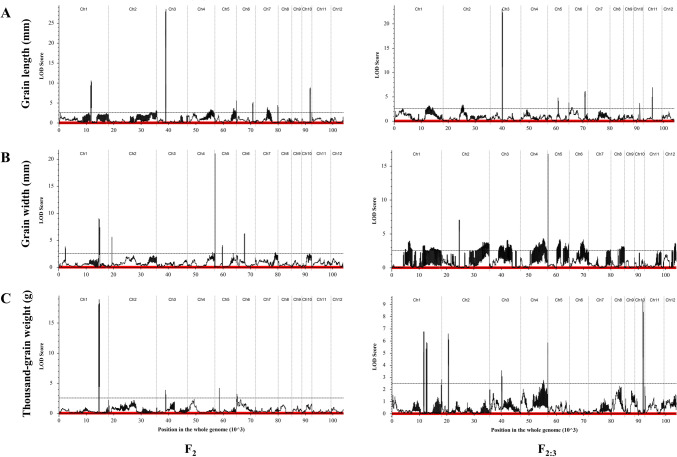
Logarithm of odds (LOD) score curves for the grain shape traits QTLs for (A) grain length, (B) grain width, and (C) thousand-grain weight in F2 and F2:3 populations. Scattered dotted line indicates LOD threshold (2.5)
Fig. 4
Fig. 4
Mapped-based cloning of qGL10.1. (A) The grain length QTLs in the F2-120 plant; three colors represent the genotypes composition; yellow = heterozygous, red = homozygous (ZS97), and blue = homozygous (Egy316). (B) Frequency distribution of grain length in Pseudo-NIF2 (F2:3-120 families). (C) qGL10.1 was convincingly mapped to the interval between markers RID10-25 and InDel10-2188 on chromosome 10 using 373 psudo-NIF2 individuals. (D) qGL10.1 was narrowed down to a 19.3 kb genomic DNA region between markers InDel10-20859 and InDel10-20878 using 4505 F3:4 individuals. The numbers above the bar in panel indicating the number of recombinants. The black and white colors indicate homozygous ZS97 and Egy316, respectively, while the downward diagonal line indicates heterozygous. (E) The structure and allelic variation of the candidate gene Os10g0536100 (qGL10.1), the only predicted open reading frame in the 19.3-kb region. The black and white vertical boxes indicate the exons and promotor region, respectively. The white horizontal box indicates the deletion region in Egy316
Fig. 5
Fig. 5
Comparison of the genome constitutions between (A) the conventionally developing NIF2 and (B) the Pseudo-NIF2. MAS, marker-assisted selection for the target trait. Three colors represent the genotypes composition; yellow = heterozygous, red = homozygous (Parent 1), and blue = homozygous (Parent 2)

References

    1. Alonso-Blanco C, Bentsink L, Hanhart CJ, Vries HB-D, Koornneef M. Analysis of natural allelic variation at seed dormancy loci of Arabidopsis thaliana. Genetics. 2003;164(2):711–729. doi: 10.1093/genetics/164.2.711. - DOI - PMC - PubMed
    1. Bai X, Huang Y, Hu Y, Liu H, Zhang B, Smaczniak C, Hu G, Han Z, Xing Y. Duplication of an upstream silencer of FZP increases grain yield in rice. Nat Plants. 2017;3(11):885–893. doi: 10.1038/s41477-017-0042-4. - DOI - PubMed
    1. Bolger AM, Lohse M, Usadel B. Trimmomatic: a flexible trimmer for Illumina sequence data. Bioinformatics. 2014;30(15):2114–2120. doi: 10.1093/bioinformatics/btu170. - DOI - PMC - PubMed
    1. Brown J, Pirrung M, McCue LA. FQC Dashboard: integrates FastQC results into a web-based, interactive, and extensible FASTQ quality control tool. Bioinformatics. 2017;33(19):3137–3139. doi: 10.1093/bioinformatics/btx373. - DOI - PMC - PubMed
    1. Cheng Y, Li G, Yin M, Adegoke TV, Wang Y, Tong X, Zhang J, Ying J. Verification and dissection of one quantitative trait locus for grain size and weight on chromosome 1 in rice. Sci Rep. 2021;11(1):18252–18265. doi: 10.1038/s41598-021-97622-8. - DOI - PMC - PubMed

LinkOut - more resources