. 2023 Sep 1;9(9):1255-1259.
doi: 10.1001/jamaoncol.2023.1830.

Vigorous Intermittent Lifestyle Physical Activity and Cancer Incidence Among Nonexercising Adults: The UK Biobank Accelerometry Study

Affiliations

Vigorous Intermittent Lifestyle Physical Activity and Cancer Incidence Among Nonexercising Adults: The UK Biobank Accelerometry Study

Emmanuel Stamatakis et al. JAMA Oncol. .

Abstract

Importance: Vigorous physical activity (VPA) is a time-efficient way to achieve recommended physical activity (PA) for cancer prevention, although structured longer bouts of VPA (via traditional exercise) are unappealing or inaccessible to many individuals.

Objectives: To evaluate the dose-response association of device-measured daily vigorous intermittent lifestyle physical activity (VILPA) with incident cancer, and to estimate the minimal dose required for a risk reduction of 50% of the maximum reduction.

Design, setting, and participants: This was a prospective cohort analysis of 22 398 self-reported nonexercising adults from the UK Biobank accelerometry subsample. Participants were followed up through October 30, 2021 (mortality and hospitalizations), or June 30, 2021 (cancer registrations).

Exposures: Daily VILPA of up to 1 and up to 2 minutes, assessed by accelerometers worn on participants' dominant wrist.

Main outcomes and measures: Incidence of total cancer and PA-related cancer (a composite outcome of 13 cancer sites associated with low PA levels). Hazard ratios and 95% CIs were estimated using cubic splines adjusted for age, sex, education level, smoking status, alcohol consumption, sleep duration, fruit and vegetable consumption, parental cancer history, light- and moderate-intensity PA, and VPA from bouts of more than 1 or 2 minute(s), as appropriate.

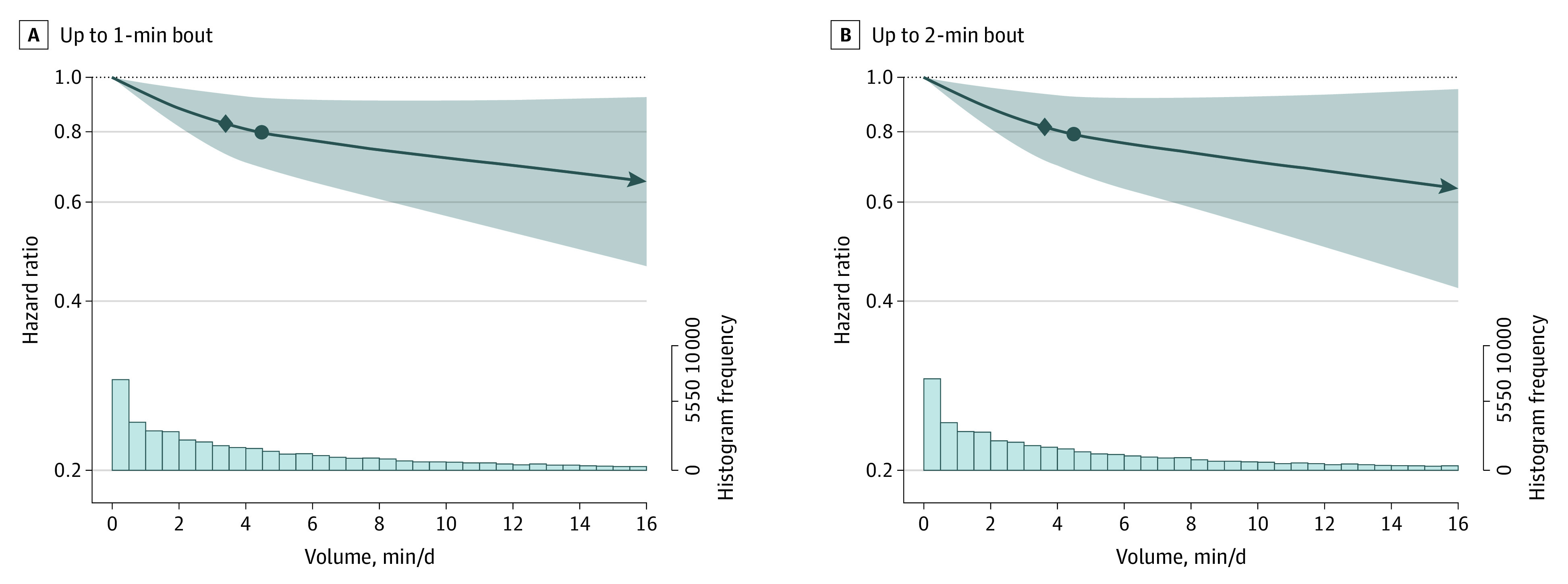
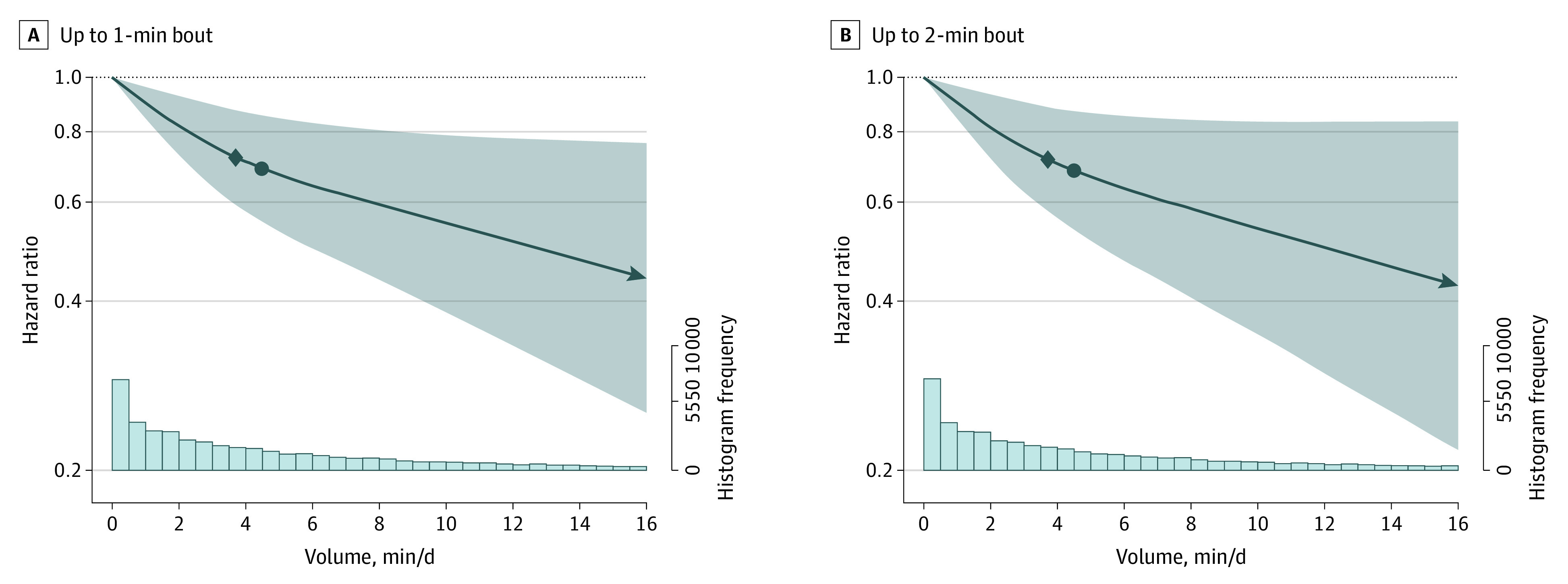
Results: The study sample comprised 22 398 participants (mean [SD] age, 62.0 [7.6] years; 10 122 [45.2%] men and 12 276 [54.8%] women; 21 509 [96.0%] White individuals). During a mean (SD) follow-up of 6.7 (1.2) years (149 650 person-years), 2356 total incident cancer events occurred, 1084 owing to PA-related cancer. Almost all (92.3%) of VILPA was accrued in bouts of up to 1 minute. Daily VILPA duration was associated with outcomes in a near-linear manner, with steeper dose-response curves for PA-related cancer than total cancer incidence. Compared with no VILPA, the median daily VILPA duration of bouts up to 1 minute (4.5 minutes per day) was associated with an HR of 0.80 (95% CI, 0.69-0.92) for total cancer and 0.69 (95% CI, 0.55-0.86) for PA-related cancer. The minimal dose was 3.4 minutes per day for total (HR, 0.83; 95% CI, 0.73-0.93) and 3.7 minutes for PA-related (HR, 0.72; 95% CI, 0.59-0.88) cancer incidence. Findings were similar for VILPA bout of up to 2 minutes.

Conclusions and relevance: The findings of this prospective cohort study indicate that small amounts of VILPA were associated with lower incident cancer risk. Daily VILPA may be a promising intervention for cancer prevention in populations not able or motivated to exercise in leisure time.


Conflict of interest statement

Conflict of Interest Disclosures: None reported.

Figures

Figure 1.
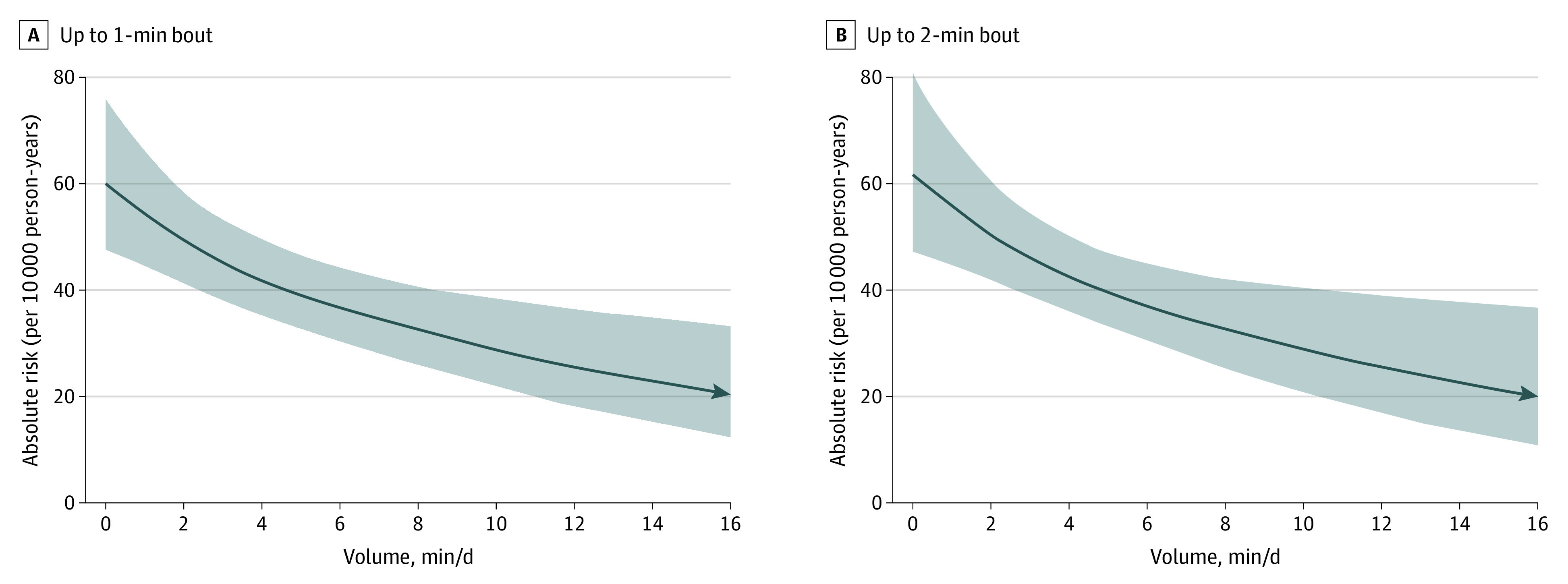
Figure 1.. Adjusted Absolute Risk Dose-Response of Vigorous Intermittent Lifestyle Physical Activity (VILPA) Daily Duration, From Bouts of Up to 1 and 2 Minutes, With Physical Activity–Related Cancer Incidence (n = 22 398; 1084 Events)
Absolute risk adjusted for age, sex, body mass index (calculated as weight in kilograms divided by height in meters squared), duration of light-intensity physical activity, duration of moderate-intensity physical activity, smoking status, alcohol consumption, accelerometer-estimated sleep duration, fruit and vegetable consumption, education level, medication use, self-reported parental history of cancer, and prevalent cardiovascular disease. All analyses were additionally adjusted for vigorous physical activity duration of more than 1 or 2 minutes, as appropriate.
Figure 2.
Figure 2.. Dose-Response Association of Vigorous Intermittent Lifestyle Physical Activity (VILPA) Daily Duration, From Bouts of Up to 1 and 2 Minutes, With Total Cancer Incidence (n = 22 398; 2356 Events)
The diamond shape indicates the ED50 value, the minimal dose defined as the daily duration of VILPA associated with 50% of the optimal risk reduction; and the circle, the effect associated with the median VILPA value (the list of values is available in eTable 7 in Supplement 1) . Analyses were adjusted for age, sex, body mass index (calculated as weight in kilograms divided by height in meters squared), duration of light-intensity physical activity, duration of moderate-intensity physical activity, smoking status, alcohol consumption, accelerometer- estimated sleep duration, fruit and vegetable consumption, education level, medication use, self-reported parental history of cancer, and prevalent cardiovascular disease. All analyses were additionally adjusted for vigorous physical activity duration of more than 1 (bouts up to 1 minute exposure) minute or more than 2 (bouts up to 2 minutes exposure) minutes. Hazard ratios were calculated using Fine-Gray models.
Figure 3.
Figure 3.. Dose-Response Association of Vigorous Intermittent Lifestyle Physical Activity (VILPA) Daily Duration From Bouts of Up to 1 and 2 Minutes With Physical Activity–Related Cancer Incidence (n = 22 398; 1084 Events)
The diamond shape indicates the ED50 value, the minimal dose defined as the daily duration of VILPA associated with 50% of the optimal risk reduction; and the circle, the effect associated with the median VILPA value (the list of values is available in eTable 7 in Supplement 1) Analyses were adjusted for age, sex, body mass index (calculated as weight in kilograms divided by height in meters squared), duration of light-intensity physical activity, duration of moderate-intensity physical activity, smoking status, alcohol consumption, accelerometer-estimated sleep duration, fruit and vegetable consumption, education, medication use, self-reported parental history of cancer, and prevalent cardiovascular. All analyses were additionally adjusted for vigorous physical activity duration of more than 1 (bouts up to 1 minute exposure) minute or more than 2 (bouts up to 2 minutes exposure) minutes. Hazard ratios were calculated using Fine-Gray models.

Comment in

References

    1. Matthews CE, Moore SC, Arem H, et al. . Amount and intensity of leisure-time physical activity and lower cancer risk. J Clin Oncol. 2020;38(7):686-697. doi:10.1200/JCO.19.02407 - DOI - PMC - PubMed
    1. Oja P, Kelly P, Pedisic Z, et al. . Associations of specific types of sports and exercise with all-cause and cardiovascular-disease mortality: a cohort study of 80 306 British adults. Br J Sports Med. 2017;51(10):812-817. doi:10.1136/bjsports-2016-096822 - DOI - PubMed
    1. Stamatakis E, Huang BH, Maher C, et al. . Untapping the health enhancing potential of vigorous intermittent lifestyle physical activity (VILPA): rationale, scoping review, and a 4-pillar research framework. Sports Med. 2021;51(1):1-10. doi:10.1007/s40279-020-01368-8 - DOI - PMC - PubMed
    1. Stamatakis E, Ahmadi MN, Gill JMR, et al. . Association of wearable device-measured vigorous intermittent lifestyle physical activity with mortality. Nat Med. 2022;28(12):2521-2529. doi:10.1038/s41591-022-02100-x - DOI - PMC - PubMed
    1. Ramakrishnan R, Doherty A, Smith-Byrne K, et al. . Accelerometer measured physical activity and the incidence of cardiovascular disease: Evidence from the UK Biobank cohort study. [published correction appears in PLoS Med. 2021;18(9):e1003809]. PLoS Med. 2021;18(1):e1003487. doi:10.1371/journal.pmed.1003487 - DOI - PMC - PubMed