Biomarkers Associated With Severe COVID-19 Among Populations With High Cardiometabolic Risk: A 2-Sample Mendelian Randomization Study
- PMID: 37498601
- PMCID: PMC10375306
- DOI: 10.1001/jamanetworkopen.2023.25914
Biomarkers Associated With Severe COVID-19 Among Populations With High Cardiometabolic Risk: A 2-Sample Mendelian Randomization Study
Abstract
Importance: Cardiometabolic parameters are established risk factors for COVID-19 severity. The identification of causal or protective biomarkers for COVID-19 severity may facilitate the development of novel therapies.
Objective: To identify protein biomarkers that promote or reduce COVID-19 severity and that mediate the association of cardiometabolic risk factors with COVID-19 severity.
Design, setting, and participants: This genetic association study using 2-sample mendelian randomization (MR) was conducted in 2022 to investigate associations among cardiometabolic risk factors, circulating biomarkers, and COVID-19 hospitalization. Inputs for MR included genetic and proteomic data from 4147 participants with dysglycemia and cardiovascular risk factors collected through the Outcome Reduction With Initial Glargine Intervention (ORIGIN) trial. Genome-wide association study summary statistics were obtained from (1) 3 additional independent plasma proteome studies, (2) genetic consortia for selected cardiometabolic risk factors (including body mass index [BMI], type 2 diabetes, type 1 diabetes, and systolic blood pressure; all n >10 000), and (3) the COVID-19 Host Genetics Initiative (n = 5773 hospitalized and 15 497 nonhospitalized case participants with COVID-19). Data analysis was performed in July 2022.
Exposures: Genetically determined concentrations of 235 circulating proteins assayed with a multiplex biomarker panel from the ORIGIN trial for the initial analysis.
Main outcomes and measures: Hospitalization status of individuals from the COVID-19 Host Genetics Initiative with a positive COVID-19 test result.
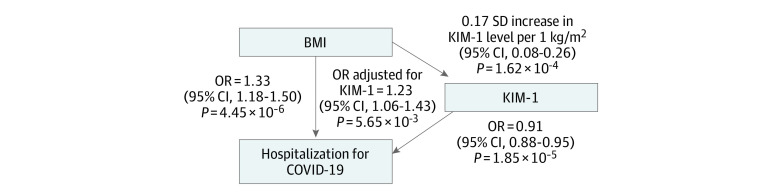
Results: Among 235 biomarkers tested in samples totaling 22 101 individuals, MR analysis showed that higher kidney injury molecule-1 (KIM-1) levels reduced the likelihood of COVID-19 hospitalization (odds ratio [OR] per SD increase in KIM-1 levels, 0.86 [95% CI, 0.79-0.93]). A meta-analysis validated the protective association with no observed directional pleiotropy (OR per SD increase in KIM-1 levels, 0.91 [95% CI, 0.88-0.95]). Of the cardiometabolic risk factors studied, only BMI was associated with KIM-1 levels (0.17 SD increase in biomarker level per 1 kg/m2 [95% CI, 0.08-0.26]) and COVID-19 hospitalization (OR per 1-SD biomarker level, 1.33 [95% CI, 1.18-1.50]). Multivariable MR analysis also revealed that KIM-1 partially mitigated the association of BMI with COVID-19 hospitalization, reducing it by 10 percentage points (OR adjusted for KIM-1 level per 1 kg/m2, 1.23 [95% CI, 1.06-1.43]).
Conclusions and relevance: In this genetic association study, KIM-1 was identified as a potential mitigator of COVID-19 severity, possibly attenuating the increased risk of COVID-19 hospitalization among individuals with high BMI. Further studies are required to better understand the underlying biological mechanisms.
Conflict of interest statement
Figures
References
Publication types
MeSH terms
Substances
Grants and funding
LinkOut - more resources
Full Text Sources
Medical