


Understanding the role of veterinarians in antimicrobial stewardship on Canadian dairy farms: A mixed-methods study
- PMID: 37498906
- PMCID: PMC10374071
- DOI: 10.1371/journal.pone.0289415
Understanding the role of veterinarians in antimicrobial stewardship on Canadian dairy farms: A mixed-methods study
Abstract
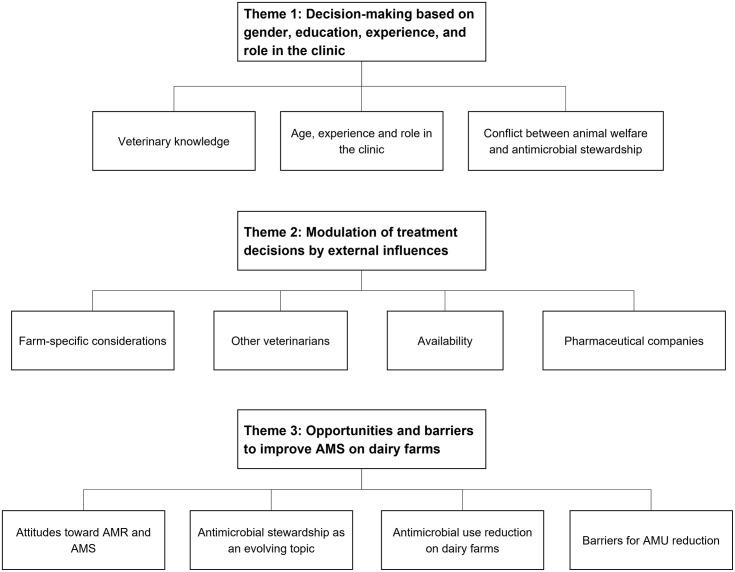
The aim of this study was to describe the factors that influence dairy cattle veterinarians´ antimicrobial prescribing, their attitudes toward reducing antimicrobial use (AMU) in the dairy industry, awareness of antimicrobial resistance (AMR), and perceived barriers to improving antimicrobial stewardship (AMS) on Canadian dairy farms. We used quantitative and qualitative research methods to consider the complexity of the antimicrobial prescription decision-making process. We designed and distributed an online survey, followed by four online focus groups with practicing veterinarians. We used frequency tables and unconditional associations to analyze quantitative data, and thematic analysis to analyze qualitative data. In total, 107 participants from four Canadian provinces responded to the survey, and 26 veterinarians participated in the focus groups. Results from both studies were triangulated to draw our key findings. We found that 1) Veterinarians must weigh numerous intra-personal and contextual considerations that could be conflicting in their decision-making process for prescribing antimicrobials. 2) Although less experienced veterinarians showed greater awareness of AMR and motivation to improve AMS than more experienced veterinarians, they also reported feeling more pressure to adapt their prescribing practices to farmers' wishes than more experienced veterinarians. 3) Some veterinarians experienced conflict between prescribing antimicrobials to maintain animal health, productivity, and welfare, and AMS, which could result in blaming others for inappropriate antimicrobial use and reducing the opportunity to critically review their own prescribing practices. 4) There were strategies and barriers in common between veterinarians and farmers such as collaborative reviews of disease treatment protocols and improving preventive medicine on dairy farms. 5) The main barriers to reducing AMU on dairy farms reported by veterinarians were concerns about animal welfare and AMU on dairy farms without consultation with the veterinarian. Our results can inform the development of AMS programs in the Canadian dairy industry.
Copyright: © 2023 Cobo-Angel et al. This is an open access article distributed under the terms of the Creative Commons Attribution License, which permits unrestricted use, distribution, and reproduction in any medium, provided the original author and source are credited.
Conflict of interest statement
The authors have declared that no competing interests exist.
Figures
References
-
- Centers for Disease Control and Prevention. About Antibiotic Resistance 2021. https://www.cdc.gov/drugresistance/about.html.
-
- World Health Organization. Antimicrobial resistance key facts 2021. https://www.who.int/news-room/fact-sheets/detail/antimicrobial-resistance.
-
- Tang KL, Caffrey NP, Nóbrega DB, Cork SC, Ronksley PE, Barkema HW, et al.. Restricting the use of antibiotics in food-producing animals and its associations with antibiotic resistance in food-producing animals and human beings: a systematic review and meta-analysis. The Lancet Planetary Health. 2017;1(8):e316–e27. doi: 10.1016/S2542-5196(17)30141-9 - DOI - PMC - PubMed
MeSH terms
Substances
LinkOut - more resources
Full Text Sources
