Review
. 2023 Jul 27;14(7):473.
doi: 10.1038/s41419-023-05905-x.

Research progress on endoplasmic reticulum homeostasis in kidney diseases

Affiliations
Review

Research progress on endoplasmic reticulum homeostasis in kidney diseases

Dan Wu et al. Cell Death Dis. .

Abstract

The endoplasmic reticulum (ER) plays important roles in biosynthetic and metabolic processes, including protein and lipid synthesis, Ca2+ homeostasis regulation, and subcellular organelle crosstalk. Dysregulation of ER homeostasis can cause toxic protein accumulation, lipid accumulation, and Ca2+ homeostasis disturbance, leading to cell injury and even death. Accumulating evidence indicates that the dysregulation of ER homeostasis promotes the onset and progression of kidney diseases. However, maintaining ER homeostasis through unfolded protein response, ER-associated protein degradation, autophagy or ER-phagy, and crosstalk with other organelles may be potential therapeutic strategies for kidney disorders. In this review, we summarize the recent research progress on the relationship and molecular mechanisms of ER dysfunction in kidney pathologies. In addition, the endogenous protective strategies for ER homeostasis and their potential application for kidney diseases have been discussed.


Conflict of interest statement

The authors declare no competing interests.

Figures
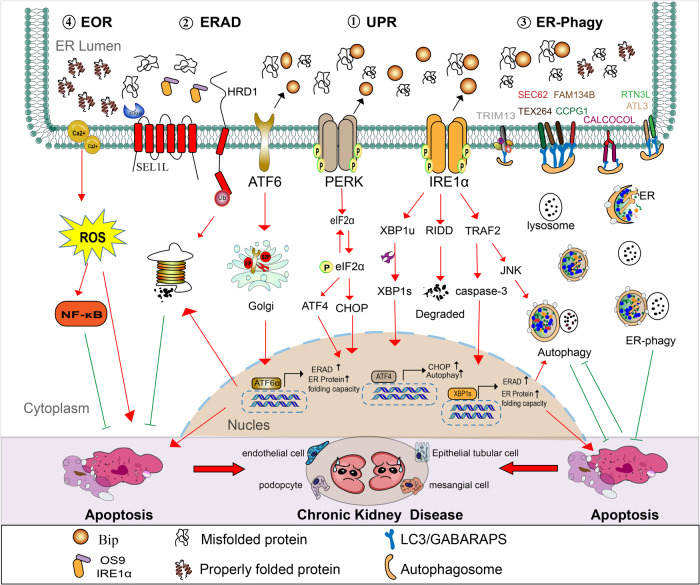
Fig. 1
Fig. 1. Restoration of ER homeostasis presents a therapeutic potential for the treatment of chronic kidney diseases.
In chronic kidney diseases, various pathogenic factors, including free fatty acid, angiotensin II, advanced glycation end products, and hyperglycemia, disrupt ER homeostasis characterized by the accumulation of massive misfolded proteins. UPR, ERAD, autophagy or ER-phagy, and EOR were induced by ER stress to restore ER homeostasis. However, persistent activation of UPR, comprised of at least three UPR stress sensors IRE1 α, PERK, and ATF6, triggers apoptosis in renal intrinsic cells, resulting in the progression of kidney diseases. Eight mammalian ER-phagy receptors have been identified, including FAM134B, SEC62, RTN3L, CCPG1, ATL3, TEX264, TRIM13, and CALCOCO1.
Fig. 2
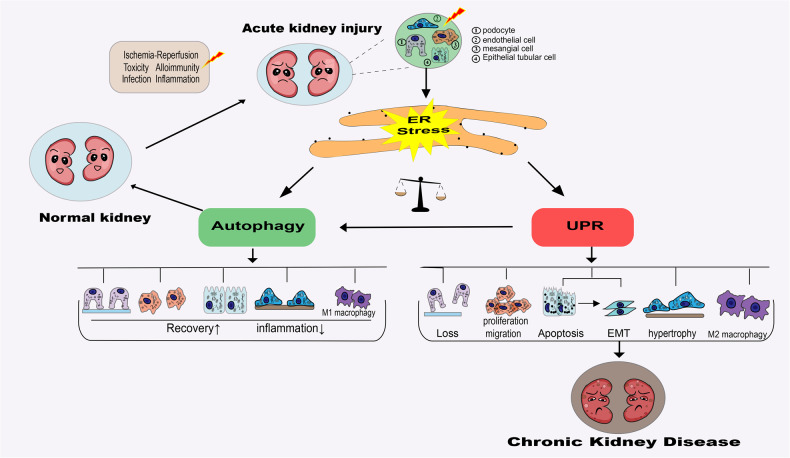
Fig. 2. Role of ER stress in AKI-CKD.
Various pathogenic factors, such as ischemia, toxicity, infection, and inflammation, cause ER stress in renal intrinsic cells. Autophagy induced by ER stress promotes recovery and restricts renal inflammation. In contrast, persistent activation of UPR impairs recovery progress. Severe ER stress leads to maladaptive repair in the transition from AKI to CKD.
Fig. 3
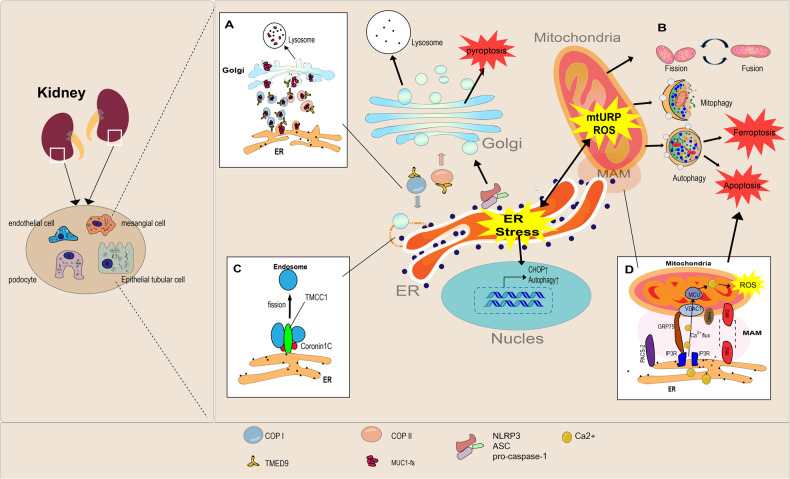
Fig. 3. ER interact closely with other organelles to maintain the function of kidney intrinsic cells.
A Bidirectional membrane trafficking between ER and Golgi is mediated by COPI and COPII. When the MUC1 fs protein is trapped in the vesicles containing TMED9 cargo receptors in the early secretion pathway, and cannot promptly be degraded by the lysosome, the accumulation of toxic MUC1 leads to mucin 1 nephropathy (MKD). B ER stress induces ROS production in mitochondria. The interface between the Golgi apparatus, ER, and mitochondria is an important hub for the activation of NLRP3 Inflammasome to cause pyroptosis. C Transmembrane and coil domain family 1 (TMCC1) concentrates at the ER-endosome membrane contact sites and controls ER-associated bud fission and subsequent cargo sorting to the Golgi. D The part of ER directly connected with mitochondria is called mitochondrial associated ER membrane (MAM), which is composed of a variety of proteins, including inositol triphosphate receptor (IP3R), voltage-dependent anion channel (VDAC), glucose-regulated protein 75 (GRP75), and fibroin 2 (Mfn2) PACS-2, DsbA-L. Calcium can be transported from ER to mitochondria. Mitochondrial fission also occurs at the MAM site. In addition, MAM is closely related to autophagy, mitophagy, and ferroptosis.

References

    1. Chen S, Novick P, Ferro-Novick S. ER structure and function. Curr Opin Cell Biol. 2013;25:428–33. doi: 10.1016/j.ceb.2013.02.006. - DOI - PMC - PubMed
    1. Westrate LM, Lee JE, Prinz WA, Voeltz GK. Form follows function: the importance of endoplasmic reticulum shape. Annu Rev Biochem. 2015;84:791–811. doi: 10.1146/annurev-biochem-072711-163501. - DOI - PubMed
    1. Csordás G, Weaver D, Hajnóczky G. Endoplasmic reticulum-mitochondrial contactology: structure and signaling functions. Trends Cell Biol. 2018;28:523–40. doi: 10.1016/j.tcb.2018.02.009. - DOI - PMC - PubMed
    1. Saraste J. Spatial and functional aspects of ER-Golgi Rabs and tethers. Front Cell Dev Biol. 2016;4:28. doi: 10.3389/fcell.2016.00028. - DOI - PMC - PubMed
    1. Chino H, Mizushima N. ER-Phagy: quality control and turnover of endoplasmic reticulum. Trends Cell Biol. 2020;30:384–98. doi: 10.1016/j.tcb.2020.02.001. - DOI - PubMed

Publication types