


Hand hygiene behavior change: a review and pilot study of an automated hand hygiene reminder system implementation in a public hospital
- PMID: 37502248
- PMCID: PMC10369449
- DOI: 10.1017/ash.2023.195
Hand hygiene behavior change: a review and pilot study of an automated hand hygiene reminder system implementation in a public hospital
Abstract
Objective: To review and study implementation of an automated hand hygiene reminder system (AHHRS).
Design: Prospective, nonrandomized, before-after quality improvement pilot study conducted over 6 months.
Setting: Medical-surgical unit (MSU) and medical intensive care unit (MICU) at a public hospital in New York City.
Participants: There were 2,642 healthcare worker observations in the direct observation (DO) period versus 265,505 in the AHHRS period, excluding AHHRS observations collected during the 1-month crossover period when simultaneous DO occurred.
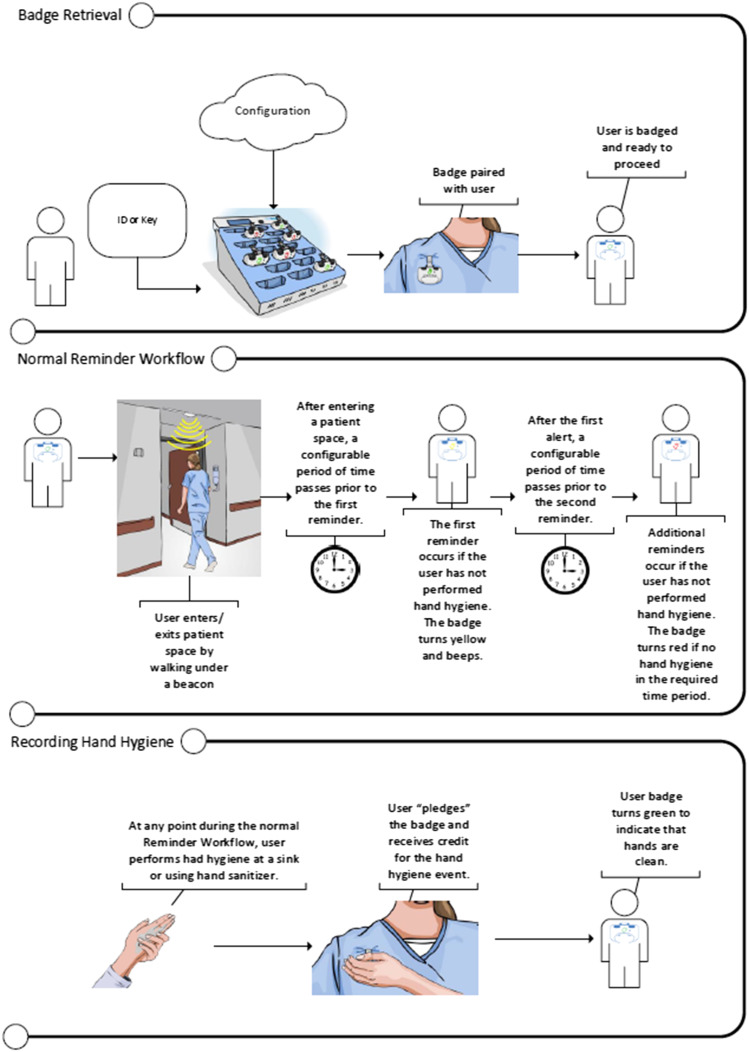
Intervention: We compared hand hygiene adherence (HHA) measured by DO prior to the pilot and after AHHRS implementation. We compared changes in HHA and potential cross-contamination events (CCEs) (room exit and subsequent entry without HHA) from baseline for each biweekly period during the pilot.
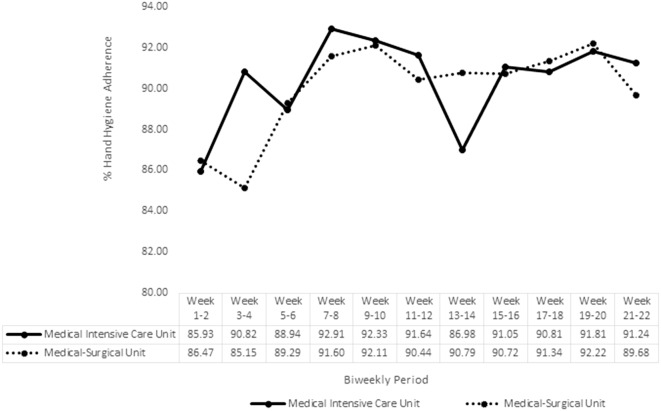
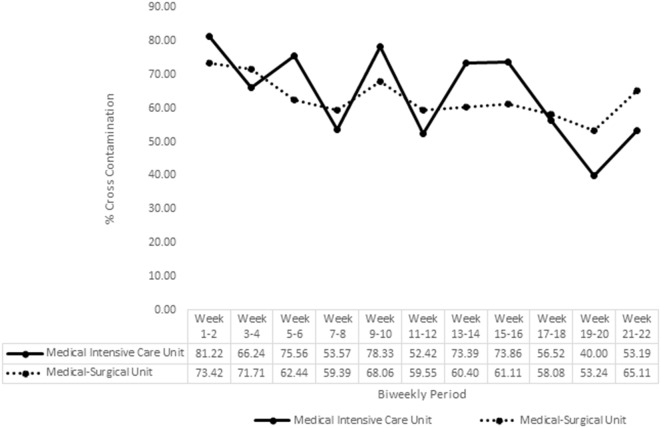
Results: Engagement, education/training, data transparency, and optimization period resulted in successful implementation and adoption of the AHHRS. Observations were greater utilizing AHHRS than DO (265,505 vs 2,642, P < .01). Due to the expected Hawthorne effect, HHA was significantly less for AHHRS than DO in MSU (90.99% vs 97.21%, P < .01) and MICU (91.21% vs 98.65%, P < .01). HHA significantly improved from 86.47% to 89.68% in MSU (P < .001) and 85.93% to 91.24% in the MICU (P < .001) from the first biweekly period of AHHRS utilization to the last. CCE decreased from 73.42% to 65.11% in the MSU and significantly decreased from 81.22% to 53.19% in the MICU (P < .05).
Conclusions: We describe how an AHHRS approach was successfully implemented at our facility. With ongoing feedback and system optimization, AHHRS improved HHA and reduced CCE over time.
© The Author(s) 2023.
Conflict of interest statement
The authors report no conflicts of interest.
Figures
References
-
- Scott RD II. The Direct Medical Costs of Healthcare-associated Infections in U.S. Hospitals and the Benefits of Prevention. 2009. https://www.cdc.gov/hai/pdfs/hai/scott_costpaper.pdf. Accessed January 3, 2023.
-
- World Health Organization. WHO Guidelines on Hand Hygiene in Health Care: First Global Patient Safety Challenge Clean Care Is Safer Care. 2009. https://www.who.int/publications/i/item/9789241597906. Accessed January 3, 2023. - PubMed
Publication types
LinkOut - more resources
Full Text Sources