


The US Federal Retail Pharmacy Program: Optimizing COVID-19 Vaccine Delivery Through a Strategic Public-Private Partnership
- PMID: 37503697
- PMCID: PMC10576480
- DOI: 10.1177/00333549231186606
The US Federal Retail Pharmacy Program: Optimizing COVID-19 Vaccine Delivery Through a Strategic Public-Private Partnership
Abstract
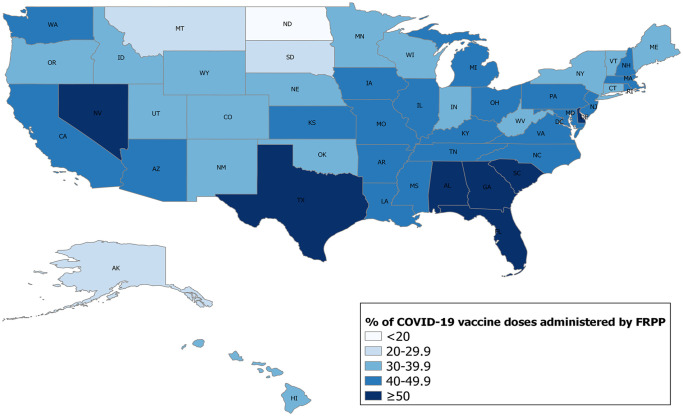
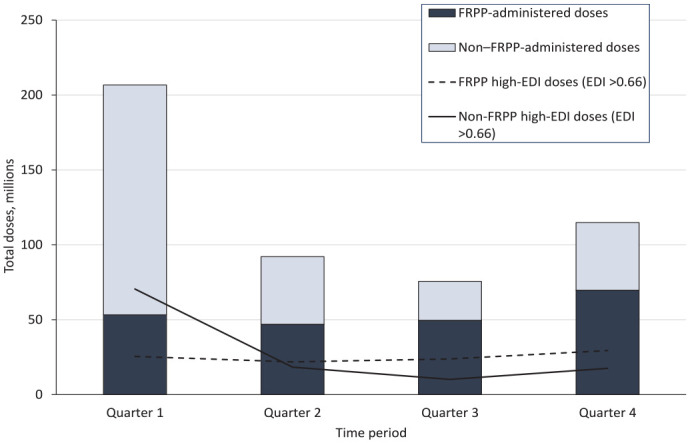
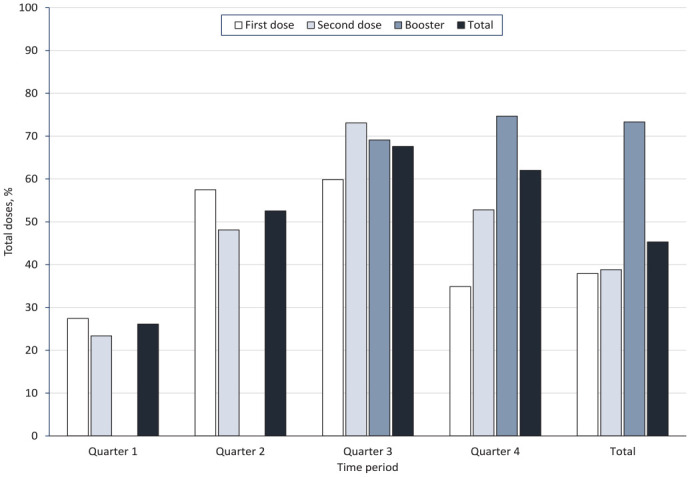
To help achieve the initial goal of providing universal COVID-19 vaccine access to approximately 258 million adults in 62 US jurisdictions, the federal government launched the Federal Retail Pharmacy Program (FRPP) on February 11, 2021. We describe FRPP's collaboration among the federal government, US jurisdictions, federal entity partners, and 21 national chain and independent pharmacy networks to provide large-scale access to COVID-19 vaccines, particularly in communities disproportionately affected by COVID-19 (eg, people aged ≥65 years, people from racial and ethnic minority groups). FRPP initially provided 10 000 vaccination sites for people to access COVID-19 vaccines, which was increased to >35 000 vaccination sites by May 2021 and sustained through January 31, 2022. From February 11, 2021, through January 31, 2022, FRPP vaccination sites received 293 million doses and administered 219 million doses, representing 45% of all COVID-19 immunizations provided nationwide (38% of all first doses, 72% of all booster doses). This unprecedented public-private partnership allowed the federal government to rapidly adapt and scale up an equitable vaccination program to reach adults, later expanding access to vaccine-eligible children, during the COVID-19 pandemic. As the largest federal COVID-19 vaccination program, FRPP exemplifies how public-private partnerships can expand access to immunizations during a public health emergency. Pharmacies can help meet critical national public health goals by serving as convenient access points for sustained health services. Lessons learned from this effort-including the importance of strong coordination and communication, efficient reporting systems and data quality, and increasing access to and demand for vaccine, among others-may help improve future immunization programs and support health system resiliency, emphasizing community-level access and health equity during public health emergencies.
Keywords: COVID-19; access; equity; pharmacy; vaccine distribution.
Conflict of interest statement
Declaration of Conflicting InterestsThe authors declared no potential conflicts of interest with respect to the research, authorship, and/or publication of this article.
Figures
References
-
- Centers for Disease Control and Prevention. What is health equity? Health equity considerations and racial and ethnic minority groups. 2021. Accessed May 28, 2022. https://www.cdc.gov/coronavirus/2019-ncov/community/health-equity/race-e...
-
- Bilal U, Jemmott JB, Schnake-Mahl A, Murphy K, Momplaisir F. Racial/ethnic and neighbourhood social vulnerability disparities in COVID-19 testing positivity, hospitalization, and in-hospital mortality in a large hospital system in Pennsylvania: a prospective study of electronic health records. Lancet Reg Health Am. 2022;10:100220. doi: 10.1016/j.lana.2022.100220 - DOI - PMC - PubMed
-
- US Department of Health and Human Services. From the factory to the frontlines: the Operation Warp Speed strategy for distributing a COVID-19 vaccine. 2020. Accessed May 24, 2023. https://www.hhs.gov/sites/default/files/strategy-for-distributing-covid-...
Publication types
MeSH terms
Substances
LinkOut - more resources
Full Text Sources
Medical
Research Materials
