


From Bad to Worse: Safety Behaviors Exacerbate Eating Disorder Fears
- PMID: 37504021
- PMCID: PMC10376478
- DOI: 10.3390/bs13070574
From Bad to Worse: Safety Behaviors Exacerbate Eating Disorder Fears
Abstract
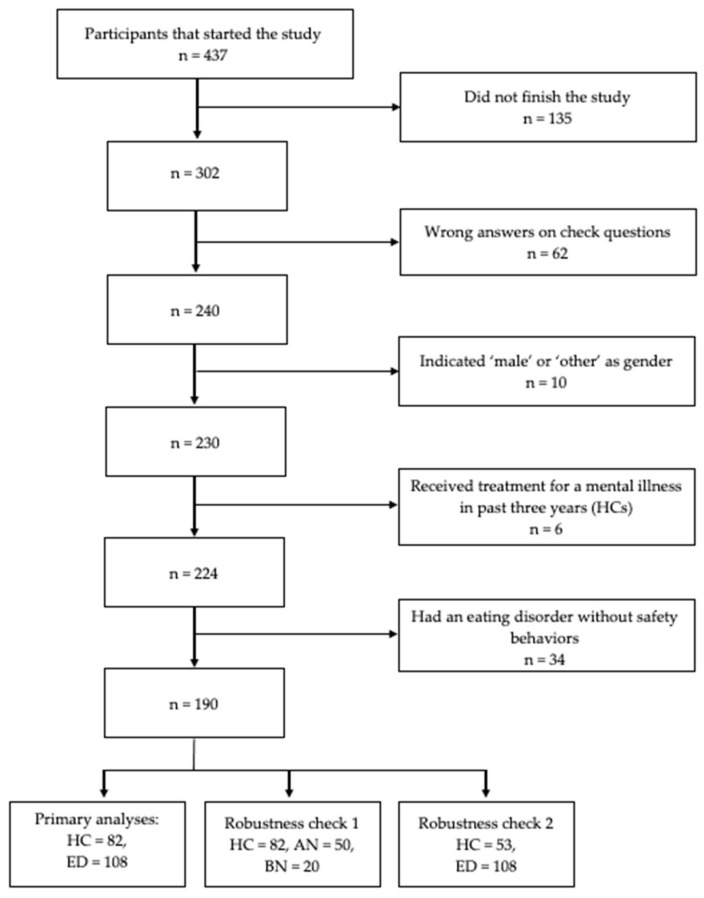
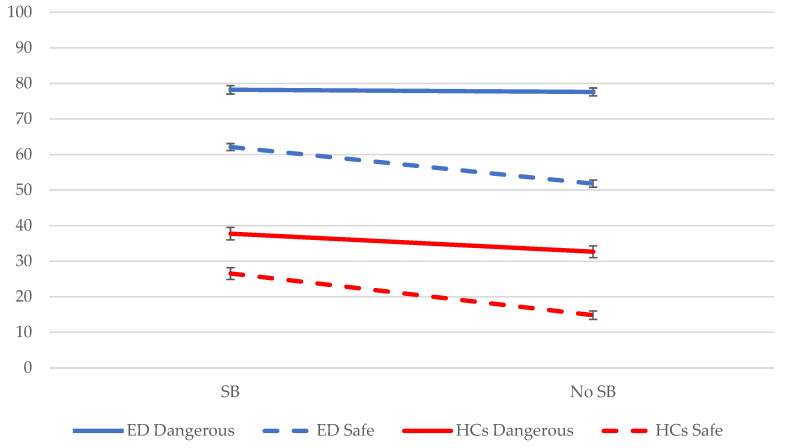
When evaluating ambiguous situations, humans sometimes use their behavior as a source of information (behavior-as-information effect) and interpret safety behaviors as evidence for danger. Accordingly, we hypothesized that eating disorder safety behaviors (restrictive eating, body checking, etc.) might aggravate fear and anxiety in individuals with an eating disorder. The present study tested to what extent eating disorder safety behaviors increase threat perception in individuals with and without an eating disorder. For this, 108 individuals with a self-reported eating disorder diagnosis and 82 healthy controls rated the dangerousness of several short situations. The situations systematically varied in the presence of eating disorder safety behaviors and danger information. As expected, all participants perceived situations in which the protagonist executed an eating disorder safety behavior as more threatening than situations without a safety behavior. This 'behavior-as-information' effect was equally strong in individuals with and without an eating disorder. Additionally, safety behaviors strengthened threat perception more in safe situations than in dangerous situations. To conclude, the presence of eating disorder safety behavior can increase threat perception regardless of whether individuals have an eating disorder or not. This makes eating disorder safety behaviors a potential risk factor for the development and maintenance of eating disorder fears.
Keywords: anorexia nervosa; behavior as information; bulimia nervosa; eating disorder; fear of weight gain; safety behaviors; vignette study.
Conflict of interest statement
The authors declare no conflict of interest. The funders had no role in the design of the study; in the collection, analyses, or interpretation of data; in the writing of the manuscript; or in the decision to publish the results.
Figures
References
-
- American Psychiatric Association Diagnostic and Statistical Manual of Mental Disorders. 2013. [(accessed on 14 December 2022)]. Available online: - DOI
Grants and funding
LinkOut - more resources
Full Text Sources
Research Materials
