. 2023 Jun 25;9(7):515.
doi: 10.3390/gels9070515.

Statistically Optimized Tacrolimus and Thymoquinone Co-Loaded Nanostructured Lipid Carriers Gel for Improved Topical Treatment of Psoriasis

Affiliations

Statistically Optimized Tacrolimus and Thymoquinone Co-Loaded Nanostructured Lipid Carriers Gel for Improved Topical Treatment of Psoriasis

Meraj Alam et al. Gels. .

Abstract

The aim of this investigation was to develop and analyze a tacrolimus and thymoquinone co-loaded nanostructured lipid carriers (TAC-THQ-NLCs)-based nanogel as a new combinatorial approach for the treatment of psoriasis. The NLCs were formulated by an emulsification-solvent-evaporation technique using glyceryl monostearate, Capryol 90 (oil), and a mixture of Tween 80 and Span 20 as a solid lipid, liquid lipid, and surfactant, respectively. Their combination was optimized using a three-factor and three-level Box-Behnken design (33-BBD). The optimized TAC-THQ-NLCs were observed to be smooth and spherical with a particle size of 144.95 ± 2.80 nm, a polydispersity index of 0.160 ± 0.021, a zeta potential of -29.47 ± 1.9 mV, and an entrapment efficiency of >70% for both drugs. DSC and PXRD studies demonstrated the amorphous state of TAC and THQ in the lipid matrix of the NLCs. An FTIR analysis demonstrated the excellent compatibility of the drugs with the excipients without interactions. The TAC-THQ-NLC-based nanogel (abbreviated as TAC-THQ-NG) exhibited a good texture profile and good spreadability. The in vitro release study demonstrated a sustained drug release for 24 h from the TAC-THQ-NG that followed the Korsmeyer-Peppas kinetic model with a Fickian diffusion mechanism. Moreover, the TAC-THQ-NG revealed significantly higher dose-dependent toxicity against an HaCaT cell line compared to a TAC-THQ suspension gel (abbreviated as TAC-THQ-SG). Furthermore, the developed formulations demonstrated antioxidant activity comparable to free THQ. Confocal microscopy revealed improved permeation depth of the dye-loaded nanogel in the skin compared to the suspension gel. Based on these findings, it was concluded that TAC-THQ-NG is a promising combinatorial treatment approach for psoriasis.

Keywords: Box–Behnken design; nanostructured lipid carrier; psoriasis; tacrolimus; thymoquinone; topical delivery.


Conflict of interest statement

The authors declare no conflict of interest.

Figures

Figure 1
Figure 1
Image showing RP-HPLC chromatogram of: (A) TAC; (B) THQ; and (C) TAC and THQ for simultaneous estimation.
Figure 2
Figure 2
Solubility profiles of: (A) TAC in liquid lipids; (B) THQ in liquid lipids; and (C) TAC and THQ in solid lipids.
Figure 3
Figure 3
Image illustrating the impact of independent factors on PS: (A) 3D surface plot; (B) predicted vs. actual response; (C) perturbation plot; and (D) residual vs. run plot of TAC-THQ-NLCs optimized by BBD.
Figure 4
Figure 4
Image illustrating the impact of independent factors on PDI: (A) 3D Surface plot; (B) predicted vs. actual response; (C) perturbation plot; and (D) residual vs. run plot of TAC-THQ-NLCs optimized by BBD.
Figure 5
Figure 5
Image illustrating the impact of independent factors on the %EE-TAC: (A) 3D surface plot; (B) predicted vs. actual response; (C) perturbation plot; and (D) residual vs. run plot of TAC-THQ-NLCs optimized by BBD.
Figure 6
Figure 6
Image illustrating the impact of independent factors on the %EE-THQ: (A) three-dimensional surface plot; (B) predicted vs. actual response; (C) perturbation plot; and (D) residual vs. run plot of TAC-THQ-NLCs optimized by BBD.
Figure 7
Figure 7
Image illustrating: (A) particle size distribution; (B) zeta potential distribution; (C) TEM photomicrograph; and (D) SEM photomicrograph of TAC-THQ-NLCs.
Figure 8
Figure 8
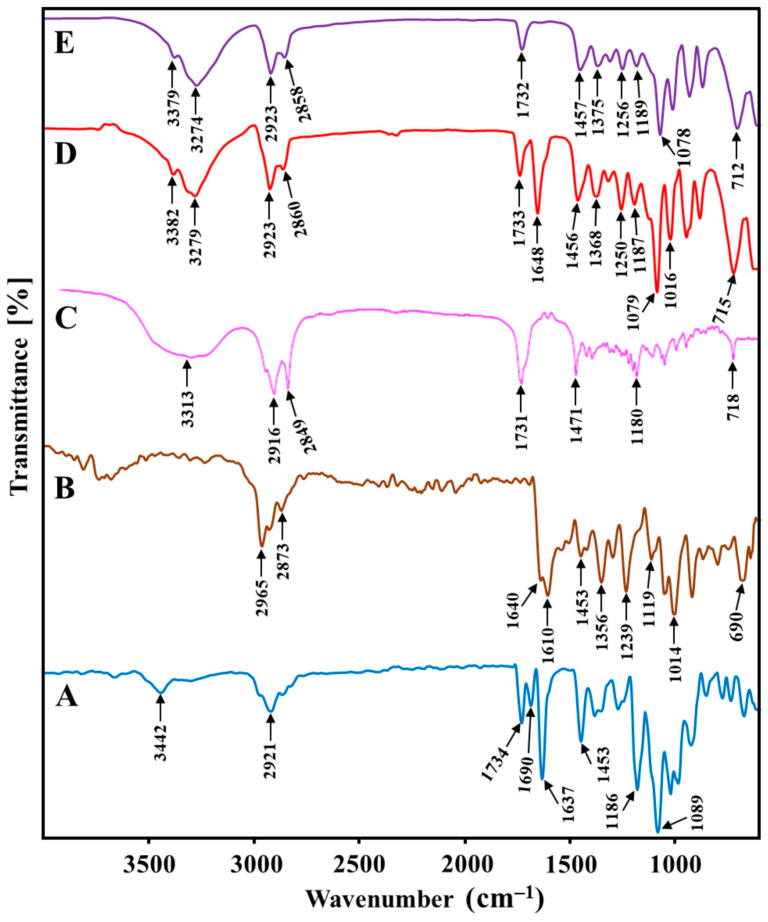
FT-IR spectra of (A) TAC; (B) THQ; (C) GMS; (D) physical mixture (TAC, THQ, GMS); and (E) TAC-THQ-NLCs.
Figure 9
Figure 9
Image showing (I) DSC curves (II) Powder-XRD of (A) TAC; (B) THQ; (C) GMS (D) physical mixture (TAC, THQ, GMS); (E) mannitol; and (F) lyophilized TAC-THQ-NLCs.
Figure 10
Figure 10
Image showing physical appearance of: (A) TAC-THQ-NLCs; and (B) TAC-THQ-NG. Representative texture analysis graph of (C) TAC-THQ-NG; and (D) TAC-THQ-SG showing firmness, consistency, cohesiveness, and work of cohesion.
Figure 11
Figure 11
Comparative in vitro drug-release profiles of TAC and THQ from the optimized TAC-THQ-NG and TAC-THQ-SG.
Figure 12
Figure 12
Anti-proliferation effects of TAC-SG, TAC-NG, TAC-THQ-SG, and TAC-THQ-NG against HaCaT cells after an incubation period of 24 h.
Figure 13
Figure 13
In vitro antioxidant activities of (A) TAC-SG; (B) THQ-SG; (C) TAC-THQ-SG; and (D) TAC-THQ-NG.
Figure 14
Figure 14
Confocal images of the perpendicular cross-section of mice skin treated with TAC-THQ-NG and TAC-THQ-SG.

References

    1. Vičić M., Kaštelan M., Brajac I., Sotošek V., Massari L.P. Current concepts of psoriasis immunopathogenesis. Int. J. Mol. Sci. 2021;22:11574. doi: 10.3390/ijms222111574. - DOI - PMC - PubMed
    1. Garg T., Rath G., Goyal A.K. Nanotechnological approaches for the effective management of psoriasis. Artif. Cells Nanomed. Biotechnol. 2016;44:1374–1382. doi: 10.3109/21691401.2015.1037885. - DOI - PubMed
    1. Hawkes J.E., Chan T.C., Krueger J.G. Psoriasis pathogenesis and the development of novel targeted immune therapies. J. Allergy Clin. Immunol. 2017;140:645–653. doi: 10.1016/j.jaci.2017.07.004. - DOI - PMC - PubMed
    1. Ferreira M., Barreiros L., Segundo M.A., Torres T., Selores M., Lima S.A.C., Reis S. Topical co-delivery of methotrexate and etanercept using lipid nanoparticles: A targeted approach for psoriasis management. Colloids Surf. B Biointerfaces. 2017;159:23–29. doi: 10.1016/j.colsurfb.2017.07.080. - DOI - PubMed
    1. Laws P.M., Young H.S. Topical treatment of psoriasis. Expert Opin. Pharmacother. 2010;11:1999–2009. doi: 10.1517/14656566.2010.492778. - DOI - PubMed

LinkOut - more resources