Review
. 2023 Jun 30;9(7):533.
doi: 10.3390/gels9070533.

Advancements and Applications of Injectable Hydrogel Composites in Biomedical Research and Therapy

Affiliations
Review

Advancements and Applications of Injectable Hydrogel Composites in Biomedical Research and Therapy

Hossein Omidian et al. Gels. .

Abstract

Injectable hydrogels have gained popularity for their controlled release, targeted delivery, and enhanced mechanical properties. They hold promise in cardiac regeneration, joint diseases, postoperative analgesia, and ocular disorder treatment. Hydrogels enriched with nano-hydroxyapatite show potential in bone regeneration, addressing challenges of bone defects, osteoporosis, and tumor-associated regeneration. In wound management and cancer therapy, they enable controlled release, accelerated wound closure, and targeted drug delivery. Injectable hydrogels also find applications in ischemic brain injury, tissue regeneration, cardiovascular diseases, and personalized cancer immunotherapy. This manuscript highlights the versatility and potential of injectable hydrogel nanocomposites in biomedical research. Moreover, it includes a perspective section that explores future prospects, emphasizes interdisciplinary collaboration, and underscores the promising future potential of injectable hydrogel nanocomposites in biomedical research and applications.

Keywords: biomedical applications; controlled release; injectable hydrogel nanocomposites; therapeutic outcomes; tissue engineering.


Conflict of interest statement

The authors declare no conflict of interest.

Figures
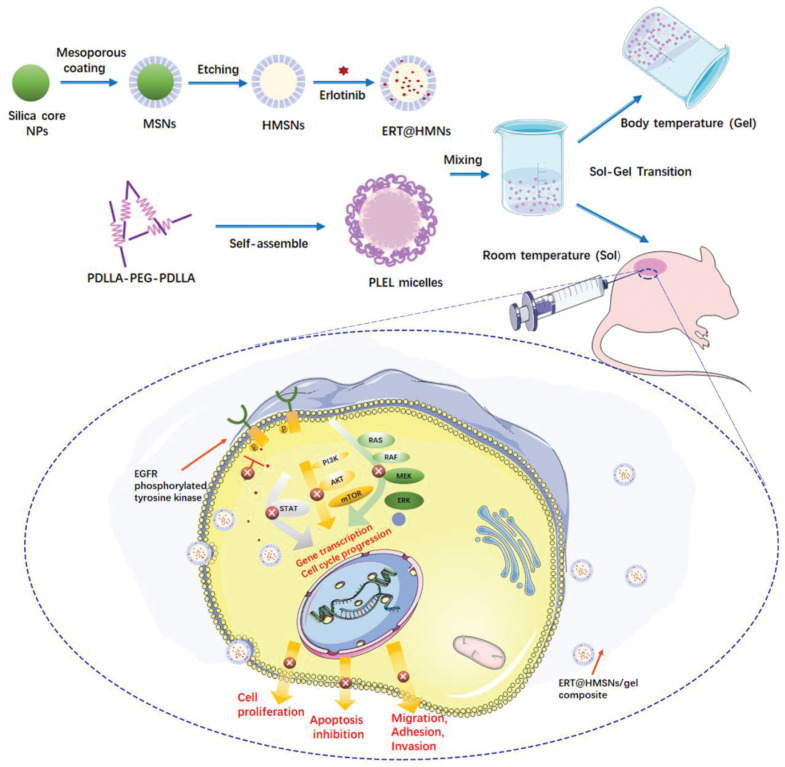
Figure 1
Figure 1
Schematic representation of ERT@HMSNs/gel composite to treat NSCLC. Hollow mesoporous silica nanoparticles (HMSNs) act as a carrier for encapsulating erlotinib, aiming to enhance its therapeutic efficacy and mitigate drug-related toxicity. To endure homogeneity and stability of the injectable matrix, PLEL added to the ERT@HMSNs solution. The evaluation included assessing transition from sol to gel phase and the sustained release of the drug. Adopted with permission [77].
Figure 2
Figure 2
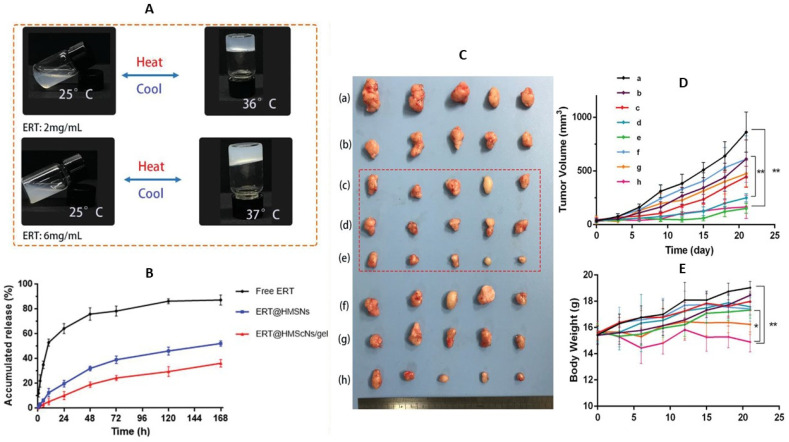
(A) Reversible sol–gel phase transition of ERT@HMSNs/gel composite; (B) In vitro drug release profile; (C) In vivo antitumor efficiency of different ERT formulations and Terceva on NSCLC xenograft models. (a) NS; (b) ERT@HMSNs; (c–e) different concentrations of ERT@HMSNs/gel (25, 50, and 100 mg/kg); (f–h) different concentrations of marketed drug Tarceva (25, 50, and 100 mg/kg). (D) The tumor growth curves of each group. (E) Body weight changes of mice as a function of time in each group. All quantitative data are given as mean ± SD (n = 5). “*” mean p < 0.05 and “**”mean p< 0.01. Adopted with permission [77].
Figure 3
Figure 3
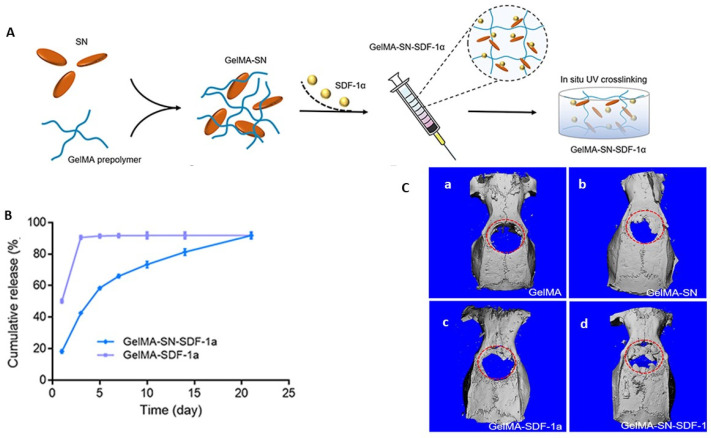
(A) Schematic presentation of GelMA-SN-SDF-1α hydrogel fabrication; (B) In vitro study of release profile of SDF-1α from GelMA-SDF-1α and GelMA-SN- SDF-1α and (C) Micro-CT scanning results of the bone healing of calvaria defects rats treated with GelMA, GelMA-SN, GelMA-SDF-1α, and GelMA-SN-SDF-1α hydrogel for 6 weeks. Adopted with permission [120].
Figure 4
Figure 4
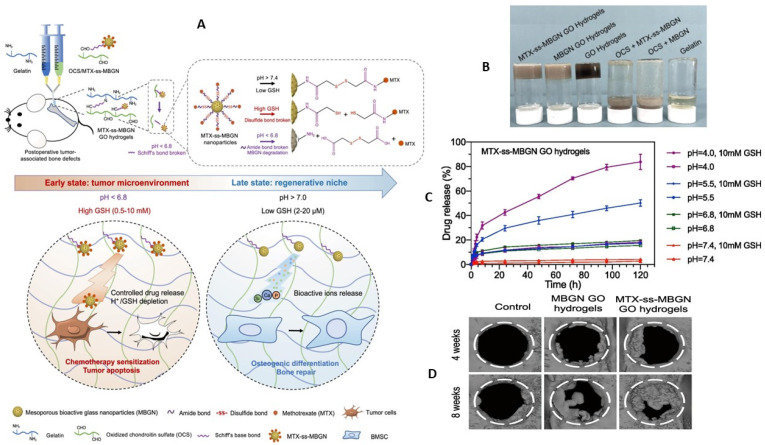
(A) Schematic representation of the synthesized injectable TME-modulated MTX-ss-MBGN GO hydrogels showing residual tumor apoptosis, restoring chemotherapy sensitivity and promoting bone regeneration for postoperative tumor-associated bone defect closed-loop management; (B) Observation study of hydrogels; (C) In vitro drug release study to confirm controlled release capability of MTX-ss-MBGN GO hydrogels under tumor-mimicking environment; (D) Micro-CT image of calvarial defect repair at 4 or 8 weeks under different treatments on healthy SD rats. Adopted with permission [17].
Figure 5
Figure 5
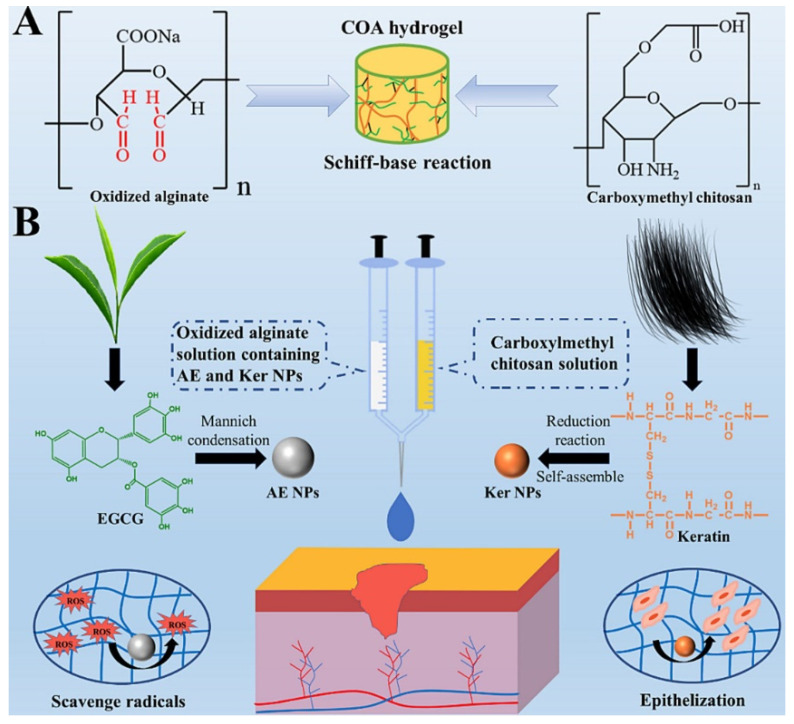
(A,B) Schematic representation of COA hydrogel fabrication and functionalization for wound repair. Adopted with permission [141].
Figure 6
Figure 6
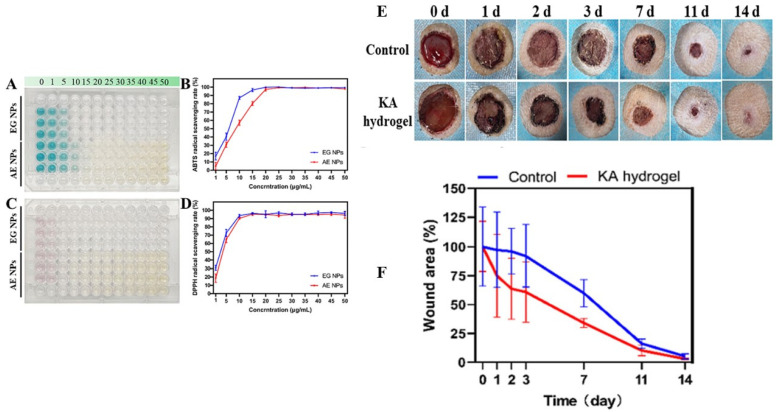
Images and quantitative antioxidant capacity of (A,B) ABTS and (C,D) DPPH radical scavenging assay of EG and AE NPs. (E) Photographs of the wound area of rats treated with or without KA hydrogel at different times. (F) Statistical results of wound area at different times where the wound area for KA hydrogel is 34% decreased than control group at day 7. Adopted with permission [141].

References

    1. Bar A., Cohen S. Inducing Endogenous Cardiac Regeneration: Can Biomaterials Connect the Dots? Front. Bioeng. Biotechnol. 2020;8:126. doi: 10.3389/fbioe.2020.00126. - DOI - PMC - PubMed
    1. Bruno M.C., Cristiano M.C., Celia C., D’Avanzo N., Mancuso A., Paolino D., Wolfram J., Fresta M. Injectable Drug Delivery Systems for Osteoarthritis and Rheumatoid Arthritis. ACS Nano. 2022;16:19665–19690. doi: 10.1021/acsnano.2c06393. - DOI - PubMed
    1. Chen Y.L., Lai J.Y., Zhou R.F., Ouyang Y.F., Fu H. The Analgesic Effect of Dexmedetomidine Loaded with Nano-Hydrogel as a Novel Nano-Drug Delivery System for Thoracic Paravertebral Block After Thoracic Surgery. J. Biomed. Nanotechnol. 2022;18:1604–1612. doi: 10.1166/jbn.2022.3377. - DOI
    1. Du Toit L.C., Choonara Y.E., Pillay V. An Injectable Nano-Enabled Thermogel to Attain Controlled Delivery of p11 Peptide for the Potential Treatment of Ocular Angiogenic Disorders of the Posterior Segment. Pharmaceutics. 2021;13:176. doi: 10.3390/pharmaceutics13020176. - DOI - PMC - PubMed
    1. Qasim M., Chae D.S., Lee N.Y. Advancements and frontiers in nano-based 3D and 4D scaffolds for bone and cartilage tissue engineering. Int. J. Nanomed. 2019;14:4333–4351. doi: 10.2147/IJN.S209431. - DOI - PMC - PubMed

LinkOut - more resources