Review
. 2023 Jul 19;9(7):760.
doi: 10.3390/jof9070760.

Fungal Biodegradation of Polyurethanes

Affiliations
Review

Fungal Biodegradation of Polyurethanes

Clotilde Maestri et al. J Fungi (Basel). .

Abstract

Polyurethanes (PURs) are versatile polymers used in a wide variety of fields, such as the medical, automotive, textile, thermal insulation, and coating industries as well as many everyday objects. Many PURs have applications that require a long service life, sometimes with exposure to aggressive conditions. They can undergo different types of physicochemical and biological degradation, but they are not compostable, and many of them constitute persistent waste in the environment. Although both bacteria and fungi can be involved in the degradation of PURs, fungi are often the main biodegradation agents. The chemical structure of PURs determines their degree of biodegradation. Fungal biodegradation of PURs is linked to the production of enzymes, mainly esterases and proteases, alongside laccases, peroxidases, and tyrosinases, which can modify the structure of polyurethane compounds by forming carbonyl groups. The experimental analysis of the biodegradation of PUR can be carried out by bringing the polymer into contact with a mold in pure culture or with a microbial consortium. Then, global measurements can be taken, such as weight loss, tensile tests, or the ability of microorganisms to grow in the presence of PUR as the sole carbon source. The analysis of the chemical structure of the polymer and its degradation products after fungal growth can confirm biodegradation and specify the mechanism. The main avenues of future research are directed towards the development of fully biodegradable PURs and, on the contrary, towards the development of PURs that are more resistant to degradation phenomena, in particular biodegradation, for applications where the material is in contact with living organisms.

Keywords: biodegradation; degradation; deterioration; fungi; mold; polyester urethane; polyether urethane; polyurethane.


Conflict of interest statement

The authors declare no conflict of interest.

Figures
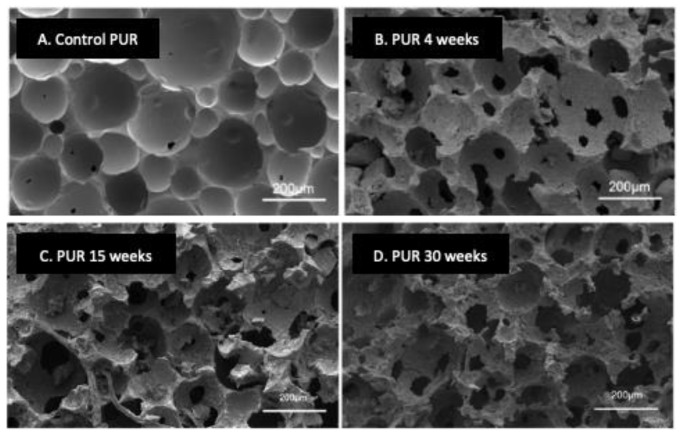
Figure 1
Figure 1
Scanning electron microscopy view of the biodegradation of PUR foam samples composed of linear polyester polyols based on aliphatic diacids and aliphatic diols incubated in a natural ocean environment over time. (A), the control sample was not immersed in the ocean. (BD), samples were immersed in the ocean for 4, 15, or 30 weeks, respectively. Adapted from Ref. [39] which is an open access article under the CC BY license (http://creativecommons.org/licenses/by/4.0/).
Figure 2
Figure 2
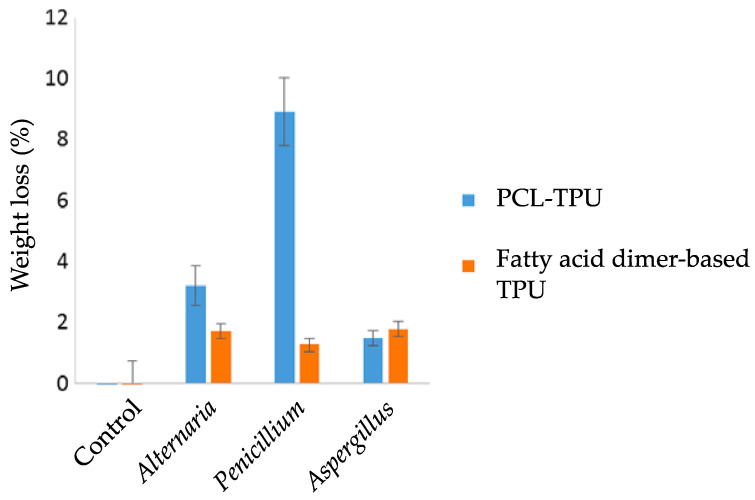
Weight loss measurements of thermoplastic polyurethane polycaprolactone (PLC-TPU) and TPU based on fatty acid dimers after 2 months of incubation at 30 °C with different molds. Control: material incubated in the absence of molds. Adapted from Ref. [46] which is an open access article under the terms of the Creative Commons Attribution License (http://creativecommons.org/licenses/by/4.0/).
Figure 3
Figure 3
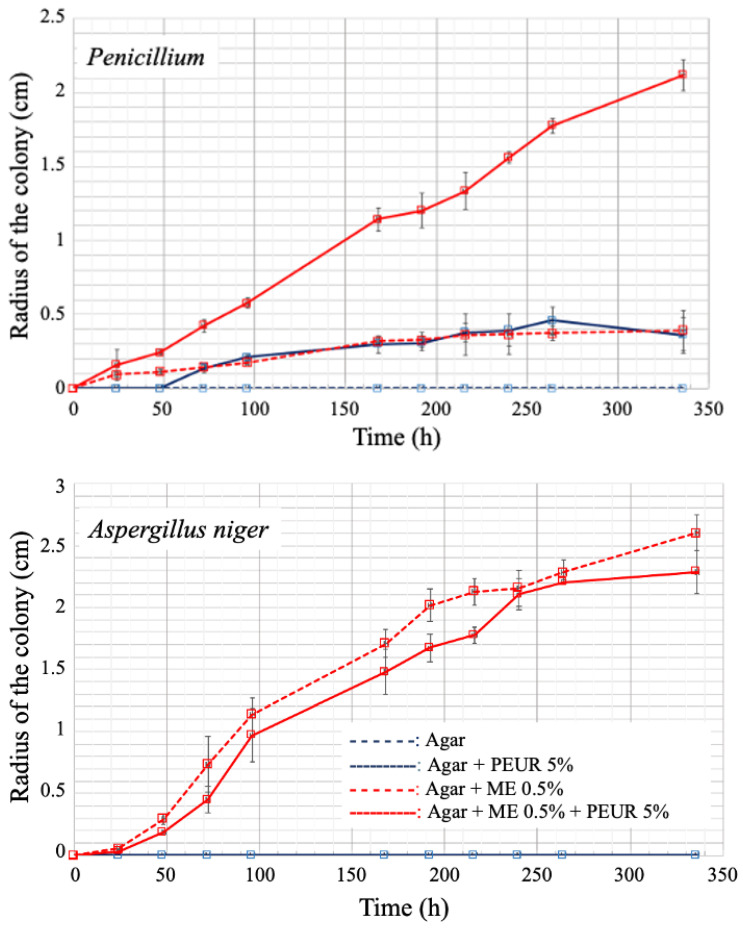
Comparative growth of molds in Petri dishes containing different agar media over time at 24 °C. ME, malt extract. PEUR, polyether-urethane polymer [31].
Figure 4
Figure 4
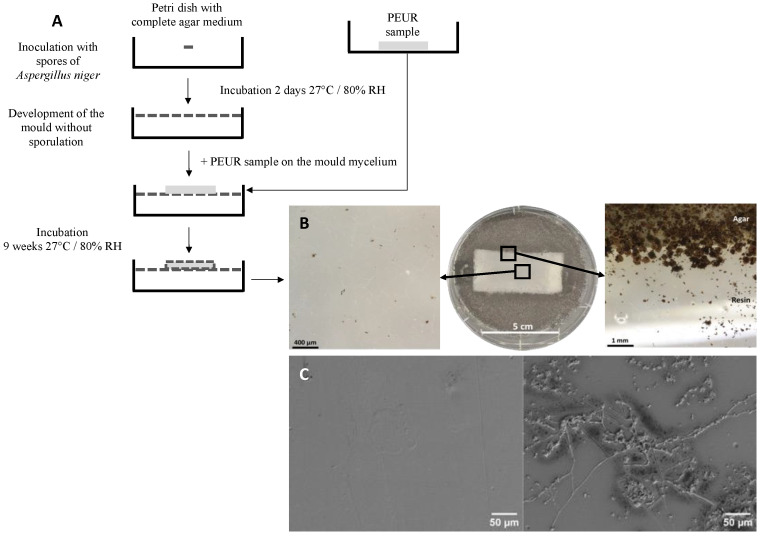
(A), Diagram of method B′ of the ISO 846 standard. In this method, the PUR sample is placed on the agar nutrient medium containing a carbon source when it is completely covered by mycelium. The test was performed in a 90 mm diameter Petri dish. (B), Growth of Aspergillus niger on polyether urethane after 9 weeks of contact according to the method described in A The magnification was obtained with a stereomicroscope. (C), scanning electron microscope views of a PUR coupon incubated on an agar medium containing no carbon source (left picture) and of a coupon of the same material incubated under the same conditions in the presence of A. niger (right picture).
Figure 5
Figure 5
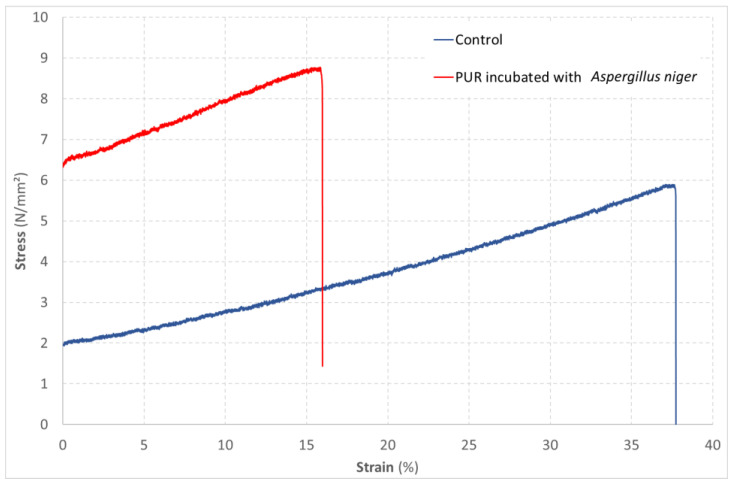
Evolution of the strain of a PUR material as a function of the stress applied in a tensile test. Comparison of an unexposed material (control) with a material exposed to the growth of Aspergillus niger according to method B′ of the ISO 846 standard.
Figure 6
Figure 6
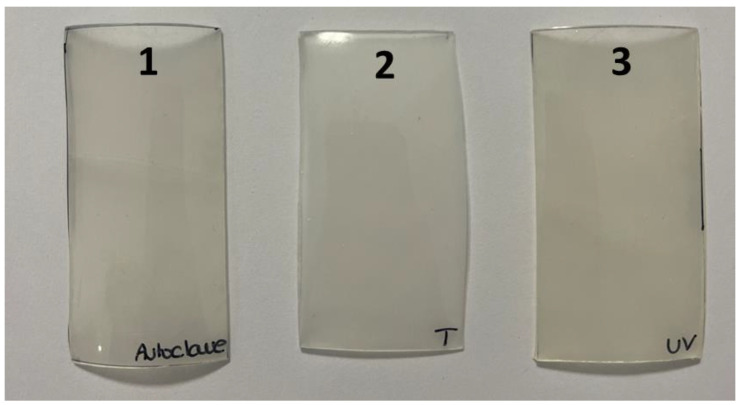
Macroscopic observation of PUR coupons (6 × 3 cm) after different physical treatments. 1, autoclaving 15 min at 121 °C. 2, no treatment (control). 3, UV-C exposure for 24 h at 254 nm.
Figure 7
Figure 7
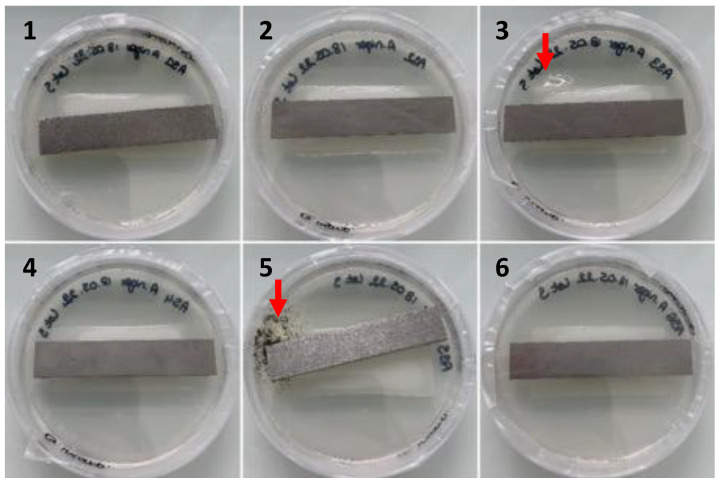
Observation of the growth of contaminants (red arrows, Petri dishes 3 and 5) developing from PUR coupons deposited on nutrient agar (Petri dish 9 cm in diameter) after cleaning with ethanol and disinfection with o-phenylphenol after 6 weeks of incubation at 27 °C/80% relative humidity according to ISO 846.
Figure 8
Figure 8
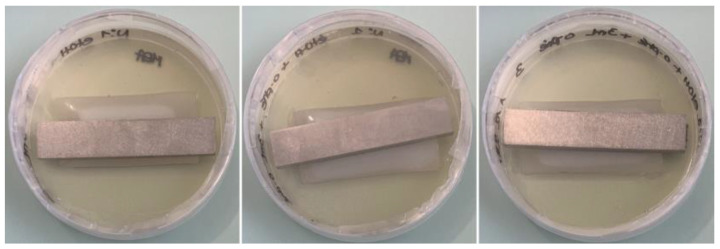
Observation of cleaned and disinfected PUR coupons placed on malt extract agar (Petri dish 9 cm in diameter), incubated for 6 weeks at 27 °C/80% relative humidity. Before depositing on agar plates, the coupons were cleaned with distilled water and disinfected with successive baths of 70% ethanol and 1% o-phenylphenol.

References

    1. Das A., Mahanwar P. A brief discussion on advances in polyurethane applications. Adv. Ind. Eng. Polym. Res. 2020;3:93–101. doi: 10.1016/j.aiepr.2020.07.002. - DOI
    1. Fried J.R. Polymer science and technology. Mater. Des. 1995;16:189. doi: 10.1016/0261-3069(95)90127-2. - DOI
    1. Xie F., Zhang T., Bryant P., Kurusingal V., Colwell J.M., Laycock B. Degradation and stabilization of polyurethane elastomers. Prog. Polym. Sci. 2019;90:211–268. doi: 10.1016/j.progpolymsci.2018.12.003. - DOI
    1. Gao Q., Wang L., Luo H., Fan H., Xiang J., Yan J., Li C., Chen Z. Photodegradation behavior and blocking strategy of waterborne polyurethane under UV and Xenon irradiation. Mater. Today Commun. 2023;34:105212. doi: 10.1016/j.mtcomm.2022.105212. - DOI
    1. Zafar U., Nzeram P., Langarica-Fuentes A., Houlden A., Heyworth A., Saiani A., Robson G.D. Biodegradation of polyester polyurethane during commercial composting and analysis of associated fungal communities. Bioresour. Technol. 2014;158:374–377. doi: 10.1016/j.biortech.2014.02.077. - DOI - PubMed

LinkOut - more resources