. 2023 Nov;30(12):7882-7891.
doi: 10.1245/s10434-023-13931-4. Epub 2023 Jul 28.

The Importance of Awaiting Biopsy Results in Solitary Pathological Proximal Femoral Fractures : Do We Need to Biopsy Solitary Pathological Fractures?

Affiliations

The Importance of Awaiting Biopsy Results in Solitary Pathological Proximal Femoral Fractures : Do We Need to Biopsy Solitary Pathological Fractures?

Floortje G M Verspoor et al. Ann Surg Oncol. 2023 Nov.

Abstract

Background: The optimal surgical treatment for patients presenting with (impending and complete) pathological proximal femoral fractures is predicated on prognosis. Guidelines recommend a preoperative biopsy to exclude sarcomas, however no evidence confirms a benefit.

Objective: This study aimed to describe the diagnostic accuracy, morbidity and sarcoma incidence of biopsy results in these patients.

Material and methods: All patients (n = 153) presenting with pathological proximal femoral fractures between 2000 and 2019 were retrospectively evaluated. Patients after inadvertent surgery (n = 25) were excluded. Descriptive statistics were used to evaluate the accuracy and morbidity of diagnostic biopsies.

Results: Of 112/128 patients who underwent biopsy, nine (8%) biopsies were unreliable either due to being inconclusive (n = 5) or because the diagnosis changed after resection (n = 4). Of impending fractures, 32% fractured following needle core biopsy. Median time from diagnosis to surgery was 30 days (interquartile range 21-46). The overall biopsy positive predictive value (PPV) to differentiate between sarcoma and non-sarcoma was 1.00 (95% confidence interval [CI] 0.88-1.00). In patients with a previous malignancy (n = 24), biopsy (n = 23) identified the diagnosis in 83% (PPV 0.91, 95% CI 0.71-0.99), of whom five (24%) patients had a new diagnosis. In patients without a history of cancer (n = 61), final diagnosis included carcinomas (n = 24, 39.3%), sarcomas (n = 24, 39.3%), or hematological malignancies (n = 13, 21.3%). Biopsy (n = 58) correctly identified the diagnosis in 66% of patients (PPV 0.80, 95% CI 0.67-0.90).

Conclusion: This study confirms the importance of a preoperative biopsy in solitary pathological proximal femoral fractures due to the risk of sarcoma in patients with and without a history of cancer. However, biopsy delays the time to definite surgery, results can be inconclusive or false, and it risks completion of impending fractures.


Conflict of interest statement

Floortje G.M. Verspoor, Gerjon Hannink, Michael Parry, Lee Jeys, and Jonathan D. Stevenson have no conflicts of interest to declare.

Figures
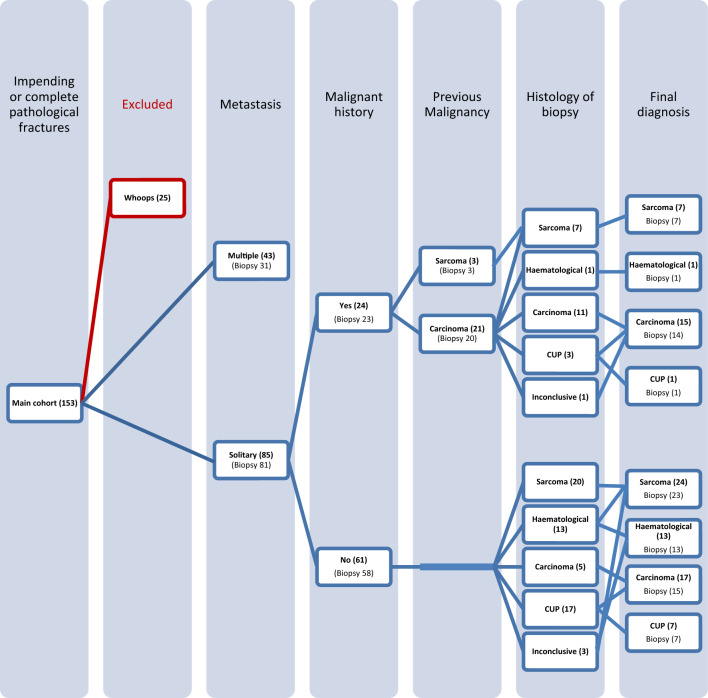
Fig. 1
Fig. 1
Flowchart of consecutive patients with impending and complete pathological proximal femoral fractures. Numbers shown in bold are the number of patients, while other numbers are the number of biopsies. Please note that four patients with solitary metastasis did not receive a biopsy before their final treatment, however they did have a final post-surgical resection diagnosis. In the ‘Final diagnosis’ column, the number of patients per histologic type is shown and whether these patients had a biopsy before further treatment. CUP carcinoma of unknown origin, inconclusive inconclusive biopsy results, Whoops inadvertent surgical procedure in which a surgeon is not aware of the diagnosis.
Fig. 2
Fig. 2
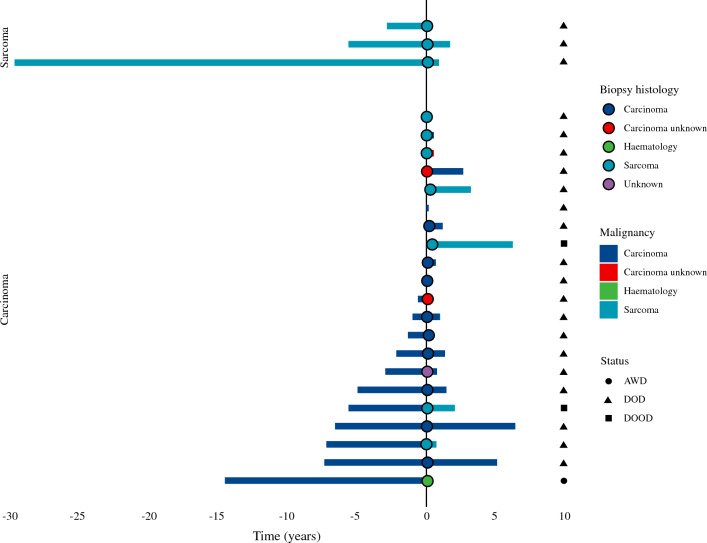
Swimmer plot with detailed information on biopsy and follow-up of patients with a solitary pathological proximal femoral fracture and a previous history of malignancy. The length of the bars indicates the time, in years, from first malignant diagnosis to the date of presentation with impending or pathological fracture (time point zero), followed by the length of follow-up after presentation. The colors indicate malignant history (bar to the left of the zero line), biopsy (circle), and final diagnosis (bar to the right of the zero line). AWD alive with disease, DOD death of disease, DOOD death of other disease
Fig. 3
Fig. 3
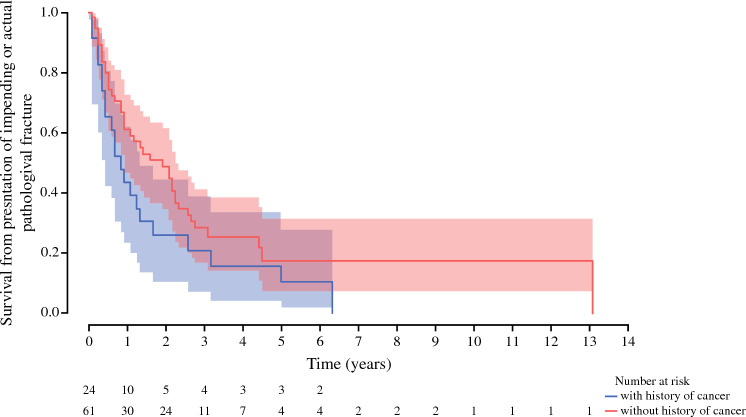
Kaplan–Meier curve for overall survival for patients with a solitary pathological proximal femoral (impending) fracture with (blue curve) and without (red curve) a history of cancer, showing no significant survival. The length of the bars indicates the time, in years, from first malignant diagnosis to the date of presentation with impending or pathological fracture (time point zero), followed by the length of follow-up after presentation. The colors indicate malignant history (bar to the left of the zero line), biopsy (circle), and final diagnosis (bar to the right of the zero line). AWD alive with disease, DOD death of disease, DOOD death of other disease

References

    1. Storm HH, Kejs AM, Engholm G, et al. Trends in the overall survival of cancer patients diagnosed 1964–2003 in the Nordic countries followed up to the end of 2006: the importance of case-mix. Acta Oncol. 2010;49(5):713–724. doi: 10.3109/0284186X.2010.484426. - DOI - PubMed
    1. PH E. Cancer in the West Midlands. 2017.
    1. Maddams J, Utley M, Moller H. Projections of cancer prevalence in the United Kingdom, 2010–2040. Br J Cancer. 2012;107(7):1195–1202. doi: 10.1038/bjc.2012.366. - DOI - PMC - PubMed
    1. Palmieri C, Owide J, Fryer K. Estimated prevalence of metastatic breast cancer in England, 2016–2021. JAMA Netw Open. 2022;5(12):e2248069. doi: 10.1001/jamanetworkopen.2022.48069. - DOI - PMC - PubMed
    1. Guzik G. Oncological and functional results after surgical treatment of bone metastases at the proximal femur. BMC Surg. 2018;18(1):5. doi: 10.1186/s12893-018-0336-0. - DOI - PMC - PubMed

LinkOut - more resources