Prevalence of Hearing Loss and Hearing Aid Use Among US Medicare Beneficiaries Aged 71 Years and Older
- PMID: 37505496
- PMCID: PMC10383002
- DOI: 10.1001/jamanetworkopen.2023.26320
Prevalence of Hearing Loss and Hearing Aid Use Among US Medicare Beneficiaries Aged 71 Years and Older
Abstract
Importance: National prevalence estimates are needed to guide and benchmark initiatives to address hearing loss. However, current estimates are not based on samples that include representation of the oldest old US individuals (ie, aged ≥80 years), who are most at-risk of having hearing loss.
Objective: To estimate the prevalence of hearing loss and hearing aid use by age and demographic covariates in a large, nationally representative sample of adults aged 71 years and older.
Design, setting, and participants: In this cohort study, prevalence estimates of hearing loss by age, gender, race and ethnicity, education, and income were computed using data from the 2021 National Health Aging and Trends Study. Survey weights were applied to produce nationally representative estimates to the US older population. Data were collected from June to November 2021 and were analyzed from November to December 2022.
Main outcomes and measures: Criterion-standard audiometric measures of hearing loss and self-reported hearing aid use.
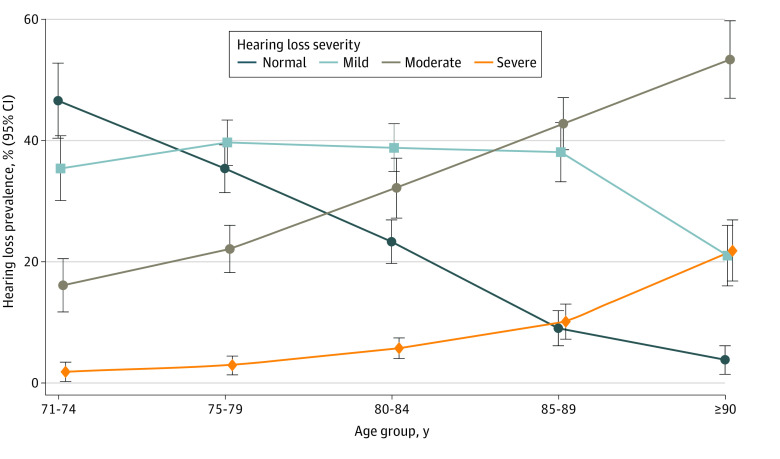
Results: In this nationally representative sample of 2803 participants (weighted estimate, 33.1 million individuals) aged 71 years or older, 38.3% (95% CI, 35.5%-41.1%) were aged 71 to 74 years, 36.0% (95% CI, 33.1%-38.8%) were aged 75 to 79 years, 13.8% (95% CI, 12.6%-14.9%) were aged 80 to 84 years, 7.9% (95% CI, 7.2%-8.6%) were aged 85 to 89 years, and 4.0% (95% CI, 3.5%-4.6%) were aged 90 years or older; 53.5% (95% CI, 50.9%-56.1%) were female and 46.5% (95% CI, 43.9%-49.1%) were male; and 7.5% (95% CI, 6.2%-8.7%) were Black, 6.5% (95% CI, 4.4%-8.7%) were Hispanic, and 82.7% (95% CI, 79.7%-85.6%) were White. An estimated 65.3% of adults 71 years and older (weighted estimate, 21.5 million individuals) had at least some degree of hearing loss (mild, 37.0% [95% CI, 34.7%-39.4%]; moderate, 24.1% [95% CI, 21.9%-26.4%]; and severe, 4.2% [95% CI, 3.3%-5.3%]). The prevalence was higher among White, male, lower-income, and lower education attainment subpopulations and increased with age, such that 96.2% (95% CI, 93.9%-98.6%) of adults aged 90 years and older had hearing loss. Among those with hearing loss, only 29.2% (weighted estimate, 6.4 million individuals) used hearing aids, with lower estimates among Black and Hispanic individuals and low-income individuals.
Conclusions and relevance: These findings suggest that bilateral hearing loss is nearly ubiquitous among older US individuals, prevalence and severity increase with age, and hearing aid use is low. Deeper consideration of discrete severity measures of hearing loss in this population, rather than binary hearing loss terminology, is warranted.
Conflict of interest statement
Figures
References
-
- Deal JA, Albert MS, Arnold M, et al. . A randomized feasibility pilot trial of hearing treatment for reducing cognitive decline: results from the Aging and Cognitive Health Evaluation in Elders Pilot Study. Alzheimers Dement (N Y). 2017;3(3):410-415. doi:10.1016/j.trci.2017.06.003 - DOI - PMC - PubMed
Publication types
MeSH terms
Grants and funding
LinkOut - more resources
Full Text Sources
Medical