Clinical Trial
. 2023 Jul 28;14(1):4551.
doi: 10.1038/s41467-023-40272-3.

Safety and immunogenicity of a SARS-CoV-2 Gamma variant RBD-based protein adjuvanted vaccine used as booster in healthy adults

Collaborators, Affiliations
Clinical Trial

Safety and immunogenicity of a SARS-CoV-2 Gamma variant RBD-based protein adjuvanted vaccine used as booster in healthy adults

Karina A Pasquevich et al. Nat Commun. .

Abstract

A Gamma Variant RBD-based aluminum hydroxide adjuvanted vaccine called ARVAC CG was selected for a first in human clinical trial. Healthy male and female participants (18-55 years old) with a complete COVID-19-primary vaccine scheme were assigned to receive two intramuscular doses of either a low-dose or a high-dose of ARVAC CG. The primary endpoint was safety. The secondary objective was humoral immunogenicity. Cellular immune responses were studied as an exploratory objective. The trial was prospectively registered in PRIISA.BA (Registration Code 6564) and ANMAT and retrospectively registered in ClinicalTrials.gov (NCT05656508). Samples from participants of a surveillance strategy implemented by the Ministry of Health of the Province of Buenos Aires that were boosted with BNT162b2 were also analyzed to compare with the booster effect of ARVAC CG. ARVAC CG exhibits a satisfactory safety profile, a robust and broad booster response of neutralizing antibodies against the Ancestral strain of SARS-CoV-2 and the Gamma, Delta, Omicron BA.1 and Omicron BA.5 variants of concern and a booster effect on T cell immunity in individuals previously immunized with different COVID-19 vaccine platforms.


Conflict of interest statement

J.M.R., L.P.C. R&D and CMC Group, F.M.O., J.C.V. are employees of Laboratorio Pablo Cassará S.R.L., which developed the vaccine and funded the trial. M.L. and J.F. are external consultants and received honoraria from Laboratorio Pablo Cassará S.R.L. All other authors declare no competing interests.

Figures
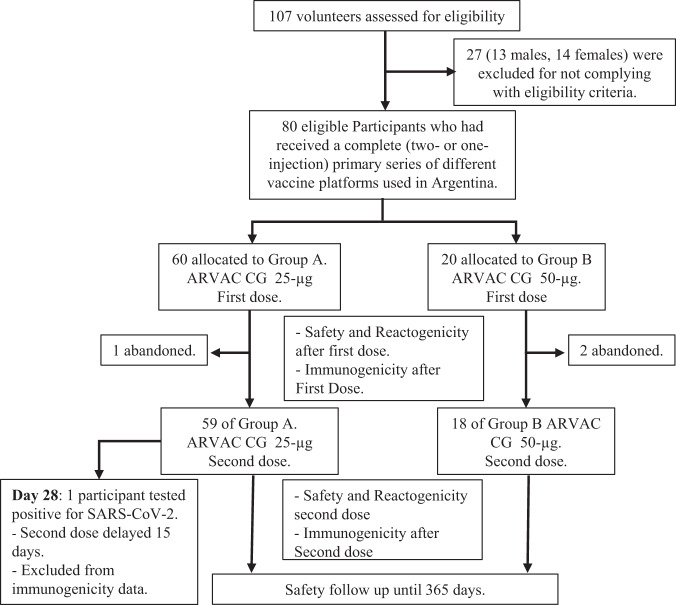
Fig. 1
Fig. 1. Subject disposition in Phase-1 study (consort diagram).
Trial profile showing the study groups, number of participants, and vaccine dose received.
Fig. 2
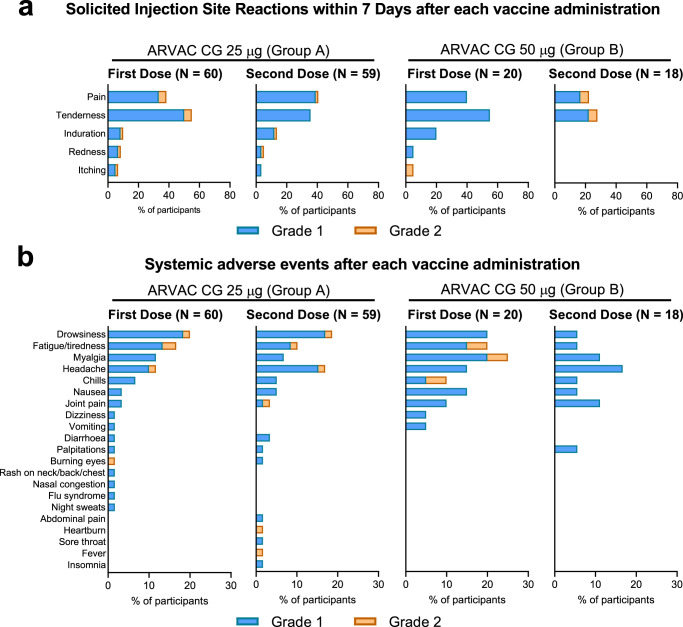
Fig. 2. Safety profile.
a Percentage of participants in each study group with the indicated injection site AEs up to 7 days after the first or the second injection. b Percentage of participants in each study group with the indicated systemic AEs recorded up to 28 days after each vaccine administration. Events were classified according to the FDA toxicity grading scale for healthy adult and adolescent volunteers enrolled in preventive vaccine clinical trials (Mild (Grade 1), Moderate (Grade 2), Severe (Grade 3), Potentially Life Threatening (Grade 4)).
Fig. 3
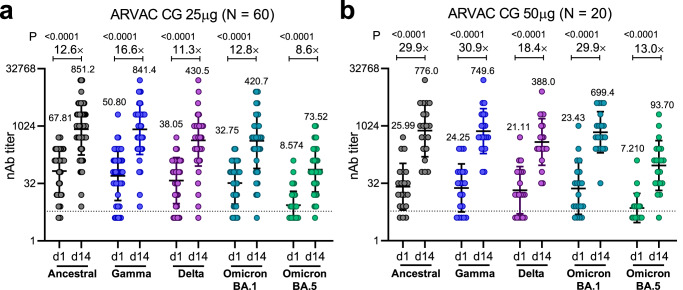
Fig. 3. Administration of ARVAC CG booster increases the nAb titers against the Ancestral, Gamma, Delta, Omicron BA.1 and Omicron BA.5 variants of SARS-CoV-2.
The nAb titers against the Ancestral, Gamma, Delta and Omicron BA.1 and Omicron BA.5 variants of SARS-CoV-2 in plasma samples of individuals boosted with ARVAC CG 25 µg (N = 60 individuals) (a) or 50 µg (N = 20 individuals) (b) prior to the vaccine administration (d1) or after 14 days of booster administration (d14). Each point represents the nAb titer of a volunteer at the indicated time point and against the depicted viral variant. The nAb geometric mean titers (GMTs) and 95% CIs are shown as horizontal and error bars, respectively. The numbers depicted above the individual points for each specified time point and viral variant represent de GMT. The fold increase in the GMT from day 1 to day 14 (GMFR) for each specified variant are shown with a number followed by a ×. The dashed line represents the positivity threshold on the virus neutralization assay. Statistical differences were analyzed using the two-tailed Wilcoxon pair-matched test. P-values are depicted above the data sets that were compared. In panel (a) all P values were smaller than 10e-15; in panel (b) P = 0.000004 for Ancestral strain, Gamma and Omicron BA.1 VOCs, P = 0.000099 for Delta VOC and P = 0.000015 for Omicron BA.5.
Fig. 4
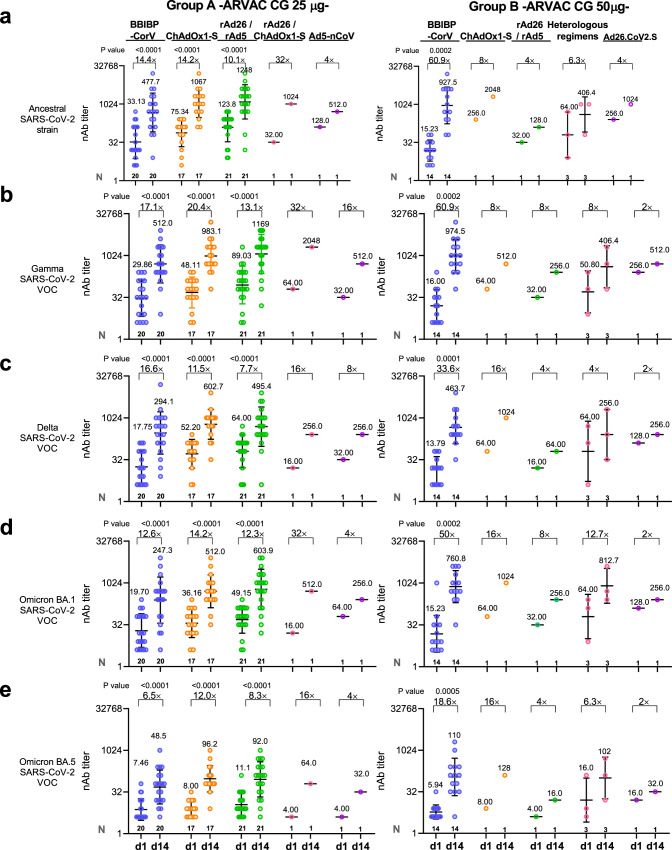
Fig. 4. Administration of ARVAC CG as booster increases the nAb titers against the Ancestral, Gamma, Delta, Omicron BA.1 and Omicron BA.5 variants of SARS-CoV-2 in individuals with different primary vaccinations schemes.
Neutralizing antibody titers against the Ancestral (a), Gamma (b), Delta (c), Omicron BA.1 (d) and Omicron BA.5 (e) variants of SARS-CoV-2 in plasma samples of individuals boosted with ARVAC CG 25 µg (left panels) or 50 µg (right panels) prior to the vaccine administration (d1) or after 14 days of booster (d14). Participants in each cohort were grouped according to the primary vaccination scheme received. ARVAC CG 25 µg cohort: BBIBP-CorV (N = 20), ChAdOx1-S (N = 17), rAd26/rAd5 (N = 21), rAd26/ChAdOx1-S (N = 1) and Ad5-nCoV (N = 1). ARVAC CG 50 µg cohort: BBIBP-CorV (N = 14), ChAdOx1-S (N = 1), rAd26/rAd5 (N = 1), heterologous vaccination regimens (ChAdOx1-S/mRNA1273 or BBIBP-CorV/BNT162b2) (N = 3) and Ad26.CoV2.S (N = 1). Each point represents the nAb titer of a volunteer. In subgroups with N > 1, the nAb GMTs with geometric SD are shown as horizontal and error bars, respectively. The numbers depicted above the individual points for each specified time point represent the GMT values. The GMFR from day 1 to day 14 for each specified variant are shown with a number followed by a ×. The number of participants included in each data set analyzed are depicted in the bottom of each data set (N). Statistical differences were performed using the two-tailed Wilcoxon pair-matched test. P-values are depicted above the data sets that were compared. Exact P-values (d1 vs. d14 nAb titers) in ARVAC CG 25 µg subgroups (left panels) are: BBIBP-CorV (P = 0.000002 (a, b, d), P = 0.00003 (c), and P = 0.000004 (d, e), ChAdOx1-S (P = 0.000002 (a, b, c) and P = 0.00002 (d, e). In ARVAC CG 50 µg BBIBP-CorV primary vaccination exact P-values are: P = 0.0002 (a, b, d), P = 0.0001 (c) and P = 0.0005 (e).
Fig. 5
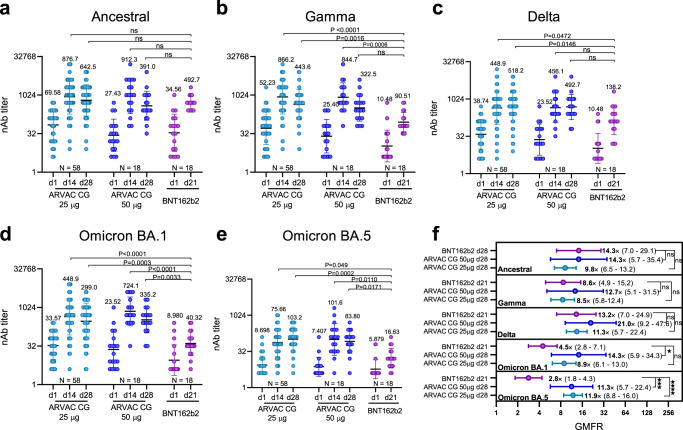
Fig. 5. Comparison of nAb GMT and GMFR after booster with ARVAC CG or booster with BNT162b2.
Neutralizing antibody titers against the Ancestral (a), Gamma (b), Delta (c), Omicron BA.1 (d) and Omicron BA.5 (e) variants of SARS-CoV-2 in plasma samples of individuals boosted with the indicated vaccine (ARVAC CG 25 µg, ARVAC CG 50 µg or BNT162b2) prior booster administration (d1) or at the indicated days after booster administration (d14, d21, d28). Each point represents the nAb titer of a volunteer. Data are from participants with no missing data at all analyzed time points (ARVAC CG 25 µg (N = 58), ARVAC CG 50 µg (N = 18) or BNT162b2 (N = 18). The nAb GMTs and 95% CIs are shown as horizontal and error bars, respectively. The numbers depicted above the individual points for each specified time point and viral variant represent the GMTs. The number of participants included in each data set analyzed is depicted in the bottom of the graph (N = number of individuals in each data set). Statistical differences were analyzed using the Kruskal-Wallis test followed by the Dunn´s multiple comparison test. P-values are depicted above the data sets that were compared. ns: P > 0.05. Exact P-values for each comparison are: BNT162b2 d21 vs. ARVAC CG 25 µg d14: P = 0.000007 (b), P = 0.0472 (c), P = 0.00001 (d) and P = 0.049 (e); BNT162b2 d21 vs. ARVAC CG 25 µg d28: P = 0.0016 (b), P = 0.015 (c), P = 0.0003 (d) and P = 0.0002 (e); BNT162b2 d21 vs. ARVAC CG 50 µg d14: P = 0.0006 (b), P = 0.00003 (d) and P = 0.0110 (e); BNT162b2 d21 vs. ARVAC CG 50 µg d28: P = 0.0033 (d) and P = 0.0171 (e). f Fold increases in the GMT from day 1 to day 21 or 28 (GMFR) for each specified variant represented by a point and written with a number followed by a ×. The horizontal lines represent the 95% CIs. Data are from participants with no missing data at baseline and at all time points analyzed (ARVAC CG 25 µg (N = 58), ARVAC CG 50 µg (N = 18) or BNT162b2 (N = 18). Statistical differences were analyzed using Kruskal-Wallis test followed by the Dunn´s multiple comparison test. ns: P > 0.05, P = 0.0243; ★★★P = 0.0009; ★★★★P = 0.00004.
Fig. 6
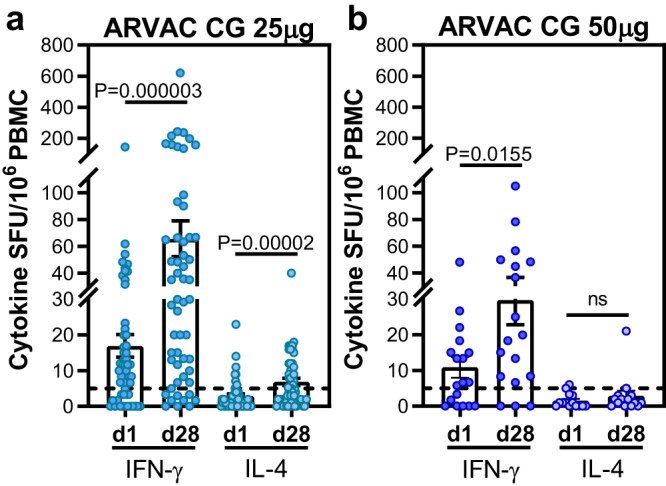
Fig. 6. ARVAC CG booster induces significant increase of Th1-predominant cell response measured by IFN-γ and IL-4 ELISpot after restimulation of PBMCs with RBD spanning peptide pool.
Before booster administration (d1) and after 28 days (d28) of administration of ARVAC CG 25 μg (a) or 50 μg (b) dose, RBD specific cellular responses were measured by IFN-γ and IL-4 ELISpot in PBMCs. Samples from 58 subjects and 18 subjects from ARVAC CG 25 µg and 50 µg cohorts were analyzed. Shown are spot-forming units (SFU) per 1 × 106 PBMCs producing IFN-γ and IL-4 after stimulation with-RBD peptide pool from samples with viable cells: N = 55 for IFN-γ and N = 51 for IL-4 in ARVAC CG 25 µg group and N = 18 for IFN-γ and N = 14 for IL-4 in ARVAC CG 50 µg group. Each point represents the result from a subject. Bars indicate the mean, and error bars the SEM. Statistical analysis (d1 vs. d28) was performed by the two tailed Wilcoxon matched pairs signed rank test. a IFN-γ SFU d1 vs. d28: P = 0.000003; IL-4 SFU d1 vs. d28: P = 0.00002; (b) IFN-γ SFU d1 vs. d28: P = 0.0155; IL-4 SFU d1 vs. d28: P > 0.05.

References

    1. Chi W-Y, et al. COVID-19 vaccine update: vaccine effectiveness, SARS-CoV-2 variants, boosters, adverse effects, and immune correlates of protection. J. Biomed. Sci. 2022;29:82. doi: 10.1186/s12929-022-00853-8. - DOI - PMC - PubMed
    1. Shrestha LB, Foster C, Rawlinson W, Tedla N, Bull RA. Evolution of the SARS-CoV-2 omicron variants BA.1 to BA.5: Implications for immune escape and transmission. Rev. Med Virol. 2022;32:e2381. doi: 10.1002/rmv.2381. - DOI - PMC - PubMed
    1. Martinez-Flores D, et al. SARS-CoV-2 Vaccines Based on the Spike Glycoprotein and Implications of New Viral Variants. Front Immunol. 2021;12:701501. doi: 10.3389/fimmu.2021.701501. - DOI - PMC - PubMed
    1. Pollet J, Chen WH, Strych U. Recombinant protein vaccines, a proven approach against coronavirus pandemics. Adv. Drug Deliv. Rev. 2021;170:71–82. doi: 10.1016/j.addr.2021.01.001. - DOI - PMC - PubMed
    1. Heidary M, et al. A Comprehensive Review of the Protein Subunit Vaccines Against COVID-19. Front Microbiol. 2022;13:927306. doi: 10.3389/fmicb.2022.927306. - DOI - PMC - PubMed

Publication types

Supplementary concepts

Associated data