. 2023 Jul 28;13(1):12271.
doi: 10.1038/s41598-023-39222-2.

Unveiling the functional epitopes of cobra venom cytotoxin by immunoinformatics and epitope-omic analyses

Affiliations

Unveiling the functional epitopes of cobra venom cytotoxin by immunoinformatics and epitope-omic analyses

Jia Jin Hiu et al. Sci Rep. .

Abstract

Approximate 70% of cobra venom is composed of cytotoxin (CTX), which is responsible for the dermonecrotic symptoms of cobra envenomation. However, CTX is generally low in immunogenicity, and the antivenom is ineffective in attenuating its in vivo toxicity. Furthermore, little is known about its epitope properties for empirical antivenom therapy. This study aimed to determine the epitope sequences of CTX using the immunoinformatic analyses and epitope-omics profiling. A conserved CTX was used in this study to determine its T-cell and B-cell epitope sequences using immunoinformatic tools and molecular docking simulation with different Human Leukocyte Antigens (HLAs). The potential T-cell and B-cell epitopes were 'KLVPLFY,' 'CPAGKNLCY,' 'MFMVSTPTK,' and 'DVCPKNSLL.' Molecular docking simulations disclosed that the HLA-B62 supertype exhibited the greatest binding affinity towards cobra venom cytotoxin. The namely L7, G18, K19, N20, M25, K33, V43, C44, K46, N47, and S48 of CTX exhibited prominent intermolecular interactions with HLA-B62. The multi-enzymatic-limited-digestion/liquid chromatography-mass spectrometry (MELD/LC-MS) also revealed three potential epitope sequences as 'LVPLFYK,' 'MFMVS,' and 'TVPVKR'. From different epitope mapping approaches, we concluded four potential epitope sites of CTX as 'KLVPLFYK', 'AGKNL', 'MFMVSTPKVPV' and 'DVCPKNSLL'. Site-directed mutagenesis of these epitopes confirmed their locations at the functional loops of CTX. These epitope sequences are crucial to CTX's structural folding and cytotoxicity. The results concluded the epitopes that resided within the functional loops constituted potential targets to fabricate synthetic epitopes for CTX-targeted antivenom production.


Conflict of interest statement

The authors declare no competing interests.

Figures
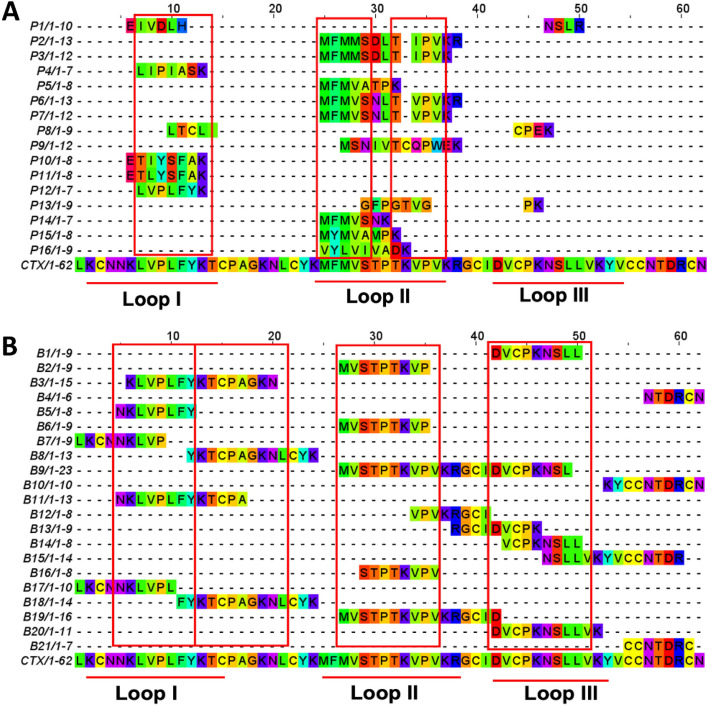
Figure 1
Figure 1
Multiple sequence alignment of predicted (A) T-cell epitopes, and (B) B-cell epitopes of cytotoxin. The red boxes represent the highly consensus residues.
Figure 2
Figure 2
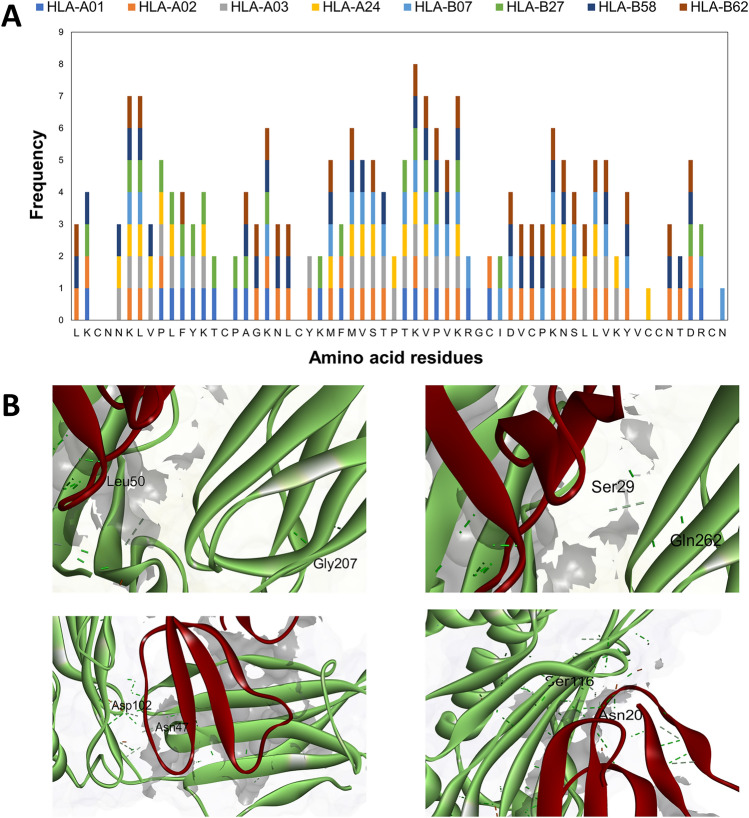
The molecular docking analysis of cytotoxin (CTX) with different Human Leukocyte Antigen (HLA) supertypes. (A) RING analysis for determination of interacting residues between CTX and eight HLA supertypes. Four regions indicated the highly frequent interacting sites (frequency ⩾3) suggesting these interacting sites were the potential epitopes. (B) Examples of interaction between CTX (red color) and the best docked HLA, HLA-B62 (green). The interacting residues were annotated, the dashed lines indicated hydrogen bonds.
Figure 3
Figure 3
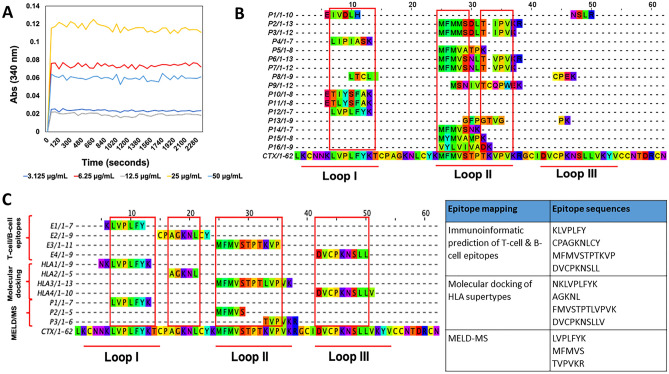
The alignment of epitope sequences determined by different epitope mapping approaches. (A) Immunocomplex kinetic analysis of CTX and anti-CTX, different concentrations of anti-CTX (3.125–50 µg/mL) were incubated with 12.5 µg/mL of CTX. Absorbance readings were measured at the wavelength (λ) of 340 nm (n = 3). (B) Multiple sequence alignment of MELD/LC–MS peptides with CTX revealed the presence of highly consensus sequences, annotated in red boxes. (C) Multiple sequence alignment and summary of epitope sequences determined from different mapping methods.
Figure 4
Figure 4
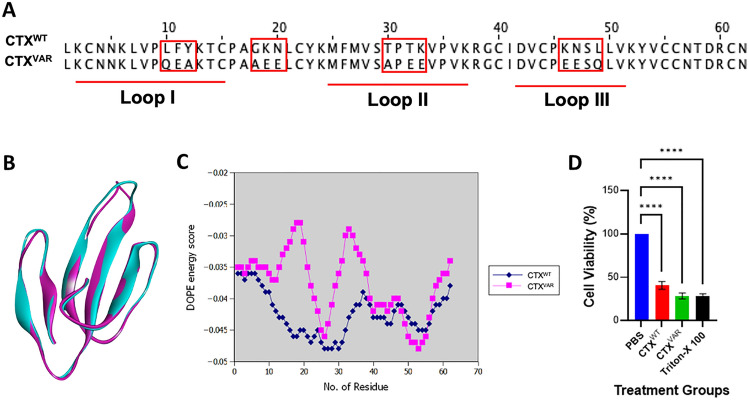
Site-directed mutagenesis analysis of cytotoxin (CTX) to determine its functionality. (A) Comparison of amino acid sequences between wildtype CTX (CTXWT) and variant (CTXVAR), red boxes indicate the mutagenesis sites. (B) Superimposed structural view of CTXWT (cyan color) and CTXVAR (purple color) showed similar three-finger folded structure. (C) DOPE per residue energy score against amino acid residue, CTXVAR demonstrated variations at amino acid residues 10–12, 17–20, 30–34, and 46–49 compared to CTXWT. (D) Cell viability of HaCat cell lines after treatment with CTXWT and CTXVAR for 24 h. PBS and Triton-X 100 were used as negative and positive controls, respectively. The cytotoxic effect of CTXVAR was slightly higher than the CTXWT; treatment groups. The data are shown as mean ± SEMs of three independent experiments (n = 3), the data was analyzed using one-way ANOVA whereby **** indicates p < 0.0001.

References

    1. Chippaux J. Snakebite envenomation turns again into a neglected tropical disease! J. Venom. Anim. Toxins incl. Trop. Dis. 2017;23:1–2. doi: 10.1186/s40409-017-0127-6. - DOI - PMC - PubMed
    1. Panagides N, et al. How the cobra got its flesh-eating venom: Cytotoxicity as a defensive innovation and its co-evolution with hooding, aposematic marking, and spitting. Toxins. 2017;9:1–22. doi: 10.3390/toxins9030103. - DOI - PMC - PubMed
    1. Gasanov SE, et al. Naja naja oxiana cobra venom cytotoxins CTI and CTII disrupt mitochondrial membrane integrity: Implications for basic three-fingered cytotoxins. PLoS ONE. 2015;10:1–28. doi: 10.1371/journal.pone.0129248. - DOI - PMC - PubMed
    1. Ismail, M., al-Bekairi, A. M., el-Bedaiwy, A. M. & Abd-el Salam, M. A. The ocular effects of spitting cobras: II. Evidence that cardiotoxins are responsible for the corneal opacification syndrome. J. Toxicol. Clin. Toxicol. 31, 45–62 (1993). - PubMed
    1. Liu CC, et al. Pathogenesis of local necrosis induced by Naja atra venom: Assessment of the neutralization ability of Taiwanese freeze-dried neurotoxic antivenom in animal models. PLoS Negl. Trop. Dis. 2020;14:1–20. doi: 10.1371/journal.pntd.0008054. - DOI - PMC - PubMed

Publication types