Review
. 2023 Jul 19;13(14):2357.
doi: 10.3390/ani13142357.

The 3Rs in Experimental Liver Disease

Affiliations
Review

The 3Rs in Experimental Liver Disease

Sebastian Martinez-Lopez et al. Animals (Basel). .

Abstract

Patients with cirrhosis present multiple physiological and immunological alterations that play a very important role in the development of clinically relevant secondary complications to the disease. Experimentation in animal models is essential to understand the pathogenesis of human diseases and, considering the high prevalence of liver disease worldwide, to understand the pathophysiology of disease progression and the molecular pathways involved, due to the complexity of the liver as an organ and its relationship with the rest of the organism. However, today there is a growing awareness about the sensitivity and suffering of animals, causing opposition to animal research among a minority in society and some scientists, but also about the attention to the welfare of laboratory animals since this has been built into regulations in most nations that conduct animal research. In 1959, Russell and Burch published the book "The Principles of Humane Experimental Technique", proposing that in those experiments where animals were necessary, everything possible should be done to try to replace them with non-sentient alternatives, to reduce to a minimum their number, and to refine experiments that are essential so that they caused the least amount of pain and distress. In this review, a comprehensive summary of the most widely used techniques to replace, reduce, and refine in experimental liver research is offered, to assess the advantages and weaknesses of available experimental liver disease models for researchers who are planning to perform animal studies in the near future.

Keywords: disease; liver; reduction; refinement; replacement; research.


Conflict of interest statement

The authors declare no conflict of interest.

Figures
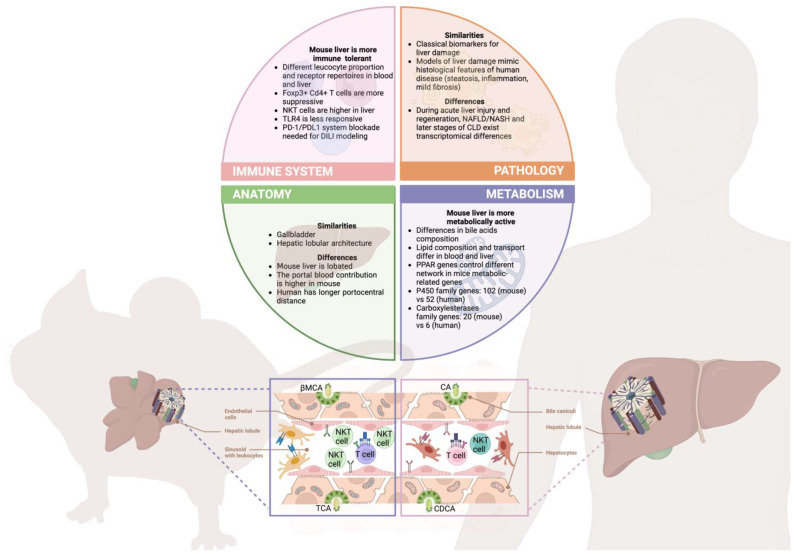
Figure 1
Figure 1
Relevant human and mouse differences in liver physiopathology. Although mice remain one of the best approximations to the human systems, key differences in liver biology need to be considered while designing projects in order to avoid failed experiments and inconclusive results, thus meeting the 3Rs principles. With respect to liver anatomy, albeit the external appearance differs between mice and humans, the functional microscopic lobule architecture is quite conserved in both [28]. This aspect translates into similar phenotypic manifestations during liver pathology (steatosis, inflammation, and fibrosis), although the symptomatology of advanced human disease is difficult to mimic in mice [29]. This might be attributed to the differences in rodents’ local immune system and metabolism. Regarding liver immunology, mice are considered more tolerant, with a reduced response to bacterial products and potent regulatory lymphocytes compared to humans [30,31]. Metabolism is considered to be more active in murine models, being exemplified in the expansion of metabolic enzyme genes and their respective increased production [32,33]. Remarkably, these distinctions are further exemplified in omics analyses that highlight partially divergent genomic responses to liver injury and disease progression [34,35], ultimately indicating that improved models, such as humanized mice, could reduce the gap between the two species [36]. This image was created using Biorender platform.

References

    1. Driskill J.H., Pan D. The Hippo Pathway in Liver Homeostasis and Pathophysiology. Annu. Rev. Pathol. 2021;16:299–322. doi: 10.1146/annurev-pathol-030420-105050. - DOI - PMC - PubMed
    1. Schuppan D., Afdhal N.H. Liver cirrhosis. Lancet. 2008;371:838–851. doi: 10.1016/S0140-6736(08)60383-9. - DOI - PMC - PubMed
    1. Yanguas S.C., Cogliati B., Willebrords J., Maes M., Colle I., van den Bossche B., de Oliveira C., Andraus W., Alves V.A.F., Leclercq I., et al. Experimental models of liver fibrosis. Arch. Toxicol. 2016;90:1025–1048. doi: 10.1007/s00204-015-1543-4. - DOI - PMC - PubMed
    1. Bosch J., Pizcueta P., Feu F., Fernandez M., Garcia-Pagan J.C. Pathophysiology of portal hypertension. Gastroenterol. Clin. N. Am. 1992;21:1–14. doi: 10.1016/S0889-8553(21)00175-8. - DOI - PubMed
    1. Bataller R., Brenner D.A. Liver fibrosis. J. Clin. Investig. 2005;115:209–218. doi: 10.1172/JCI24282. - DOI - PMC - PubMed

LinkOut - more resources
