


Pain Evaluation and Treatment in Children: A Practical Approach
- PMID: 37508709
- PMCID: PMC10378137
- DOI: 10.3390/children10071212
Pain Evaluation and Treatment in Children: A Practical Approach
Abstract
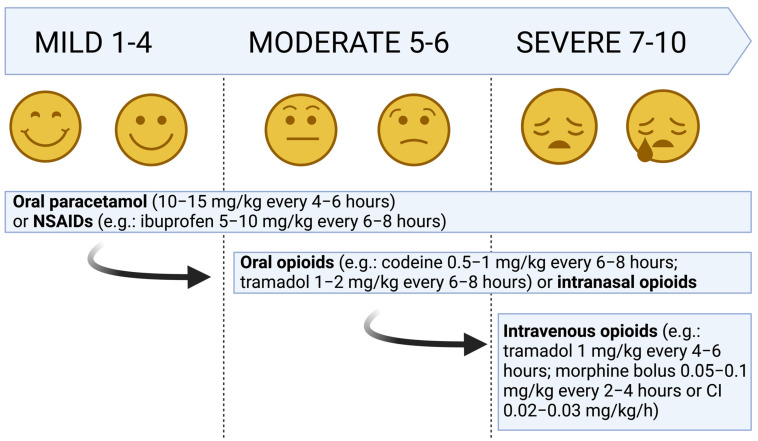
Pain is the most common complaint reported by children who access the emergency departments, but despite its frequency and the availability of many international guidelines, it often remains underreported and undertreated. Recently, the American Academy of Pediatrics and the American Pain Society have reiterated the importance of a multidisciplinary approach in order to eliminate pain in children. In all pediatric settings, an adequate assessment is the initial stage in a proper clinical approach to pain, especially in the emergency departments; therefore, an increasing number of age-related tools have been validated. A wide range of analgesic agents are currently available for pain management, and they should be tailored according to the patient's age, the drug's pharmacokinetics and the intensity of pain. In order to facilitate the choice of the appropriate drug, a treatment algorithm based on a ladder approach can be used. Moreover, non-pharmacological techniques should be considered to alleviate anxiety and distress in pediatric age. This review aims to offer a simple but intuitive description of the best strategies for pain relief in children, starting with the prompt recognition and quantification of pain through adequate assessment scales, and following with the identification of the most appropriate therapeutic choice among the ones available for pediatric age.
Keywords: analgesic agents; assessment scales; children; non-pharmacological techniques; pain; pain management.
Conflict of interest statement
The authors declare no conflict of interest.
Figures

References
-
- Eccleston C., Fisher E., Howard R.F., Slater R., Forgeron P., Palermo T.M., Birnie K.A., Anderson B.J., Chambers C.T., Crombez G., et al. Delivering Transformative Action in Paediatric Pain: A Lancet Child & Adolescent Health Commission. Lancet Child. Adolesc. Health. 2021;5:47–87. doi: 10.1016/S2352-4642(20)30277-7. - DOI - PubMed
-
- Raja S.N., Carr D.B., Cohen M., Finnerup N.B., Flor H., Gibson S., Keefe F.J., Mogil J.S., Ringkamp M., Sluka K.A., et al. The Revised International Association for the Study of Pain Definition of Pain: Concepts, Challenges, and Compromises. Pain. 2020;161:1976–1982. doi: 10.1097/j.pain.0000000000001939. - DOI - PMC - PubMed
Publication types
LinkOut - more resources
Full Text Sources
