


Coping as a Mediator between Attachment and Depressive Symptomatology Either in Pregnancy or in the Early Postpartum Period: A Structural Equation Modelling Approach
- PMID: 37508934
- PMCID: PMC10377438
- DOI: 10.3390/brainsci13071002
Coping as a Mediator between Attachment and Depressive Symptomatology Either in Pregnancy or in the Early Postpartum Period: A Structural Equation Modelling Approach
Abstract
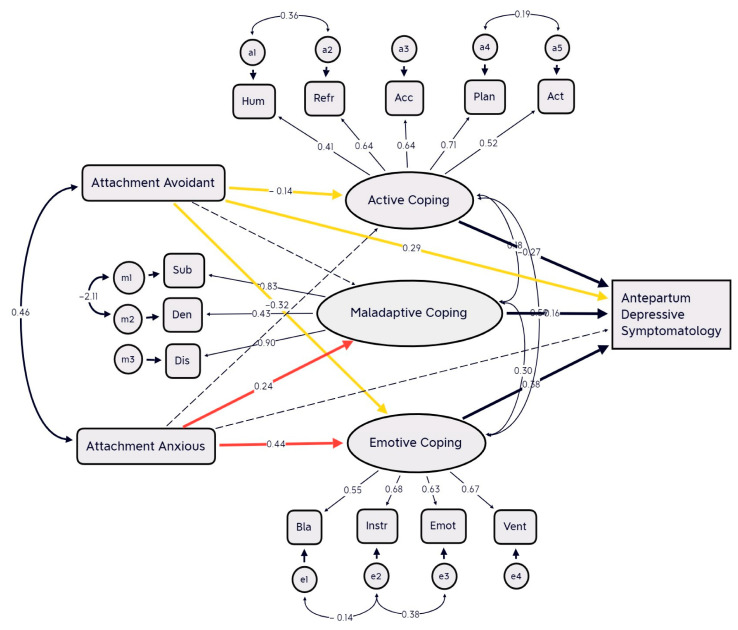
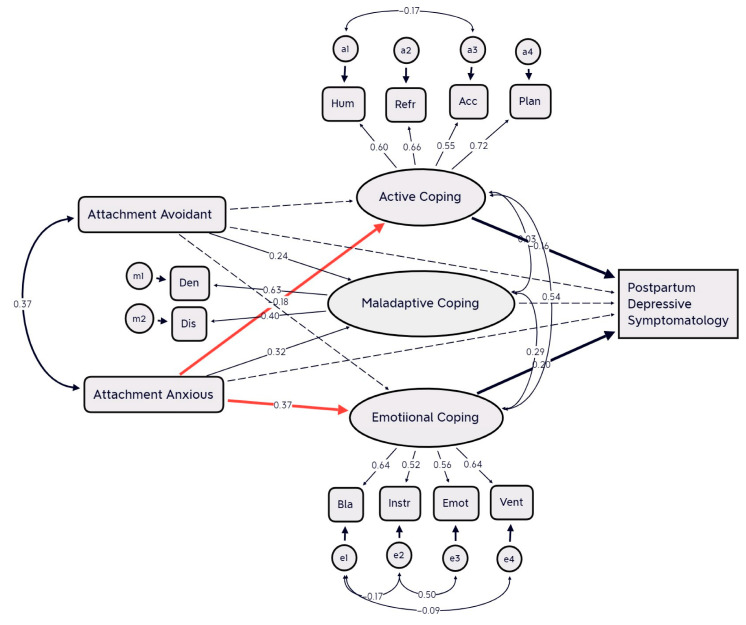
Peripartum depression (PPD) is a major complication of pregnancy, and numerous risk factors have been associated with its onset, including dysfunctional coping strategies and insecure attachment styles, both during pregnancy and postpartum. The aim of our study was to investigate the role of coping strategies in mediating the relationship between women's attachment style and depressive symptomatology in pregnancy and one week after giving birth in a large sample of women (N = 1664). Our hypothesis was that the relationship between anxious and avoidant attachment and depressive symptomatology would be mediated by use of maladaptive coping strategies. The assessment instruments were Edinburgh Postnatal Depression Scale (EPDS), Brief Coping Orientation for Problem Experiences (COPE), and Experiences in Close Relationship Scale (ECR). The results indicated that the effect of insecure attachment styles (anxious and avoidant attachment) on antepartum depressive symptomatology was partially mediated by dysfunctional coping styles. Anxious attachment also has an indirect significant effect on postpartum depressive symptomatology through emotional coping; however, avoidant attachment does not seem to be significantly related to postpartum depressive symptoms. Our findings revealed that not only is it important to consider attachment in understanding peripartum depressive symptomatology, but also that coping plays an important role in these relationships. These findings would help a preventive coping-based intervention strategy to enhance the capacity of women with insecure attachment styles to use more adaptive coping during and after pregnancy.
Keywords: attachment style; coping strategies; gender medicine; perinatal depression; structural equation modelling.
Conflict of interest statement
The authors declare no conflict of interest. The funders had no role in the design of the study; in the collection, analyses, or interpretation of data; in the writing of the manuscript; or in the decision to publish the results.
Figures
References
-
- Langan R., Goodbred A.J. Identification and Management of Peripartum Depression. Am. Fam. Physician. 2016;10:852–858. - PubMed
-
- Gutiérrez-Zotes A., Labad J., Martín-Santos R., García-Esteve L., Gelabert E., Jover M., Guillamat R., Mayoral F., Gornemann I., Canellas F., et al. Coping strategies and postpartum depressive symptoms: A structural equation modelling approach. Eur. Psychiatry. 2015;30:701–708. doi: 10.1016/j.eurpsy.2015.06.001. - DOI - PubMed
Grants and funding
LinkOut - more resources
Full Text Sources
