


Lower Nerve Growth Factor Levels in Major Depression and Suicidal Behaviors: Effects of Adverse Childhood Experiences and Recurrence of Illness
- PMID: 37509019
- PMCID: PMC10377511
- DOI: 10.3390/brainsci13071090
Lower Nerve Growth Factor Levels in Major Depression and Suicidal Behaviors: Effects of Adverse Childhood Experiences and Recurrence of Illness
Abstract
Major depressive disorder (MDD) and its severe subtype, major dysmood disorder (MDMD), are distinguished by activation of inflammatory and growth factor subnetworks, which are associated with recurrence of illness (ROI) and adverse childhood experiences (ACEs). Nerve growth factor (NGF) plays a crucial role in facilitating neuro-immune communications and may regulate the inflammatory response.
Methods: The present study examined the effects of ACEs and ROI on culture supernatant NGF, stem cell factor (SCF), stem cell GF (SCGF), hepatocyte GF (HGF), and macrophage colony-stimulating factor (M-CSF), in relation to a neurotoxicity (NT) cytokine profile.
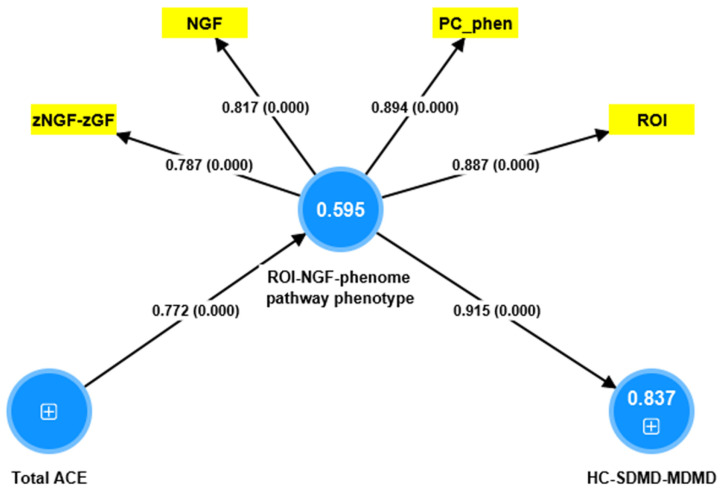
Results: NGF levels are lower in MDD (p = 0.003), particularly MDMD (p < 0.001), as compared with normal controls. ROI and ACE were significantly and inversely associated with NGF (≤0.003) and the NGF/NT ratio (≤0.001), whereas there are no effects of ACEs and ROI on SCF, SCGF, HGF, or M-CSF. Lowered NGF (p = 0.003) and the NGF/NT ratio (p < 0.001) are highly significantly and inversely associated with the severity of the current depression phenome, conceptualized as a latent vector extracted from the current severity of depression, anxiety, and suicidal behaviors. We found that one validated and replicable latent vector could be extracted from NGF, ROI, and the depression phenome, which therefore constitutes a novel ROI-NGF-pathway-phenotype. ACEs explained 59.5% of the variance in the latter pathway phenotype (p < 0.001).
Conclusions: The imbalance between decreased NGF and increased neurotoxic cytokines during the acute phase of severe depression may contribute to decreased neuroprotection, increased neuro-affective toxicity, and chronic mild inflammation.
Keywords: biomarkers; inflammation; major depression; mood disorders; neuro-immune.
Conflict of interest statement
The authors have no conflicts of interest with any commercial or other association in connection with the submitted article.
Figures


References
-
- Maes M., Scharpé S., Van Grootel L., Uyttenbroeck W., Cooreman W., Cosyns P., Suy E. Higher alpha 1-antitrypsin, haptoglobin, ceruloplasmin and lower retinol binding protein plasma levels during depression: Further evidence for the existence of an inflammatory response during that illness. J. Affect. Disord. 1992;24:183–192. doi: 10.1016/0165-0327(92)90066-F. - DOI - PubMed
-
- Rachayon M., Jirakran K., Sodsai P., Sughondhabirom A., Maes M. T cell activation via the CD40 ligand and transferrin receptor and deficits in T regulatory cells are associated with major depressive disorder and severity of depression. medRxiv. 2023 doi: 10.1101/2023.05.03.23289312. - DOI - PMC - PubMed
-
- Maes M., Rachayon M., Jirakran K., Sodsai P., Klinchanhom S., Gałecki P., Sughondhabirom A., Basta-Kaim A. The Immune Profile of Major Dysmood Disorder: Proof of Concept and Mechanism Using the Precision Nomothetic Psychiatry Approach. Cells. 2022;11:1183. doi: 10.3390/cells11071183. - DOI - PMC - PubMed
Grants and funding
LinkOut - more resources
Full Text Sources
Research Materials
Miscellaneous
