


How [18F]-FDG-PET/CT Affects Clinical Management of Patients with Germ Cell Tumors in the Real World
- PMID: 37509313
- PMCID: PMC10377569
- DOI: 10.3390/cancers15143652
How [18F]-FDG-PET/CT Affects Clinical Management of Patients with Germ Cell Tumors in the Real World
Abstract
Objective: The aim of this study was to evaluate the impact of PET/CT on clinical management of patients with germ cell tumors (GCTs) conducted in a real-world setting, including avoidance of invasive procedures, additional diagnostic imaging, and changes in treatment.
Methods: Patients with GCTs were prospectively enrolled into a PET/CT registry study between May 2013 and April 2021. Intended patient management prior and after PET/CT was documented using standardized questionnaires. Changes in oncologic staging and clinical management after PET/CT were recorded, including planned treatment and planned additional diagnostics.
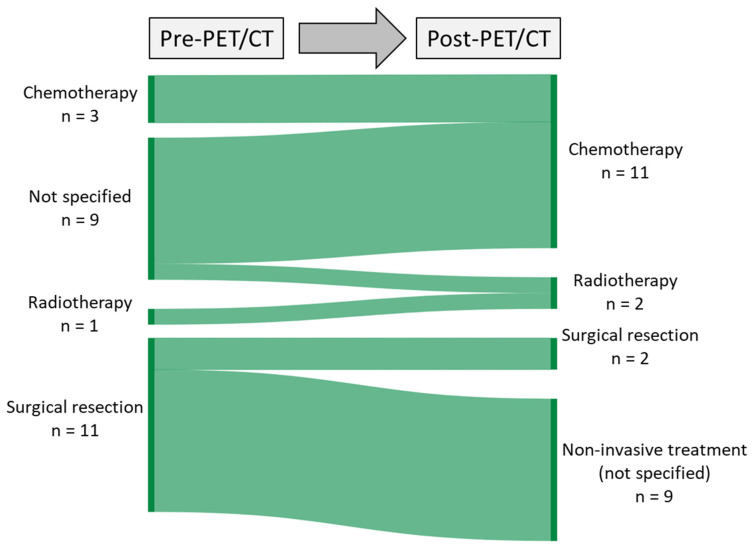
Results: Forty-three male patients with GCTs were included consecutively in this study. After PET/CT, oncologic staging changed in 22/43 patients (51%), with upstaging in seven cases (16%), downstaging in ten cases (23%), and cancer relapse in five cases (11%). The number of patients with intended curative treatment remained stable, while a considerable change in intended therapeutic intervention was noted after PET/CT, with an increase in planned chemotherapy from three to eleven patients and a decrease in planned surgical resection from eleven to two patients. In addition, PET/CT contributed to preventing patients from intended invasive procedures including biopsy and surgery in 8/43 (19%) cases and from additional diagnostic procedures in 25 (58%) cases.
Conclusion: With the use of FDG-PET/CT as a tool to guide patient management in GCTs, we observed a notable impact on clinical staging and a consequent reduction in the need for additional invasive and diagnostic procedures. These findings are expected to be even more consequential in the future as treatment modalities improve and the life expectancy of GCT patients further increases.
Key points: PET/CT considerably influences the clinical stage of GCT patients. PET/CT has remarkable influence on the choice of therapeutic interventions and reduces additional diagnostic procedures.
Keywords: PET/CT; clinical management; germ cell tumors; seminoma.
Conflict of interest statement
The authors declare no conflict of interest.
Figures



References
-
- Gilligan T.D., Seidenfeld J., Basch E.M., Einhorn L.H., Fancher T., Smith D.C., Stephenson A.J., Vaughn D.J., Cosby R., Hayes D.F. American Society of Clinical Oncology Clinical Practice Guideline on Uses of Serum Tumor Markers in Adult Males with Germ Cell Tumors. J. Clin. Oncol. 2010;28:3388–3404. doi: 10.1200/JCO.2009.26.4481. - DOI - PubMed
-
- Treglia G., Sadeghi R., Annunziata S., Caldarella C., Bertagna F., Giovanella L. Diagnostic performance of fluorine-18-fluorodeoxyglucose positron emission tomography in the postchemotherapy management of patients with seminoma: Systematic review and meta-analysis. BioMed Res. Int. 2014;2014:852681. doi: 10.1155/2014/852681. - DOI - PMC - PubMed
-
- Pfannenberg C., Aschoff P., Dittmann H., Mayer F., Reischl G., von Weyhern C., Kanz L., Claussen C.D., Bares R., Hartmann J.T. PET/CT with 18F-FLT: Does it improve the therapeutic management of metastatic germ cell tumors? J. Nucl. Med. 2010;51:845–853. doi: 10.2967/jnumed.109.070425. - DOI - PubMed
-
- Bonkat G., Pickard R., Bartoletti R. EAU Guidelines; Proceedings of the 33rd EAU Annual Congress; Copenhagen, Denmark. 16–20 March 2018; Arnhem, The Netherlands: EAU Guidelines Office; 2018. [(accessed on 21 May 2023)]. Available online: http://uroweb.org/guidelines/compilations-of-all-guidelines.
LinkOut - more resources
Full Text Sources
Miscellaneous
