Review
. 2023 Jul 20;15(14):3691.
doi: 10.3390/cancers15143691.

Roles of Fascin in Dendritic Cells

Affiliations
Review

Roles of Fascin in Dendritic Cells

Hao-Jie Wang et al. Cancers (Basel). .

Abstract

Dendritic cells (DCs) are professional antigen-presenting cells that play a crucial role in activating naive T cells through presenting antigen information, thereby influencing immunity and anti-cancer responses. Fascin, a 55-kDa actin-bundling protein, is highly expressed in mature DCs and serves as a marker protein for their identification. However, the precise role of fascin in intratumoral DCs remains poorly understood. In this review, we aim to summarize the role of fascin in both normal and intratumoral DCs. In normal DCs, fascin promotes immune effects through facilitating DC maturation and migration. Through targeting intratumoral DCs, fascin inhibitors enhance anti-tumor immune activity. These roles of fascin in different DC populations offer valuable insights for future research in immunotherapy and strategies aimed at improving cancer treatments.

Keywords: anti-tumor immune responses; dendritic cells; fascin; tumor microenvironment.


Conflict of interest statement

X.-Y.H. is a co-founder and has equity in Novita Pharmaceuticals. The remaining authors declare no competing financial interests.

Figures
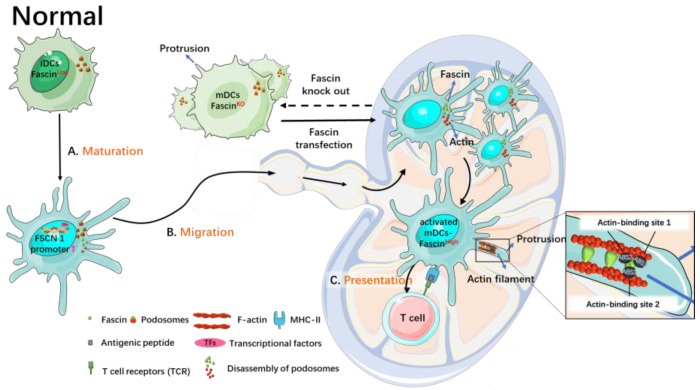
Figure 1
Figure 1
Roles of fascin in the maturation, migration, and antigen presentation of normal DCs. Fascin is barely expressed, if at all, in immature DCs and is induced during their maturation, leading to dynamic assembly of veil-like membrane protrusions, breakdown of podosomes, and migration to lymph nodes. This process results in an increased number of DCs migrating to lymph nodes. Mature DCs lacking fascin exhibit lower membrane activity, undecomposed podosomes, and a thinner and more widely distributed morphology. Transfection of fascin protein restores fascin expression, decomposes podosomes, and enhances DC migration.
Figure 2
Figure 2
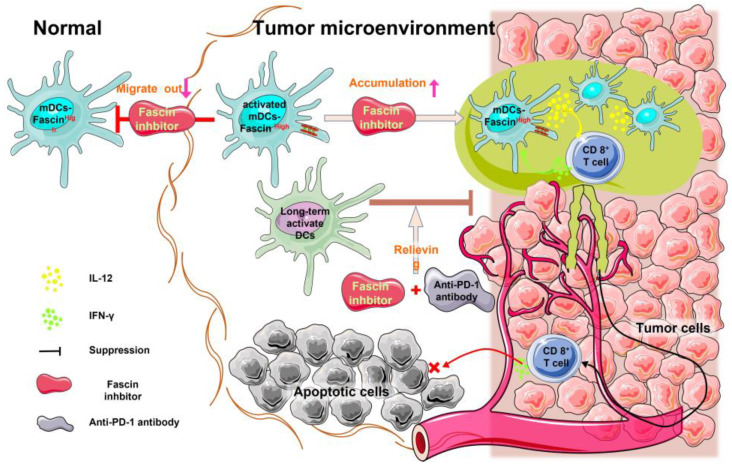
Inhibition of fascin decreases intratumoral DC migration and promotes DC accumulation within the tumor microenvironment. Migration and antigen uptake in DCs are antagonistic processes. High fascin expression in intratumoral DCs promotes their migration. Conversely, fascin inhibitors promote antigen uptake by these DCs, inhibit migration, and increase accumulation in the tumor microenvironment. Activated DCs secrete IL-12, which activates CD8+ T cells to secrete IFN-γ and exert an anti-tumor effect.

References

    1. Hart D.N.J. Dendritic Cells: Unique Leukocyte Populations Which Control the Primary Immune Response. Blood. 1997;90:3245–3287. doi: 10.1182/blood.V90.9.3245. - DOI - PubMed
    1. Aiba S., Tagami H. Dendritic Cell Activation Induced by Various Stimuli, e.g. Exposure to Microorganisms, Their Products, Cytokines, and Simple Chemicals as Well as Adhesion to Extracellular Matrix. J. Dermatol. Sci. 1998;20:1–13. doi: 10.1016/S0923-1811(99)00005-5. - DOI - PubMed
    1. Banchereau J., Steinman R.M. Dendritic Cells and the Control of Immunity. Nature. 1998;392:245–252. doi: 10.1038/32588. - DOI - PubMed
    1. Bros M., Ross X.L., Pautz A., Reske-Kunz A.B., Ross R. The Human Fascin Gene Promoter Is Highly Active in Mature Dendritic Cells Due to a Stage-Specific Enhancer. J. Immunol. 2003;171:1825–1834. doi: 10.4049/jimmunol.171.4.1825. - DOI - PubMed
    1. Hiroi M., Kuroda N., Toi M., Hayashi Y., Miyazaki E., Naruse K., Enzan H. Fascin-Positive Dendritic Cells and Fibroblastic Reticulum Cells Build a Framework of T-Cell Areas in Lymph Nodes. Virchows Arch. Int. J. Pathol. 2004;444:158–163. doi: 10.1007/s00428-003-0939-3. - DOI - PubMed

LinkOut - more resources