


Climate Change-A Global Threat Resulting in Increasing Mycotoxin Occurrence
- PMID: 37509796
- PMCID: PMC10379110
- DOI: 10.3390/foods12142704
Climate Change-A Global Threat Resulting in Increasing Mycotoxin Occurrence
Abstract
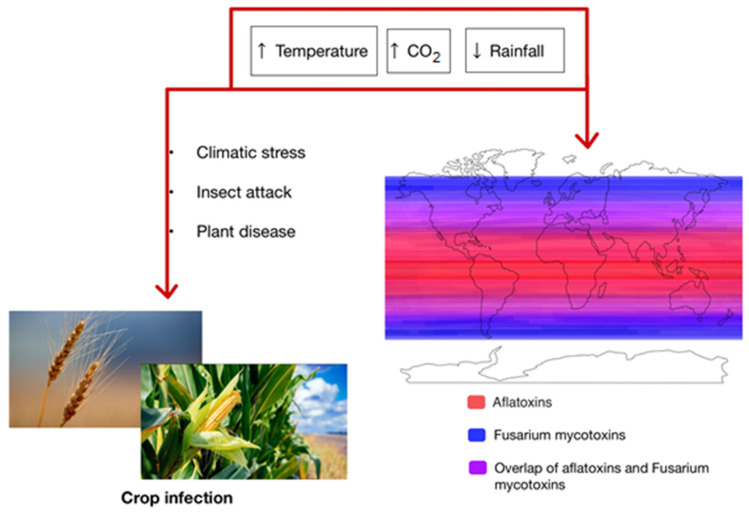
During the last decade, scientists have given increasingly frequent warnings about global warming, linking it to mycotoxin-producing moulds in various geographical regions across the world. In the future, more pronounced climate change could alter host resilience and host-pathogen interaction and have a significant impact on the development of toxicogenic moulds and the production of their secondary metabolites, known as mycotoxins. The current climate attracts attention and calls for novel diagnostic tools and notions about the biological features of agricultural cultivars and toxicogenic moulds. Since European climate environments offer steadily rising opportunities for Aspergillus flavus growth, an increased risk of cereal contamination with highly toxic aflatoxins shall be witnessed in the future. On top of that, the profile (representation) of certain mycotoxigenic Fusarium species is changing ever more substantially, while the rise in frequency of Fusarium graminearum contamination, as a species which is able to produce several toxic mycotoxins, seen in northern and central Europe, is becoming a major concern. In the following paper, a high-quality approach to a preventative strategy is tailored to put a stop to the toxicogenic mould- and mycotoxin-induced contamination of foods and feeds in the foreseeable future.
Keywords: environmental conditions; geographic regions; global warming; moulds; mycotoxins; prediction; prevention.
Conflict of interest statement
The authors declare no conflict of interest.
Figures
References
-
- CAST . Mycotoxins: Risks in Plant, Animal, and Human Systems, Task Force Report, No. 139. Council Agricultural Science and Technology; Ames, IA, USA: 2003.
-
- International Agency for Research on Cancer . IARC Monograph on the Evaluation of Carcinogenic Risks to Humans. Volume 56. World Health Organization, IARC; Lyon, France: 1993. Some naturally occurring substances: Food items and constituents, heterocyclic aromatic amines and mycotoxins; pp. 1–609.
-
- International Agency for Research on Cancer . Chemical Agents and Related Occupations, a Review of Human Carcinogens in IARC Monograph on the Evaluation of Carcinogenic Risk to Humans. Volume 100F. World Health Organization, IARC; Lyon, France: 2012. pp. 1–628.
-
- Pleadin J., Vulić A., Perši N., Škrivanko M., Capek B., Cvetnić Ž. Aflatoxin B1 occurrence in maize sampled from Croatian farms and feed factories during 2013. Food Control. 2014;40:286–291. doi: 10.1016/j.foodcont.2013.12.022. - DOI
-
- Pleadin J., Markov K., Frece J., Vulić A., Perši N. Bio-Prevalence, determination and reduction of aflatoxin B1 in cereals. In: Faulkner A.G., editor. Aflatoxins: Food Sources, Occurrence and Toxicological Effects. Nova Science Publishers; Hauppauge, NY, USA: 2014. pp. 1–34.
Publication types
LinkOut - more resources
Full Text Sources
